Imagine a country where a single authority makes all the laws, enforces them, and also decides whether they were broken. Sounds terrifying, right? That is precisely the kind of unchecked power the Doctrine of Separation of Powers was designed to prevent. In a democracy as vast and diverse as India, the need for a well-functioning, independent judiciary is not just a legal formality — it is the backbone of freedom itself.
The Indian judiciary stands as one of the most powerful and complex judicial systems in the world. From a remote village in Rajasthan to a corporate boardroom in Mumbai, the reach of Indian courts touches every citizen's life. Yet, despite its significance, many people — including students, young professionals, and everyday citizens — remain unaware of how this system works, what constitutional principles guide it, and how it balances power with the legislature and executive.
Introduction to Indian Judiciary
Historical Evolution of Indian Judiciary
The Indian judiciary did not emerge overnight. Its roots trace back to the colonial era when the British established formal courts to administer justice across their Indian territories. The Regulating Act of 1773 established the Supreme Court of Judicature at Calcutta, marking the first time a formal apex court was introduced in India. This was followed by High Courts under the Indian High Courts Act of 1861, which replaced the earlier Supreme Courts and Sadar Adalats.
Post-independence in 1947, the framers of the Indian Constitution took the best elements of colonial judicial structure and reformed them to suit a sovereign, democratic republic. The Constitution of India, which came into force on January 26, 1950, established an integrated judicial system with the Supreme Court at its apex. This was a deliberate and visionary choice — a unified court hierarchy that could interpret the Constitution uniformly across the entire country.
Key points in the historical evolution:
- 1773: Establishment of the first Supreme Court at Calcutta under British rule
- 1861: High Courts Act created a formal appellate structure in India
- 1935: Government of India Act introduced a Federal Court, a precursor to the Supreme Court
- 1950: The Constitution of India established the Supreme Court of India as the apex judicial body
- Post-1950: Gradual development of PIL, judicial review, and constitutional interpretation doctrines
Structure of Indian Judicial System
India follows a three-tier hierarchical judicial structure. At the top sits the Supreme Court of India in New Delhi, which serves as the final court of appeal and the guardian of the Constitution. Below it are the High Courts, one for each state or a group of states, which handle appeals and have original jurisdiction in certain matters. At the base are the District Courts, followed by Sub-Divisional Courts and various specialized tribunals.
The structure operates on the principle of a unified hierarchy, meaning that every court in India is ultimately subordinate to the Supreme Court. This ensures constitutional consistency and prevents conflicting legal interpretations across states.
- Supreme Court: Final interpreter of the Constitution; has original, appellate, and advisory jurisdiction
- High Courts: State-level appellate courts with supervisory powers over subordinate courts
- District and Sessions Courts: Handle most civil and criminal cases at the grassroots level
- Tribunals and Special Courts: Address specific domains such as taxation, armed forces, and consumer disputes
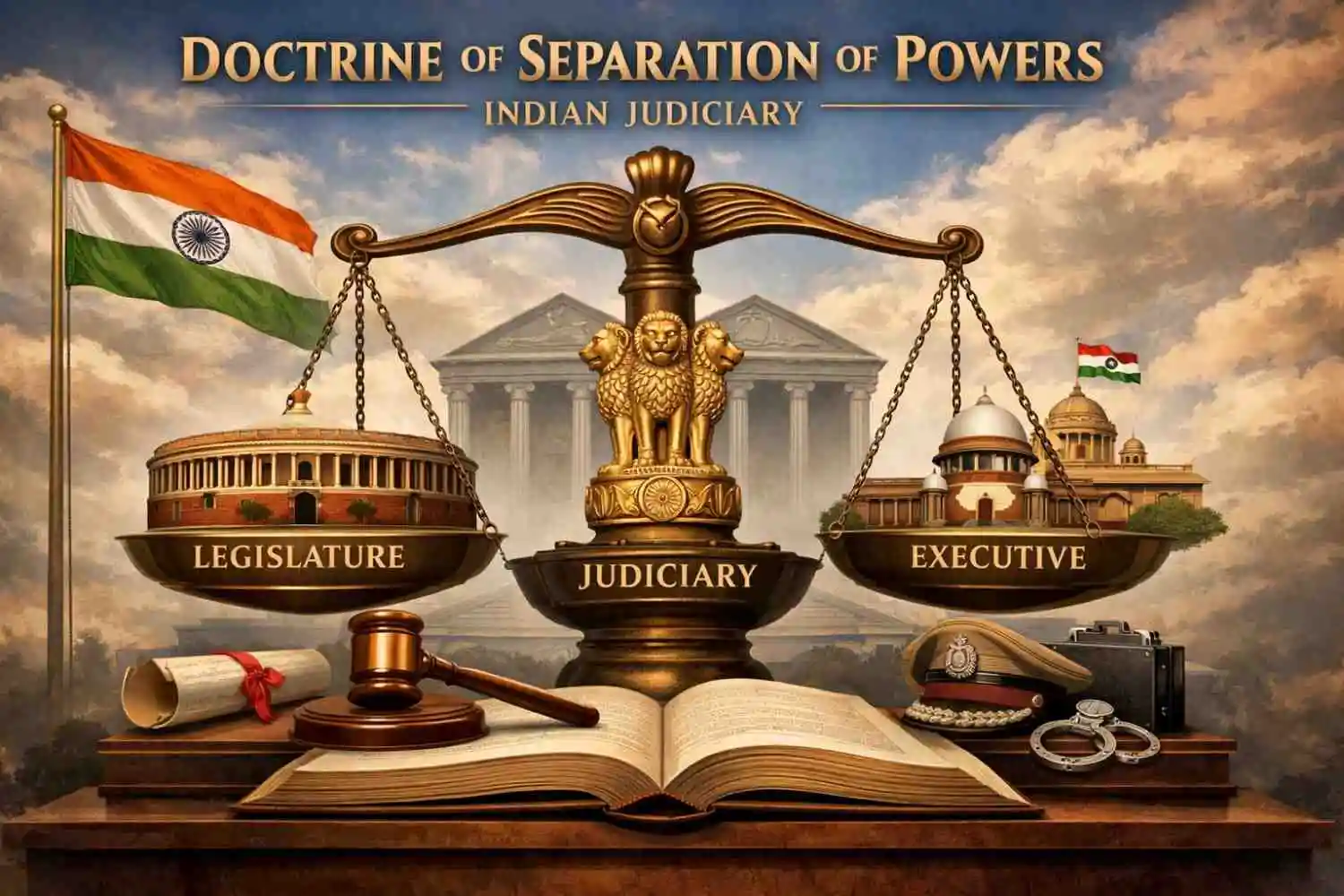
Understanding the Doctrine of Separation of Powers
Origin of the Doctrine
The Doctrine of Separation of Powers is not an Indian invention. It is a political philosophy with roots in ancient Greek thought, later refined by French philosopher Montesquieu in his 1748 work "The Spirit of the Laws." Montesquieu argued that to prevent tyranny, the powers of government must be divided among three independent institutions — the legislature, the executive, and the judiciary. This idea profoundly influenced the framers of the American Constitution and, subsequently, the Indian Constitution.
In India, while the doctrine was not adopted in its pure form, its spirit was firmly embedded in the constitutional structure. The framers drew from both the British parliamentary model and the American federal model to create a hybrid system that distributes power while maintaining functional coordination.
Meaning and Significance
At its core, the Doctrine of Separation of Powers means that the three organs of government must have clearly defined and non-overlapping functions. The legislature makes laws, the executive implements those laws, and the judiciary interprets them. No single branch should perform functions that inherently belong to another.
In India, this doctrine has a modified application. Unlike the United States, where separation is rigid, India practices a functional separation with cooperative overlap. The President, for instance, is part of the legislature and also the executive head. Ministers must be members of the legislature. These structural overlaps are intentional design choices, not flaws.
Key reasons why this doctrine matters:
- It prevents concentration of power in a single authority
- It ensures accountability of each branch to the Constitution
- It protects citizens' fundamental rights from arbitrary state action
- It enables judicial review of legislative and executive actions
- It promotes democratic governance and rule of law
Constitutional Framework in India
Articles Supporting Separation of Powers
The Indian Constitution does not explicitly use the phrase "separation of powers," but the principle is woven throughout its fabric. Articles 50, 121, 122, 211, and 212 reflect specific separations between organs. Article 50 directs the state to separate the judiciary from the executive in public services. Article 121 restricts parliamentary debate on the conduct of Supreme Court and High Court judges. Article 122 bars courts from questioning the validity of parliamentary proceedings.
Additionally, Part V (Union) and Part VI (States) clearly delineate the powers and functions of the legislature, executive, and judiciary at both central and state levels.
- Article 50: Mandates separation of judiciary from executive in public services
- Articles 52–78: Define the Union Executive (President, Vice-President, Council of Ministers)
- Articles 79–122: Establish Parliament and its legislative powers
- Articles 124–147: Constitute the Supreme Court and define its jurisdiction
- Articles 214–237: Establish the High Courts across the states
Role of Constitution as Supreme Law
India follows the principle of constitutional supremacy. Unlike the United Kingdom, where parliamentary sovereignty is supreme, in India, no law passed by Parliament can override the Constitution. The judiciary — particularly the Supreme Court — is the ultimate arbiter of constitutional validity. This gives the judiciary an indispensable role in maintaining the separation of powers. If any law violates constitutional provisions, the courts can strike it down, regardless of the majority that passed it.
Role of Judiciary in Separation of Powers
Judicial Review
Judicial review is perhaps the most powerful tool the Indian judiciary possesses. It is the power of the courts to examine whether a law or executive action is consistent with the Constitution. If found to be in conflict, the court can declare it null and void. This power is not explicitly mentioned in the Constitution but is implied through Articles 13, 32, and 226.
The Supreme Court has consistently used this power to protect fundamental rights, invalidate unconstitutional amendments, and check executive overreach.
- Article 13: Laws inconsistent with fundamental rights are void
- Article 32: Guarantees right to constitutional remedies through the Supreme Court
- Article 226: Empowers High Courts to issue writs for enforcement of fundamental rights
Judicial Activism
Judicial activism refers to the tendency of courts to go beyond mere interpretation of law and actively shape public policy through their rulings. In India, this phenomenon gained momentum in the 1970s and 1980s. The relaxation of locus standi rules gave birth to Public Interest Litigation (PIL), allowing any citizen to approach the Supreme Court on behalf of the public interest.
Cases on prison reform, environmental pollution, bonded labour, and child labour were brought through PIL, fundamentally changing how the judiciary interacts with society.
Checks and Balances in India
Legislature vs Executive
The legislature and the executive share a close but constitutionally regulated relationship in India. The Council of Ministers is collectively responsible to the Lok Sabha. If the government loses the confidence of the House, it must resign. This mechanism ensures that the executive remains accountable to elected representatives of the people.
Judiciary vs Legislature
The judiciary checks the legislature by invalidating laws that violate the Constitution. The legislature, in turn, can amend the Constitution to overcome judicial decisions — but only within the limits set by the basic structure doctrine. This creates a productive tension that forces both branches to remain constitutionally responsible.
Executive vs Judiciary
The executive appoints judges to the Supreme Court and High Courts, but the collegium system — a creation of the judiciary itself — ensures that the executive cannot unilaterally control judicial appointments. The judiciary, on the other hand, can issue writs against executive actions and strike down arbitrary executive orders.
Landmark Judgments
Kesavananda Bharati Case (1973)
This is arguably the most important constitutional judgment in Indian history. In Kesavananda Bharati v. State of Kerala, a 13-judge bench of the Supreme Court held that while Parliament has wide powers to amend the Constitution under Article 368, it cannot alter the "basic structure" of the Constitution. This basic structure doctrine is a powerful check on legislative power and remains the cornerstone of Indian constitutional law.
Indira Gandhi v. Raj Narain (1975)
In this case, the Supreme Court struck down the 39th Constitutional Amendment, which had sought to immunize the Prime Minister's election from judicial review. The Court held that this was a violation of the basic structure doctrine, specifically the principle of free and fair elections and the rule of law. This judgment reaffirmed judicial independence and the separation of powers even at the highest levels of political authority.
Challenges in Implementation
Judicial Overreach
While judicial activism has often been celebrated, it also raises concerns about judicial overreach — situations where courts go beyond their constitutional mandate and enter the domain of the legislature or executive. Critics argue that the judiciary sometimes takes on a policy-making role that belongs to elected institutions, which can undermine democratic accountability.
Political Influence
Despite constitutional safeguards, political influence over judicial appointments and administration remains a persistent challenge. The collegium system, while designed to insulate the judiciary, has itself faced criticism for lack of transparency. The debate over the National Judicial Appointments Commission (NJAC), which was struck down by the Supreme Court in 2015, highlighted the ongoing tension between judicial independence and executive accountability.
Importance in Modern Democracy
Protecting Fundamental Rights
In a country with deep social inequalities, economic disparities, and diverse communities, the judiciary serves as the last line of defense for fundamental rights. The Supreme Court has expanded the scope of Article 21 (Right to Life) to include rights to education, health, livelihood, privacy, and dignity. Without an independent judiciary, these rights would remain theoretical promises.
Ensuring Accountability
The doctrine of separation of powers, as upheld by the Indian judiciary, ensures that no branch of government operates without checks. From CBI investigations to electoral disputes, the courts have stepped in repeatedly to ensure that power is exercised responsibly, lawfully, and transparently. This accountability function is what makes India's democracy genuinely functional rather than merely procedural.
FAQs
1. What is the Doctrine of Separation of Powers in India?
The Doctrine of Separation of Powers in India refers to the division of governmental authority among three independent organs — the legislature, executive, and judiciary. While India does not follow a strict separation as in the United States, the Constitution ensures functional separation through specific articles and a system of checks and balances designed to prevent any single institution from accumulating unchecked power.
2. Is the Doctrine of Separation of Powers explicitly mentioned in the Indian Constitution?
No, the Indian Constitution does not explicitly mention the Doctrine of Separation of Powers. However, the principle is implied throughout its provisions. Articles 50, 121, 122, 211, and various other articles reflect the spirit of this doctrine by restricting the functions of one branch from interfering with the domain of another.
3. What is the Basic Structure Doctrine and why is it important?
The Basic Structure Doctrine, established in the Kesavananda Bharati case of 1973, holds that Parliament cannot amend the Constitution in a way that destroys its fundamental framework. Elements like judicial independence, rule of law, and fundamental rights are part of this basic structure. It is crucial because it limits legislative power and safeguards constitutional integrity.
4. What is the difference between judicial review and judicial activism?
Judicial review is the constitutional power of courts to examine whether laws or executive actions violate the Constitution and strike them down if necessary. Judicial activism, on the other hand, refers to a broader, more proactive approach where courts use their authority to address systemic issues, often through public interest litigation, sometimes overlapping with policymaking functions of the other branches.
5. How does the Indian judiciary ensure separation of powers in practice?
The Indian judiciary ensures separation of powers by exercising judicial review, maintaining the basic structure doctrine, hearing PILs on constitutional violations, issuing writs against arbitrary executive actions, and maintaining its independence through the collegium system for judicial appointments. Landmark judgments have repeatedly reinforced the boundaries between the three branches of government.
Conclusion
The Indian Judiciary and the Doctrine of Separation of Powers are not just academic concepts confined to textbooks — they are living principles that shape the governance and daily life of over a billion people. From the historic ruling in Kesavananda Bharati to the everyday functioning of district courts, the separation and balance of powers define the constitutional soul of India.
Understanding this relationship empowers citizens to hold the government accountable, appreciate the role of an independent judiciary, and recognize the genius of the constitutional framework that India's founders painstakingly designed. While challenges like judicial overreach and political influence remain, the overall framework has proven remarkably resilient. India's democracy continues to function because no single branch has been allowed to dominate the others entirely.
As you reflect on these ideas, remember that the strength of a democracy lies not in its laws alone but in the institutions and citizens who uphold them. The separation of powers is not an obstacle to effective governance — it is the very foundation that makes just and accountable governance possible.
Click below to generate summary