Introduction to National Maritime Day
Picture a nation surrounded by over 7,500 kilometres of coastline, dotted with some of the world's busiest ports, and powered by a maritime legacy stretching back thousands of years. Now ask yourself — how often do we pause to celebrate the sailors, shipbuilders, port workers, and navigators who keep this vast ocean economy running? The honest answer, for most Indians, is not often enough.
Here is the problem: despite India's extraordinary maritime history and its growing dependence on sea-based trade — nearly 95% of the country's trade by volume moves through its ports — public awareness of the maritime sector remains surprisingly thin. Students rarely learn about it in schools, professionals outside the industry seldom track its developments, and policy conversations get buried beneath louder debates.
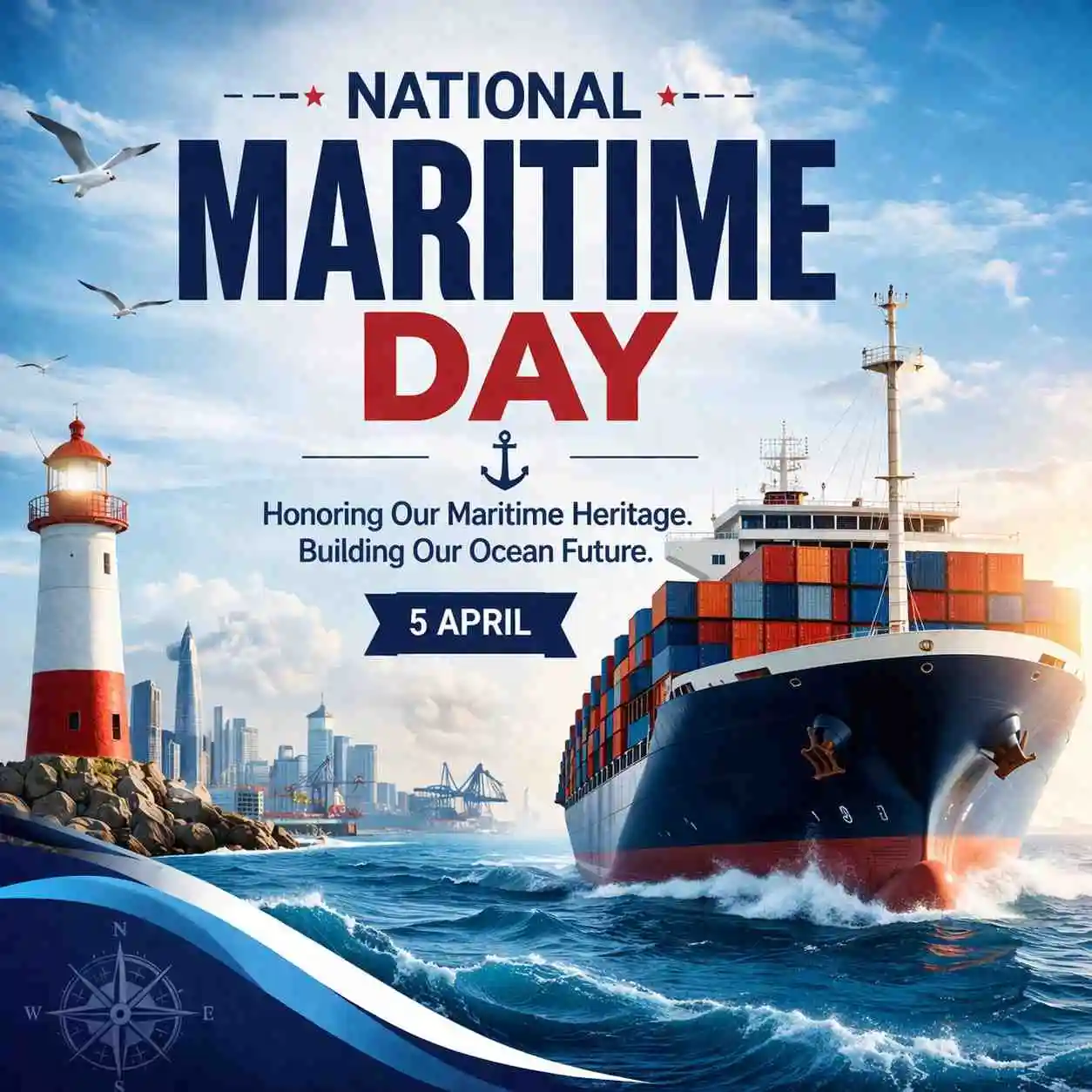
National Maritime Day, observed every year on 5 April, is India's answer to this knowledge gap. Established in 1964, it is a day dedicated to honouring the sea, the people who work on it, and the commerce that flows through it. It reminds every Indian that the nation's prosperity is deeply tied to its oceans.
"The ocean is not India's boundary — it is India's opportunity."
History and Origin of National Maritime Day
The roots of National Maritime Day trace back to a single, transformative voyage that changed the course of Indian shipping history. Before discussing that pivotal moment, it helps to understand the broader canvas. India had been a seafaring nation for millennia, but under British colonial rule, sea trade was effectively monopolised by foreign shipping companies. After independence in 1947, building an indigenous merchant navy became both an economic and a national priority.
The Government of India formally established National Maritime Day in 1964, choosing 5 April as the date. The choice was deeply symbolic — it commemorated the anniversary of the very first voyage made by an Indian-owned ship under India's national flag. That ship was the SS Loyalty, and its journey in 1919 marked the beginning of India's modern maritime identity.
Key Historical Milestones
- 1919 — SS Loyalty makes its historic maiden voyage under the Indian flag, operated by The Scindia Steam Navigation Company.
- 1947 — India gains independence and prioritises building a self-reliant merchant fleet.
- 1964 — The Government formally institutes National Maritime Day on 5 April.
- 2016 — The Sagarmala Programme is launched to modernise ports and coastal infrastructure.
- Today — India operates over 12 major ports and 200 non-major ports along its vast coastline.
The Story of SS Loyalty
The SS Loyalty was not just a ship — it was a statement of Indian ambition. Owned by The Scindia Steam Navigation Company, founded by the visionary industrialist Walchand Hirachand, the ship sailed on 5 April 1919 on a journey that would become a defining chapter in Indian maritime history. At a time when British shipping companies controlled virtually all sea-borne commerce involving India, this voyage represented bold commercial defiance.
Walchand Hirachand faced immense pressure from colonial authorities and competitors who preferred to keep Indian entrepreneurs away from the lucrative shipping business. Despite these obstacles, he persisted. The Scindia Steam Navigation Company went on to become a cornerstone of independent India's shipping sector. The ship's name itself — Loyalty — carries a poignant resonance: loyalty to the nation, to the sea, and to the dream of self-reliance.
Why National Maritime Day Matters
To understand why National Maritime Day carries such weight, one needs to appreciate just how central the maritime sector is to India's functioning as a modern economy and a geopolitical force. This is not merely a day of ceremonial speeches and award functions. It is a day that shines a light on an industry that silently underpins the lives of over a billion people.
Economic Importance
India's maritime sector is a silent giant of the national economy. Approximately 95% of India's trade by volume and around 68% by value is conducted through maritime routes. The country handles over 1,400 million metric tonnes of cargo annually across its major ports alone. The sector contributes significantly to GDP and is an essential enabler of India's export ambitions.
Economic Highlights
- Over 95% of India's international trade by volume is sea-borne.
- India has 12 major ports handling billions of tonnes of cargo annually.
- The maritime sector directly and indirectly employs millions of Indians.
- Port-led development drives growth in coastal districts and hinterland regions.
- India's shipping fleet is one of the largest in Asia.
Strategic Importance
Beyond economics, India's maritime domain is a theatre of geopolitics. Located at the crossroads of major global shipping lanes — with the Arabian Sea to the west, the Bay of Bengal to the east, and the Indian Ocean at its base — India occupies a position of unique strategic significance. Control over these waters is essential for national security, regional influence, and energy security, as much of India's oil and gas imports travel by sea.
National Maritime Day draws attention to this strategic reality, encouraging investments in the Indian Navy, the Coast Guard, maritime surveillance, and port security infrastructure. It also highlights India's active participation in international maritime conventions and its role as a responsible maritime nation on the global stage.
India's Maritime Heritage
India's relationship with the sea is not a modern development — it is ancient, rich, and deeply woven into the cultural fabric of the subcontinent. Long before the age of steam engines and container ships, Indian merchants, navigators, and fishermen were masters of their maritime environment. Understanding this heritage adds profound depth to every National Maritime Day celebration.
Ancient Trade Routes
Archaeological evidence from the Indus Valley Civilisation — particularly at Lothal in present-day Gujarat — shows that India had a structured dock as far back as 2400 BCE. Indian traders sailed to Mesopotamia, Arabia, East Africa, and Southeast Asia centuries before the Common Era began. The ancient Tamil texts known as the Sangam literature are filled with vivid descriptions of busy ports, merchant ships, and thriving international commerce.
The spice trade, driven largely from India's Malabar Coast, was one of the most powerful economic forces in the ancient and medieval world. Arab, Chinese, and later European traders all sought access to Indian ports. This maritime heritage demonstrates that India's oceanic identity is not borrowed — it is indigenous and millennia-old.
Ancient Maritime Facts Worth Celebrating
- Lothal (2400 BCE) had one of the world's first known enclosed docks.
- Ancient Indian ships sailed to Rome, Arabia, and East Africa regularly.
- India supplied over 50% of the global spice trade for centuries.
- The Chola dynasty (9th–13th CE) commanded a powerful naval empire across Southeast Asia.
- The Malabar Coast was the most sought-after trading hub in the medieval world.
Colonial Era and Modern Shipping
The colonial period brought mixed consequences for Indian maritime activity. On one hand, the British developed port infrastructure at Bombay, Calcutta, and Madras to serve their commercial interests. On the other hand, indigenous shipbuilding traditions were deliberately suppressed to benefit British shipyards. Post-independence, India had to rebuild its merchant fleet almost from scratch — a task made significantly harder by entrenched foreign shipping dominance.
Determined policy action, nationalisation of key shipping companies, and investments in indigenous shipbuilding led to steady growth. Today, Indian shipping companies own and operate hundreds of vessels, and Indian maritime academies train thousands of seafarers annually who serve on ships across the globe.
Significance in Today's Economy
In the 21st century, the maritime sector has evolved into a sophisticated, technology-driven industry that is central to India's ambitions of becoming a five-trillion-dollar economy. National Maritime Day in the contemporary context is as much about the future as it is about the past — celebrating innovation, infrastructure, and the professionals who drive the industry forward every day.
Ports and Global Trade
India's 12 major ports — including Jawaharlal Nehru Port (JNPT) in Navi Mumbai, the Port of Mumbai, Kandla, Chennai, and Vishakhapatnam — together handle an enormous volume of containers, bulk cargo, crude oil, and finished goods. JNPT alone ranks among the top container ports in South Asia. Beyond the major ports, over 200 intermediate and minor ports handle coastal shipping and fishing, supporting millions of livelihoods.
Ports are not just gateways — they are engines of regional development. Special Economic Zones clustered around ports have transformed coastal areas into industrial hubs. Government-led port modernisation drives — deeper berths for larger vessels, digital customs clearance — have significantly reduced turnaround times, making Indian ports far more competitive globally.
Employment and Careers
The maritime industry is one of India's most underappreciated sources of high-skill employment. From deck officers and marine engineers to port logistics managers, naval architects, and maritime lawyers, the sector offers career pathways that are financially rewarding and globally mobile. Indian seafarers are among the most respected in the world, serving on vessels operated by leading international shipping lines.
Career Opportunities in the Maritime Sector
- Deck Officers and Ship Masters — responsible for navigation and vessel operation.
- Marine Engineers — maintain and operate onboard machinery and propulsion systems.
- Port Operations Managers — oversee cargo handling, logistics, and terminal efficiency.
- Naval Architects — design and engineer modern vessels and offshore structures.
- Maritime Lawyers — handle shipping contracts, international disputes, and compliance.
- Hydrographers and Marine Scientists — map ocean floors and monitor marine ecosystems.
Challenges in the Maritime Sector
No industry thrives without confronting its challenges, and the maritime sector is no exception. National Maritime Day is also an occasion to honestly assess the difficulties the industry faces and to recommit to addressing them with innovation and policy vigour. Two of the most pressing challenges — environmental sustainability and maritime security — deserve particular attention.
Environmental Concerns
The shipping industry is a significant contributor to global greenhouse gas emissions, responsible for approximately 2.5 to 3% of worldwide CO₂ output. For India, rapid port expansion and increased shipping traffic also bring risks of oil spills, marine pollution, and damage to coastal ecosystems. The Coastal Regulation Zone (CRZ) rules attempt to balance development with ecological protection, but enforcement remains a challenge in many areas.
India has been actively aligning its maritime policies with International Maritime Organization (IMO) standards on sulphur emissions, ballast water management, and ship recycling. The Alang ship-breaking yard in Gujarat — one of the largest in the world — has undergone reforms to improve environmental and worker safety standards. Green shipping corridors, LNG-powered vessels, and solar-assisted ships are gradually entering India's maritime conversation.
Security Risks
Maritime security is a multidimensional challenge for India. Piracy — particularly in the Gulf of Aden and off the Somali coast — affects Indian-flagged and Indian-crewed vessels on international routes. Closer to home, the threat of sea-borne terrorism was graphically illustrated by the 2008 Mumbai attacks. Since then, India has dramatically strengthened coastal surveillance, radar networks, and multi-agency coordination.
Smuggling of contraband — including narcotics, weapons, and counterfeit goods — through maritime routes remains an ongoing concern. Drug trafficking through the Arabian Sea and the Bay of Bengal has intensified, demanding greater vigilance from the Indian Coast Guard and naval forces. National Maritime Day serves as a reminder that keeping India's waters secure is as important as keeping them commercially active.
National Maritime Day Celebrations
Every year on 5 April, India marks National Maritime Day with events that blend ceremony, education, and industry engagement. The Directorate General of Shipping coordinates the national observance, and events take place in major port cities — Mumbai, Chennai, Kolkata, Kochi, and Visakhapatnam among them.
A highlight of the celebrations is the presentation of National Maritime Awards, which recognise outstanding contributions by individuals and organisations to the shipping, ports, and seafaring community. Maritime academies hold open days and competitions. Port trusts organise public exhibitions that give ordinary citizens a glimpse into shipping operations. School and college events focus on ocean awareness, environmental conservation, and career opportunities at sea.
How National Maritime Day Is Celebrated
- National Maritime Awards presented to exemplary contributors to the industry.
- Seminars and conferences on maritime trade, technology, and policy.
- Sea cadet parades and displays by Indian Naval and Coast Guard units.
- Educational events in schools and maritime academies raising ocean awareness.
- Port open days for the public to experience shipping operations firsthand.
- Online campaigns and social media initiatives to spread maritime awareness nationally.
Government Initiatives
The Indian government has placed maritime development at the heart of its long-term economic planning. A series of bold policy initiatives has been rolled out over the past decade, reflecting a clear understanding that India's potential as a global maritime power is far from fully realised.
The Sagarmala Programme, launched in 2016, is perhaps the most ambitious maritime initiative in independent India's history. It aims to modernise ports, develop port-led industrialisation zones, enhance coastal shipping, and improve connectivity linking ports to hinterlands. Under this programme, hundreds of projects worth lakhs of crores of rupees are at various stages of planning and execution.
Key Government Initiatives in Maritime Development
- Sagarmala Programme — port modernisation, coastal shipping, and port-led industrialisation.
- Maritime India Vision 2030 — a comprehensive roadmap for the next decade of maritime growth.
- National Logistics Policy — reducing logistics costs and improving supply chain efficiency.
- Indian Maritime University — standardising and upgrading maritime education nationwide.
- Green Port initiatives — promoting sustainability and renewable energy at ports.
- Inland Waterways development — shifting cargo from congested roads to waterways.
Maritime India Vision 2030, unveiled in 2021, sets ambitious targets: making India a top maritime nation, positioning Indian ports among the world's most efficient, and significantly growing the blue economy's contribution to national income. These are not just aspirational goals — they are backed by concrete investment commitments and sweeping regulatory reforms.
Future of India's Maritime Industry
The future of India's maritime industry is genuinely exciting, and National Maritime Day offers the perfect lens through which to look ahead. Three powerful forces — technology, geopolitics, and sustainability — are converging to reshape the maritime landscape, and India is increasingly well-positioned to benefit from each of them.
Technologically, ports are becoming smart. Automated cranes, AI-driven logistics platforms, drone surveillance, and blockchain-based documentation are already transforming how major ports operate. India's JNPT has been a pioneer in adopting port automation, and others are following suit. Digitisation of customs processes under the ICEGATE platform has already cut clearance times dramatically, making Indian ports more competitive with global benchmarks.
Geopolitically, as global supply chains seek to diversify — a trend accelerated by the disruptions of the COVID-19 pandemic — India is positioned as an attractive alternative manufacturing and transit hub. The India-Middle East-Europe Economic Corridor (IMEC), announced in 2023, could redirect significant maritime trade flows through Indian ports, opening an era of unprecedented opportunity.
Future Drivers of India's Maritime Growth
- Smart port technology — automation, AI, and IoT transforming port operations end to end.
- Green shipping — LNG, hydrogen, and ammonia-powered vessels for sustainable voyages.
- IMEC Corridor — positioning India as a pivot for global east-west trade flows.
- Blue economy expansion — deep-sea mining, offshore energy, and marine biotechnology.
- Maritime tourism — cruise ship infrastructure and coastal tourism development.
- Skilled seafarer demand — growing global appetite for trained Indian maritime professionals.
On sustainability, India's commitment to a green maritime future is growing. The government has set targets for reducing carbon emissions from shipping, and private shipowners are increasingly investing in fuel-efficient and alternative-fuel vessels. The development of coastal shipping corridors to take trucks off congested national highways is also gaining momentum — a shift that benefits logistics costs, carbon emissions, and road safety simultaneously.
FAQs
Q1. What is National Maritime Day and when is it celebrated?
National Maritime Day is an annual observance in India held every year on 5 April. It was established in 1964 to mark the anniversary of the historic maiden voyage of the SS Loyalty in 1919 — the first voyage of an Indian-owned ship under the national flag. The day honours India's maritime heritage, celebrates its seafarers, and raises awareness of the critical role of the shipping and ports sector in the national economy.
Q2. Why is the SS Loyalty historically significant?
The SS Loyalty, operated by The Scindia Steam Navigation Company founded by Walchand Hirachand, sailed on 5 April 1919 — the first time an Indian-owned ship sailed under the Indian flag. This voyage broke the British colonial monopoly on sea trade involving India. It symbolised India's aspiration for maritime self-reliance and became the foundational story on which National Maritime Day is commemorated every year.
Q3. What is the Sagarmala Programme?
The Sagarmala Programme is a flagship Indian government initiative launched in 2016 to harness India's 7,500-kilometre coastline for economic development. It focuses on four pillars: port modernisation, port-led industrialisation through Coastal Economic Zones, improving port connectivity via roads, rail, and inland waterways, and coastal community development. It represents the most comprehensive investment in India's maritime infrastructure since independence.
Q4. What career opportunities exist in India's maritime industry?
India's maritime sector offers diverse career paths — from deck officers, marine engineers, and ship masters who work aboard merchant vessels worldwide, to onshore roles in port operations management, maritime law, naval architecture, ship surveying, marine insurance, and logistics. Indian maritime professionals are globally sought after, making this one of the best avenues for internationally mobile, well-compensated careers in engineering and management.
Q5. What is India's blue economy and why does it matter?
India's blue economy refers to the sustainable use of ocean resources for economic growth and improved livelihoods. It encompasses maritime trade, fisheries, aquaculture, offshore oil and gas, marine biotechnology, coastal tourism, deep-sea mining, and marine renewable energy. As one of the largest maritime nations in Asia, India's blue economy potential is vast — and fully realising it is central to the country's long-term growth strategy and global standing.
Conclusion
National Maritime Day is far more than a date on a calendar. It is a national reminder that India is, at its core, a maritime civilisation — one that sailed to distant shores when much of the world was still confined to its own horizons, one that fought colonial suppression to reclaim its seafaring identity, and one that is now striving to build a world-class maritime industry worthy of its 7,500-kilometre coastline and its vast oceanic neighbourhood.
From the historic voyage of the SS Loyalty in 1919 to the ambitious targets of Maritime India Vision 2030, the journey of India's maritime sector is a story of resilience, ambition, and quiet achievement. The sailors who spend months away from their families to keep global trade flowing, the engineers who keep ports running, the policymakers crafting complex regulatory frameworks, and the students who dream of a career at sea — all of them deserve the recognition that National Maritime Day provides.
As India charts its course toward becoming a leading global economy, its maritime sector will be one of the most powerful engines driving that journey. The ocean is not India's boundary — it is India's opportunity. National Maritime Day asks each of us to look at the sea and see possibility.
Click below to generate summary