Click below to generate summary
Why Mesopotamia Still Matters Today
Imagine a world without cities, written laws, calendars, or even the concept of time measured in hours. Hard to picture, right? Now imagine a group of people, thousands of years ago, deciding to build all of those things from scratch — not because a blueprint existed, but because necessity, ingenuity, and community drove them forward. That is exactly what happened in ancient Mesopotamia, and understanding this civilization is nothing short of unlocking the origin story of human society itself.
Mesopotamia, a Greek word meaning "land between the rivers," refers to the fertile region nestled between the Tigris and Euphrates rivers in what is modern-day Iraq, parts of Syria, Turkey, and Kuwait. This region is widely regarded by historians, archaeologists, and scholars as the "Cradle of Civilization" — the birthplace of some of humanity's most transformative achievements. We are talking about the world's first cities, the earliest known writing system, the first codified legal system, and sophisticated religious structures that influenced faiths and philosophies for millennia.
The Geography That Made Civilization Possible
Before we explore the people and empires of Mesopotamia, we need to understand the land itself — because geography was not just a backdrop here. It was the engine that drove everything.
The Tigris and Euphrates rivers flow from the mountains of modern-day Turkey southward through Iraq and into the Persian Gulf. Every year, these rivers flooded their banks, depositing rich silt across the surrounding plains. This silt made the soil extraordinarily fertile — capable of producing agricultural surpluses that could feed not just individual families, but entire communities. When people can produce more food than they personally consume, something remarkable happens: they have time. Time to specialize. Time to trade. Time to think, govern, invent, and build.
The region between these rivers, especially the southern zone known as Sumer, became the cradle of early urban life. Unlike Egypt's single predictable Nile flood, however, the Tigris and Euphrates were more volatile and unpredictable. Managing these rivers required coordinated irrigation systems, which in turn required governance, record-keeping, and organized labor. In other words, the rivers essentially forced Mesopotamians to develop complex social structures — or face famine and chaos.
The lack of natural barriers like mountains also meant that Mesopotamia was frequently invaded and culturally blended — a factor that contributed to its dynamic and ever-evolving civilizational story.
Key Insights:
- The Tigris and Euphrates rivers provided annual floods that enriched the soil for agriculture
- Agricultural surpluses freed people to specialize in crafts, governance, trade, and religion
- Unpredictable flooding required complex irrigation and organized governance
- The open geography encouraged cultural exchange but also frequent invasion and political change
- Southern Mesopotamia (Sumer) became the heartland of early urban civilization
The Sumerians — The World's First Civilization
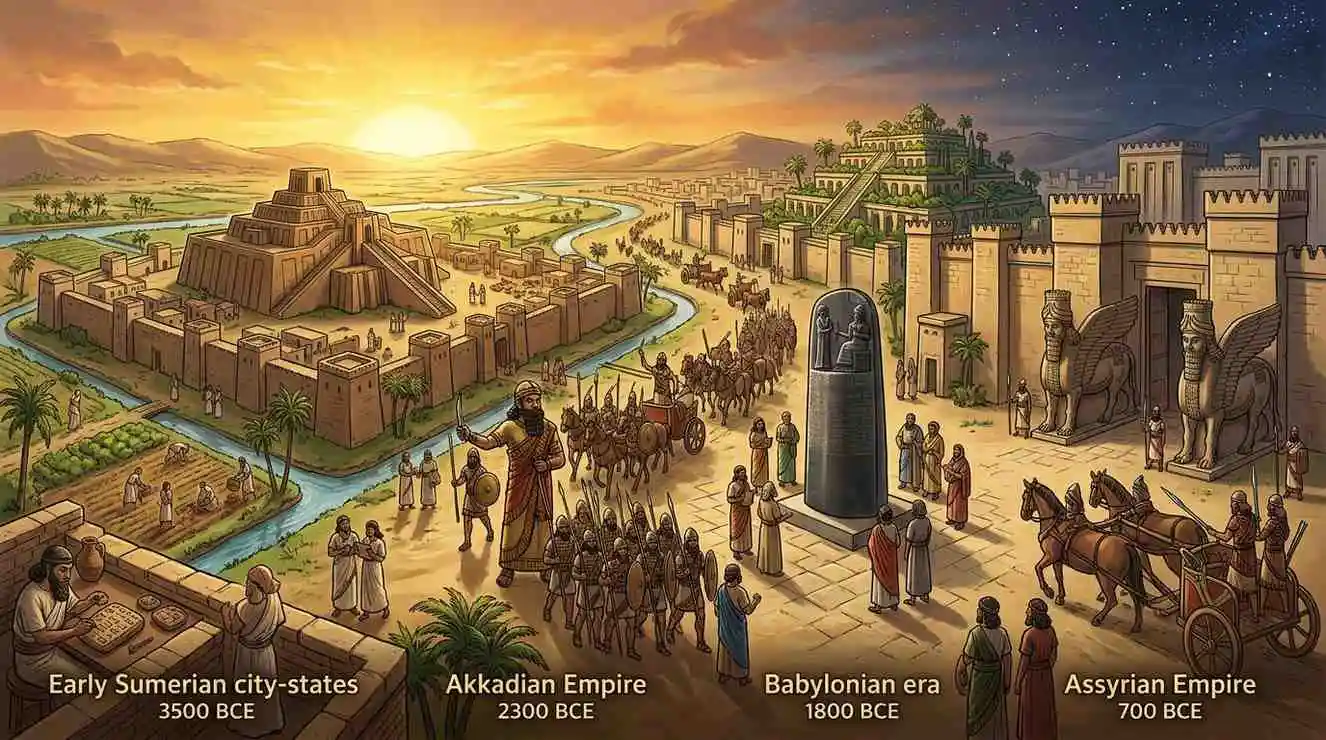
Around 4500–4000 BCE, a people known as the Sumerians began settling in southern Mesopotamia, in the region called Sumer. They are widely considered to have built the world's first true civilization — a claim backed by extraordinary archaeological evidence.
Sumerian city-states like Uruk, Ur, Eridu, and Lagash were not mere villages. Uruk, for example, had a population estimated between 40,000 and 80,000 people at its height — making it the largest city on Earth at the time. These cities featured monumental architecture, complex economies, distinct social classes, and organized religious institutions centered around massive temple structures called ziggurats.
The Sumerians are perhaps most famously credited with inventing cuneiform writing, one of the earliest writing systems ever developed. Beginning around 3200 BCE as a series of pictographic symbols pressed into clay tablets, cuneiform evolved into a sophisticated script capable of recording trade, laws, literature, and religious texts. It is through cuneiform tablets that we have recovered one of humanity's oldest stories — the Epic of Gilgamesh, a literary masterpiece that explores themes of friendship, mortality, and the search for eternal life.
Sumerians also pioneered early mathematics, the concept of a 60-minute hour, lunar calendars, and systems of weights and measures. Their administrative ingenuity laid the groundwork for everything that followed in the region.
Key Insights:
- Sumerian city-states like Uruk were among the largest human settlements on Earth circa 3000 BCE
- Cuneiform writing, developed around 3200 BCE, is one of humanity's earliest writing systems
- The Epic of Gilgamesh, a Sumerian text, is one of the world's oldest surviving literary works
- Sumerians invented the 60-minute hour and 60-second minute, still used globally today
- Ziggurats served as religious, economic, and administrative centers of Sumerian city-states
The Akkadian Empire — The World's First Empire
By around 2334 BCE, a powerful leader named Sargon of Akkad unified the Sumerian city-states under a single centralized rule, creating what historians recognize as the world's first empire. Sargon's Akkadian Empire stretched from the Persian Gulf to the Mediterranean coast — an unprecedented scale of political control for its time.
The Akkadians did not erase Sumerian culture; instead, they absorbed it. They adopted cuneiform writing and adapted it to their own Semitic language, Akkadian. They worshipped many of the same gods, continued building ziggurats, and maintained Sumerian trade networks. This cultural blending is a hallmark of Mesopotamian history — conquerors frequently became culturally absorbed by those they conquered.
Sargon's empire lasted roughly 180 years before it collapsed, likely due to a combination of climate change, drought, internal rebellions, and invasions by the Gutian people from the Zagros Mountains. His successors, particularly his grandson Naram-Sin, maintained the empire's reach for a time, but the Akkadian period ultimately gave way to a Sumerian revival known as the Third Dynasty of Ur (Ur III), which flourished around 2112–2004 BCE before itself falling to invasions.
Key Insights:
- Sargon of Akkad created the world's first known empire around 2334 BCE
- The Akkadian Empire blended with Sumerian culture rather than erasing it
- Naram-Sin, Sargon's grandson, was one of the first rulers in history to declare himself a god
- The Akkadian Empire's collapse may have been triggered in part by a prolonged drought around 2200 BCE
- The Ur III dynasty that followed briefly restored Sumerian cultural dominance before collapsing itself
Babylonia — The Golden Age of Ancient Mesopotamia
After the fall of the Ur III dynasty, Mesopotamia entered a period of fragmentation, with various city-states competing for dominance. Out of this chaos rose the city of Babylon, which would become the most celebrated city in ancient history.
Under Hammurabi (r. 1792–1750 BCE), Babylon unified most of Mesopotamia into the Old Babylonian Empire. Hammurabi is perhaps best remembered for the Code of Hammurabi, one of the oldest and most complete written legal codes ever discovered. Inscribed on a massive basalt stele, the code contained 282 laws governing everything from trade and property disputes to marriage, slavery, and criminal punishment. The famous principle of proportional justice — "an eye for an eye" — originates in this text.
Hammurabi's Babylon was also a thriving center of culture, commerce, and scholarship. Babylonian astronomers made extraordinary advances in mapping the stars, predicting eclipses, and developing early algebraic mathematics. Their astronomical records, painstakingly written on clay tablets, were so accurate that modern astronomers have used them to verify ancient celestial events.
After Hammurabi's death, Babylonia declined and was eventually sacked by the Hittites around 1595 BCE, ushering in a period of Kassite rule. But Babylon would rise again — most dramatically during the Neo-Babylonian Empire under Nebuchadnezzar II (r. 605–562 BCE), whose reign saw the construction of the legendary Hanging Gardens of Babylon and the conquest of Jerusalem.
Key Insights:
- Hammurabi's Code is one of the earliest comprehensive legal systems ever discovered
- Babylonian astronomers laid the groundwork for modern astronomy and mathematics
- The concept of proportional justice in law traces back to Mesopotamian legal traditions
- Nebuchadnezzar II's Neo-Babylonian Empire is remembered for the Hanging Gardens, one of the Seven Wonders
- Babylon's repeated rise and fall illustrates Mesopotamia's pattern of cyclical empire and collapse
The Assyrian Empire — Warriors, Scholars, and Builders
While Babylon often captures the imagination, the Assyrian Empire represents one of the most powerful and sophisticated military states the ancient world ever produced. Originating in the city of Ashur along the northern Tigris, the Assyrians built an empire that at its peak — the Neo-Assyrian Empire (911–609 BCE) — stretched from Egypt to modern-day Iran.
The Assyrians were formidable warriors, feared across the ancient Near East for their brutal military tactics, use of iron weapons, siege engines, and psychological warfare. Kings like Tiglath-Pileser III, Sargon II, Sennacherib, and Ashurbanipal expanded Assyrian control through relentless military campaigns.
Yet the Assyrian legacy is not purely martial. King Ashurbanipal (r. 668–627 BCE) assembled the Library of Nineveh, one of the ancient world's greatest repositories of knowledge. The library contained tens of thousands of clay tablets covering history, science, mythology, medicine, and literature — including the most complete surviving version of the Epic of Gilgamesh. Ashurbanipal considered himself a scholar-king and took personal pride in his ability to read and write cuneiform.
The Neo-Assyrian Empire collapsed with stunning speed around 609 BCE, brought down by a coalition of Babylonians and Medes. The city of Nineveh was razed, and Assyrian power vanished almost overnight — a reminder of how fragile even the mightiest empires can be.
Key Insights:
- The Neo-Assyrian Empire was one of the most powerful military forces in the ancient world
- Ashurbanipal's Library of Nineveh preserved thousands of cuneiform texts for future generations
- Assyrian engineering achievements included aqueducts, roads, and monumental palaces
- Iron-based weapons and advanced siege technology gave Assyria a decisive military edge
- The empire's rapid collapse around 609 BCE resulted from a coordinated Babylonian-Median coalition
Religion, Culture, and Daily Life in Ancient Mesopotamia
Understanding Mesopotamian civilization requires more than tracking empires. The everyday cultural and religious life of ordinary Mesopotamians shaped their world in profound ways that are still studied and admired today.
Mesopotamian religion was polytheistic, centered on a vast pantheon of gods and goddesses who personified natural forces. Anu was the sky god, Enlil controlled wind and storms, Enki governed wisdom and water, and Inanna (later called Ishtar) was the goddess of love and war. These deities were not distant abstractions — they were considered active participants in daily life, requiring regular worship, sacrifice, and ritual to keep the cosmic order intact.
Priests and priestesses held enormous social power. Temples, especially ziggurats, functioned as economic institutions as well as religious ones — managing land, labor, and trade redistribution on behalf of the gods (and the ruling elite). Ordinary people consulted oracles, practiced divination through reading animal entrails or star patterns, and carried small clay figurines as personal protective amulets.
Family life was structured and legally defined. Women, while generally subordinate to men, had documented legal rights in certain periods — particularly in the Old Babylonian era, where women could own property, conduct business, and seek divorce under specific conditions. Education, at least for scribal classes, involved years of intensive cuneiform training in institutions called edubba (tablet houses).
Key Insights:
- Mesopotamian religion featured a large polytheistic pantheon tied to natural forces
- Temples served simultaneously as religious, economic, and administrative institutions
- Divination practices — reading stars, entrails, and omens — were central to Mesopotamian culture
- Women in some periods had legal rights to own property and conduct business
- Scribal education was rigorous and highly valued in Mesopotamian society
The Legacy and Decline of Mesopotamian Civilization
By 539 BCE, the Persian Empire under Cyrus the Great conquered Babylon, effectively bringing the era of independent Mesopotamian civilizations to a close. Later, Alexander the Great swept through the region in 331 BCE, followed by Hellenistic and Parthian rule. With each new conquest, the distinctive Mesopotamian cultural identity gradually blended into broader regional traditions, and cuneiform writing eventually disappeared by the early centuries CE.
Yet the legacy of Mesopotamia is anything but forgotten. The sixty-minute hour you glance at right now, the legal principles embedded in modern justice systems, the literary tradition of the epic narrative, early astronomical models, and even the foundational concepts of urban planning and state governance — all carry Mesopotamian fingerprints.
Modern archaeology has only excavated a fraction of what lies beneath the sands of Iraq and Syria. Every season of excavation brings new clay tablets, new temples, and new stories that deepen our understanding of this extraordinary civilization. Sadly, ongoing regional conflict and the destruction of archaeological sites in recent decades have threatened this irreplaceable heritage significantly.
Key Insights:
- The Persian conquest of Babylon in 539 BCE marked the end of independent Mesopotamian civilizations
- Cuneiform writing gradually disappeared by the early centuries CE after millennia of use
- Mesopotamian contributions to law, science, literature, and urban governance echo through modern civilization
- Only a fraction of Mesopotamian archaeological sites have been fully excavated
- Ongoing conflict in the region continues to threaten invaluable archaeological heritage
Frequently Asked Questions (FAQ)
Q1: What is Mesopotamia and where is it located?
Mesopotamia is an ancient region located primarily in modern-day Iraq, with parts extending into Syria, Turkey, and Kuwait. The name means "land between the rivers" in Greek, referring to the Tigris and Euphrates rivers. It is considered the Cradle of Civilization because it was home to some of humanity's earliest cities, writing systems, and legal codes, beginning around 4500 BCE.
Q2: Who were the Sumerians and why are they important?
The Sumerians were the earliest known civilization in Mesopotamia, flourishing in the region of Sumer from around 4500 BCE. They are critically important because they developed cuneiform writing, built the world's first cities like Uruk, created early legal systems, and produced literature including the Epic of Gilgamesh. Many of their innovations — including the 60-minute hour — remain part of daily life worldwide.
Q3: What is the Code of Hammurabi?
The Code of Hammurabi is one of the world's oldest and most complete legal codes, created by the Babylonian king Hammurabi around 1754 BCE. It contains 282 laws governing trade, property, family life, and criminal justice. Carved onto a large basalt stele, it introduced concepts of proportional justice that influenced legal traditions across centuries and civilizations, including those that underpin modern legal systems.
Q4: Why did Mesopotamian civilization decline?
Mesopotamian civilization did not collapse in one single event but declined gradually through a combination of repeated conquest, climate change, resource depletion, political instability, and cultural absorption. The Persian conquest of Babylon in 539 BCE effectively ended the era of independent Mesopotamian states. Later Greek, Hellenistic, and Parthian rule further diluted the distinct Mesopotamian cultural identity until cuneiform writing itself disappeared.
Q5: What inventions came from ancient Mesopotamia?
Ancient Mesopotamia gave the world an extraordinary range of inventions and concepts, including cuneiform writing (one of the first writing systems), the wheel, early mathematical concepts including algebra, the 60-minute hour and 60-second minute, the lunar calendar, irrigation and canal systems, codified law, and monumental urban architecture including the ziggurat. Many of these breakthroughs form the invisible foundation of modern civilization.
Studylab24
100 Like · 4K views