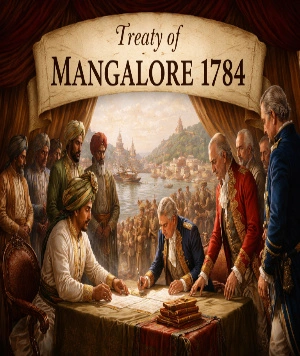
The Treaty of Mangalore, signed on March 11, 1784, remains one of the most remarkable diplomatic agreements in the history of India. It concluded the Second Anglo-Mysore War and symbolized a rare moment when an Indian ruler successfully negotiated with the British East India Company on equal terms. During the late eighteenth century, the British were steadily expanding their influence across the Indian subcontinent. However, the powerful kingdom of Mysore, first under Hyder Ali and later under his son Tipu Sultan, emerged as one of the strongest challengers to British authority in southern India.
The war between Mysore and the British East India Company from 1780 to 1784 was intense and complex, involving multiple regional powers and shifting alliances. The conflict ended only after both sides realized that prolonged fighting was costly and uncertain. The treaty was therefore negotiated to restore peace and stabilize relations between the two rivals.
The importance of this agreement lies not only in its immediate political outcomes but also in its long-term strategic consequences. It temporarily halted British expansion in South India, strengthened the authority of the Mysore ruler, and triggered reforms within the British administration. Many historians view it as the last major instance when the British had to negotiate with an Indian state from a position of relative equality.
Historical Background of the Second Anglo-Mysore War
The circumstances that led to the treaty were rooted in the growing rivalry between Mysore and the British East India Company during the eighteenth century. Mysore had emerged as a powerful regional state under the leadership of Hyder Ali, who modernized the army and expanded the kingdom’s territory. His rise threatened British ambitions in southern India, where the Company aimed to strengthen its control over trade and politics.
The Second Anglo-Mysore War began in 1780 when tensions escalated into open conflict. Hyder Ali formed alliances with other regional powers and launched campaigns against British-controlled territories. Early in the war, Mysorean forces achieved several victories that shocked the British military establishment. The conflict soon spread across large parts of South India, drawing in multiple armies and creating widespread instability.
The war continued even after Hyder Ali’s death in December 1782. His son Tipu Sultan took command of the Mysorean forces and continued to resist British advances. The fighting remained intense for several years until both sides realized that the situation had reached a stalemate.
Important background elements that shaped the war include:
-
Mysore had grown into a strong regional power under Hyder Ali’s leadership.
-
The British East India Company sought to expand political and commercial control in South India.
-
Regional alliances and rivalries intensified the conflict between Mysore and the British.
-
The war involved major battles, sieges, and shifting military strategies.
-
Both sides faced heavy economic and military pressures during the prolonged struggle.
Rise of Tipu Sultan and the Transition of Leadership
A crucial moment during the war was the transition of leadership from Hyder Ali to his son Tipu Sultan. Hyder Ali had been the architect of Mysore’s military strength, and his leadership played a decisive role in challenging British authority. However, his death in December 1782 created uncertainty about the future direction of the kingdom.
Tipu Sultan quickly stepped into power and proved himself a capable military commander and political leader. He inherited not only the throne but also the ongoing war against the British East India Company. Despite the sudden responsibility, Tipu managed to maintain the strength of Mysore’s forces and continued the resistance against British troops.
Tipu Sultan’s leadership style combined military innovation with strong administrative control. He sought to modernize the Mysorean army, strengthen fortifications, and build alliances that could counter British expansion. His determination ensured that Mysore remained a formidable opponent during the remaining years of the war.
Key aspects of the leadership transition include:
-
Hyder Ali died during the war in December 1782 due to illness.
-
Tipu Sultan succeeded him as the ruler of Mysore and continued the conflict.
-
The new ruler maintained the military strength built by his father.
-
Tipu focused on strengthening administration and defense.
-
His leadership ensured that Mysore remained a powerful force in regional politics.
The Battle of Pollilur and Early Mysorean Success
One of the most significant moments in the conflict occurred early in the war with the Battle of Pollilur in 1780. This battle is remembered as one of the most devastating defeats suffered by the British East India Company in India during the eighteenth century.
Mysorean forces used innovative military tactics and effective coordination to overwhelm the British troops. The defeat damaged British morale and demonstrated the strength of Mysore’s military capabilities. The victory also strengthened the confidence of Mysore’s leadership and encouraged further resistance against British expansion.
The battle highlighted the strategic skills of Mysorean commanders and their ability to challenge European-style armies. It became a symbol of Indian resistance against colonial forces and remains an important event in military history.
Important features of the Battle of Pollilur include:
-
The battle took place in 1780 during the early phase of the war.
-
Mysorean forces defeated a British army led by Company officers.
-
It became one of the worst defeats for the British in India at that time.
-
The victory enhanced the reputation of Mysore’s military strength.
-
It encouraged continued resistance against British expansion in the region.
Negotiations and the Road to Peace
Although Mysore achieved several successes during the war, the situation eventually changed due to international developments. One major factor was the withdrawal of French support for Mysore following the Treaty of Paris in 1783. The French had been important allies in countering British power in India.
Without strong French backing, Mysore faced greater diplomatic pressure to negotiate with the British East India Company. At the same time, the British were also experiencing difficulties. The prolonged conflict drained resources and created uncertainty within the Company’s administration.
Both sides gradually realized that continuing the war would bring limited benefits. Negotiations were therefore initiated to establish a peace agreement that could stabilize the region and end hostilities.
Key elements that led to negotiations include:
-
French support for Mysore ended after the Treaty of Paris in 1783.
-
Both Mysore and the British faced economic strain due to the prolonged war.
-
Military stalemate made decisive victory difficult for either side.
-
Diplomatic discussions began to find a mutually acceptable solution.
-
The goal was to restore stability in South India.
Signing of the Treaty of Mangalore
The formal agreement that ended the war was signed on March 11, 1784. The treaty was executed in the coastal city of Mangalore, which was an important port and strategic location on the western coast of India.
The signatories represented two powerful forces of the time. Tipu Sultan signed the treaty on behalf of the Kingdom of Mysore. The British East India Company was represented by commissioners Anthony Sadlier, George Leonard Staunton, and John Hudleston.
The agreement symbolized a rare moment of diplomatic parity between an Indian state and the British colonial power. The treaty was negotiated carefully to ensure that both sides accepted its terms without appearing to surrender.
Important facts about the signing include:
-
The treaty was signed on March 11, 1784.
-
The location of the agreement was Mangalore, also known historically as Codial Bunder.
-
Tipu Sultan represented the Kingdom of Mysore.
-
British representatives included Anthony Sadlier, George Leonard Staunton, and John Hudleston.
-
The treaty formally ended the Second Anglo-Mysore War.
Terms and Conditions of the Agreement
The central principle of the treaty was the restoration of conditions that existed before the war began. This principle, known as status quo ante bellum, meant that both sides agreed to return conquered territories and restore previous boundaries.
Another important condition involved the release of prisoners of war captured during the conflict. Thousands of soldiers and officials held by both sides were to be freed as part of the peace agreement.
The treaty was carefully structured to prevent immediate conflict and restore diplomatic relations between Mysore and the British East India Company.
Key terms of the treaty included:
-
Restoration of all territories captured during the war.
-
Mutual release of prisoners held by both sides.
-
Recognition of existing political boundaries.
-
Commitment to peaceful relations between Mysore and the Company.
-
Agreement to avoid actions that could reignite the conflict.
Strategic and Political Consequences
The impact of the treaty extended far beyond the immediate conclusion of the war. In the short term, it prevented further hostilities and allowed both sides to focus on internal challenges.
For Mysore, the agreement strengthened the authority of Tipu Sultan and confirmed his status as the ruler of an independent and powerful kingdom. For the British East India Company, the treaty was seen as an uncomfortable compromise, as it did not deliver a clear victory.
The balance of power in South India temporarily shifted as Mysore maintained its independence and influence.
Major consequences included:
-
Temporary halt to British territorial expansion in South India.
-
Strengthening of Tipu Sultan’s authority as the Sultan of Mysore.
-
Restoration of political stability in the region.
-
Opportunity for both sides to rebuild military strength.
-
Continued rivalry that would later lead to further conflicts.
Impact on British Administration and Politics
The treaty had serious repercussions in Britain as well. Many British officials considered the agreement humiliating because it forced the East India Company to negotiate from a position of weakness.
The political consequences were significant. The dissatisfaction with the Company’s management of Indian affairs contributed to the passing of Pitt’s India Act in 1784. This legislation increased the British government’s oversight over the East India Company.
The act aimed to ensure that future diplomatic and military decisions in India would be better coordinated and controlled.
Important outcomes in Britain included:
-
Decline in the East India Company’s stock prices after the treaty.
-
Public criticism of the Company’s leadership and strategy.
-
Introduction of Pitt’s India Act to reform colonial administration.
-
Greater supervision by the British government over Company operations.
-
Attempts to prevent similar diplomatic setbacks in the future.
Regional Influence and Non-Interference Policy
Another notable aspect of the agreement was its influence on regional politics. The treaty prevented the British from interfering in Tipu Sultan’s conflicts with neighboring powers.
During the mid-1780s, Mysore had disputes with the Maratha Empire and the Nizam of Hyderabad. The agreement ensured that the British East India Company would not intervene in these conflicts, allowing Tipu Sultan to handle regional matters independently.
This clause helped Mysore maintain its sovereignty and pursue its political interests without immediate British interference.
Important regional effects included:
-
British neutrality in Mysore’s disputes with neighboring states.
-
Continued independence of Mysore’s foreign policy decisions.
-
Temporary stabilization of political relations in South India.
-
Strengthening of Mysore’s diplomatic position.
-
Opportunity for Tipu Sultan to consolidate power.
Historical Significance and Legacy
The Treaty of Mangalore occupies a special place in the history of colonial India. It demonstrated that the British East India Company was not yet an unstoppable force during the late eighteenth century. Indian states such as Mysore still possessed the military strength and diplomatic skill to challenge British ambitions.
The treaty also reflects the complexity of power politics in India at the time. Regional alliances, global events, and local leadership all played roles in shaping the outcome of the conflict.
Although the peace did not last permanently, the agreement remains a symbol of resistance and negotiation during a crucial period of Indian history.
Key aspects of its legacy include:
-
Recognition as one of the last treaties signed on equal terms between an Indian ruler and the British.
-
Demonstration of Mysore’s strength under Tipu Sultan.
-
Influence on British administrative reforms.
-
Historical importance in the study of colonial diplomacy.
-
Continued relevance in discussions about resistance to colonial expansion.
Conclusion
The Treaty of Mangalore signed in 1784 stands as a remarkable event in the political history of India. Concluding the Second Anglo-Mysore War, the agreement highlighted the strength of the Mysore kingdom and the leadership of Tipu Sultan. At a time when the British East India Company was expanding its influence across the subcontinent, the treaty represented a rare moment when an Indian power negotiated with the British on equal footing.
The agreement restored territories, freed prisoners, and established a temporary balance of power in South India. While the peace it created did not last indefinitely, its immediate effects were profound. Mysore retained its independence and political strength, while the British administration faced criticism and implemented reforms to prevent similar setbacks.
From a broader perspective, the treaty illustrates the dynamic nature of eighteenth-century Indian politics. The struggle between Mysore and the British was not simply a clash between colonial forces and local resistance; it was also shaped by international alliances, leadership changes, and strategic calculations.
Today, the Treaty of Mangalore is remembered as a symbol of diplomatic resilience and political negotiation. It reflects a moment when the trajectory of colonial expansion was briefly checked, reminding us that the history of India during this era was defined by both conflict and negotiation.