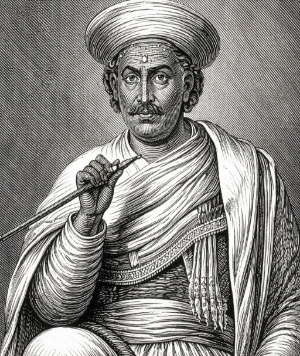
The story of Nana Sahib stands as one of the most intriguing and debated chapters in Indian history. A central figure in the uprising of 1857, he emerged from relative privilege into a symbol of resistance against colonial rule. His journey from an adopted heir of the Maratha Peshwa to a key revolutionary leader reveals a mix of personal grievance, political strategy, and historical circumstance.
Despite his prominence, his life remains shrouded in mystery, particularly his disappearance after the revolt. While Indian narratives often celebrate him as a freedom fighter, British accounts have portrayed him differently, highlighting the complexity of historical interpretation.
Early Life and Adoption
Nana Sahib was born on 19 May 1824 in Bithoor, near Kanpur. His birth name was Dhondu Pant, and he belonged to a Brahmin family. His biological parents, Narayan Bhat and Ganga Bai, were associated with the Maratha court, which helped shape his early environment.
A defining moment in his life came in 1827 when he was adopted by Baji Rao II, the last Peshwa of the Maratha Empire. This adoption elevated his social status and placed him in a position of significant privilege and responsibility. Growing up in Bithoor, he received a refined education and training in traditional arts and warfare.
His childhood circle included influential personalities such as Rani Lakshmibai (then known as Manikarnika), Tatya Tope, and Azimullah Khan. These associations later played a crucial role during the uprising.
Nana Sahib was also known for his refined tastes and interests. He was well-versed in Sanskrit literature and maintained a lavish lifestyle, complete with a vast collection of horses, elephants, and weapons.
Key Highlights:
- Born in 1824 in Bithoor near Kanpur
- Adopted by Peshwa Baji Rao II in 1827
- Grew up among future revolutionaries like Rani Lakshmibai and Tatya Tope
- Received education in Sanskrit and traditional warfare
- Maintained a luxurious lifestyle with a strong military inclination
The Catalyst for Rebellion
The turning point in Nana Sahib’s life came after the death of Baji Rao II in 1851. As the adopted son, he expected to inherit not only his father’s title but also the annual pension of 8 lakh rupees granted by the British East India Company. However, the British refused to recognize his claim.
This refusal was based on the controversial Doctrine of Lapse introduced by Lord Dalhousie. The policy denied adopted heirs the right to inherit titles or pensions, effectively stripping Nana Sahib of his rightful status and financial support.
Determined to seek justice, Nana Sahib sent Azimullah Khan to London in 1853 to present his case before the British authorities. Despite efforts, the mission failed, leaving him deeply frustrated and resentful toward British rule.
This combination of personal loss and political injustice became the foundation of his rebellion. His transformation from a loyal aristocrat to a revolutionary leader was gradual but inevitable.
Key Highlights:
- Pension dispute arose after Baji Rao II’s death in 1851
- British denied his claim under the Doctrine of Lapse
- Lost status and financial security
- Sent Azimullah Khan to London in 1853, but failed
- Developed strong resentment against British authority
Role in the 1857 Uprising
The revolt of 1857, often called the First War of Independence, provided Nana Sahib with the opportunity to act on his grievances. He became one of the leading figures in the rebellion, particularly in the Kanpur region.
The Siege of Kanpur
On 5 June 1857, Nana Sahib joined the rebellious sepoys and laid siege to the British entrenchment in Kanpur, commanded by Hugh Wheeler. The siege lasted for several weeks and was marked by intense fighting and hardship on both sides.
The British forces eventually found themselves in a desperate situation, leading to negotiations for safe passage.
Key Highlights:
- Joined the revolt in June 1857
- Led forces against British troops in Kanpur
- Siege lasted several weeks under extreme conditions
- Forced British into negotiations
Satichaura Ghat Incident
On 27 June 1857, Nana Sahib reportedly agreed to allow British soldiers and civilians safe passage to Allahabad via boats at Satichaura Ghat. However, as the evacuation began, chaos erupted, and firing broke out.
The resulting violence led to the deaths of many British soldiers and men. The exact cause of the firing remains debated among historians, with differing interpretations on whether it was planned or accidental.
Key Highlights:
- Promised safe passage to British forces
- Incident occurred during evacuation at Satichaura Ghat
- Resulted in significant loss of life
- Causes remain controversial and debated
Bibighar Massacre
One of the most controversial episodes associated with Nana Sahib is the Bibighar massacre on 15 July 1857. As British forces advanced toward Kanpur, around 120 captured women and children were killed in a house known as Bibighar.
Their bodies were later disposed of in a nearby well. This event intensified British anger and became a major justification for harsh reprisals during the suppression of the revolt.
Key Highlights:
- Occurred on 15 July 1857
- Around 120 women and children were killed
- Bodies disposed of in a well
- Remains a deeply contested and tragic event
Proclamation as Peshwa
In June 1858, after the capture of Gwalior, Nana Sahib was formally proclaimed Peshwa by leaders such as Rani Lakshmibai and Tatya Tope. This symbolic act aimed to revive Maratha power and unify resistance against British rule.
Although short-lived, this declaration reinforced his position as a famous figure in the rebellion.
Key Highlights:
- Proclaimed Peshwa in 1858
- Supported by Rani Lakshmibai and Tatya Tope
- Attempted revival of Maratha authority
- Strengthened his leadership status
The Great Disappearance
One of the most fascinating aspects of Nana Sahib’s life is his mysterious disappearance after the failure of the uprising. Despite extensive efforts, the British were never able to capture him.
Nepal Sojourn
Many historians believe that Nana Sahib fled to the Nepalese Terai in 1859 along with his family and considerable wealth. Reports suggest he carried valuable treasures, including a gold idol of Lord Ganesha.
The dense forests and political conditions in Nepal made it a suitable refuge.
Key Highlights:
- Fled to Nepal after the revolt
- Took family and treasure with him
- Nepal’s terrain provided protection
- Widely accepted historical theory
Bhutan Connection
Local traditions in Bhutan mention a figure known as “Pasha Raja,” believed by some to be Nana Sahib. According to these accounts, he lived in the Trongsa Dzong fortress for several years.
While intriguing, these claims lack strong historical evidence.
Key Highlights:
- Mentioned in Bhutanese folklore
- Lived as “Pasha Raja” in Trongsa Dzong
- Stayed for about six years
- Evidence remains uncertain
Sihor, Gujarat Theory
Documents discovered in the 1970s suggest that Nana Sahib may have lived in Sihor, Gujarat, under the name Yogindra Dayanand Maharaj. According to this theory, he lived as an ascetic and died in 1903.
This version adds a spiritual dimension to his later life.
Key Highlights:
- Lived as an ascetic in Gujarat
- Used the name Yogindra Dayanand Maharaj
- Died in 1903 (as per documents)
- Supported by some historical findings
Naimisha Forest Account
Another account claims that he spent his final years in the Naimisha Forest under the protection of a saint, passing away in 1906. This version aligns with the idea of him renouncing worldly life after the rebellion.
However, like other theories, it remains unverified.
Key Highlights:
- Lived in Naimisha Forest
- Protected by a saint
- Died in 1906 (claimed)
- Lacks conclusive proof
Historical Legacy
The legacy of Nana Sahib is complex and shaped by differing perspectives. In India, he is remembered as a courageous leader who stood against colonial oppression. His role in the uprising of 1857 has earned him recognition as a famous architect of resistance.
In contrast, British narratives have historically portrayed him as a controversial figure, largely due to the events in Kanpur. These differing interpretations highlight the subjectivity of historical memory.
Today, his legacy is commemorated in various ways. The Nana Rao Park stands as a tribute to his role in the revolt. It is located on the site of the former British entrenchment and serves as a reminder of the events of 1857.
His story continues to inspire discussions about resistance, justice, and the complexities of colonial history.
Key Highlights:
- Seen as a nationalist hero in India
- Viewed controversially in British accounts
- Played a major role in the 1857 uprising
- Honored through memorials like Nana Rao Park
- Symbol of resistance and historical debate
Conclusion
Nana Sahib remains one of the most enigmatic figures in Indian history. His life reflects the intersection of personal grievance and national struggle, making him a central character in the uprising of 1857. From his privileged upbringing in Bithoor to his leadership during the revolt, his journey is both inspiring and complex.
The controversies surrounding events like Satichaura Ghat and Bibighar highlight the harsh realities of conflict and the challenges of interpreting history. Meanwhile, his mysterious disappearance continues to intrigue historians and scholars.
Ultimately, Nana Sahib’s legacy is not defined by a single narrative. Instead, it represents a broader story of resistance, identity, and the enduring quest for justice. His life serves as a reminder of the many voices and perspectives that shape history.