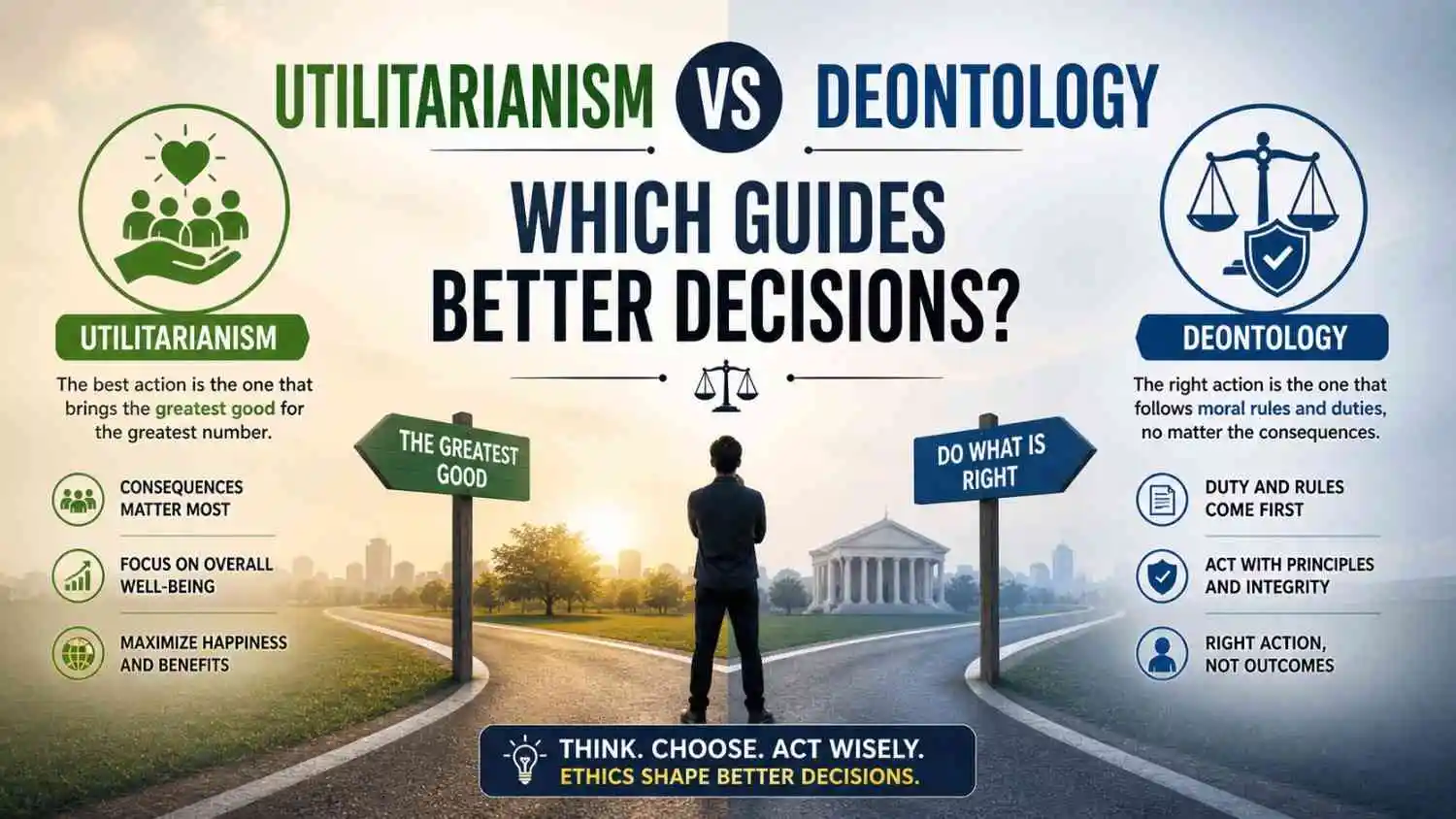
Every decision carries a weight most of us never consciously measure. Should a doctor lie to a dying patient to spare them distress? Should a government sacrifice individual rights to save thousands of lives? Should a judge enforce a technically unjust law because breaking it leads to chaos? These are not abstract puzzles — they happen in hospitals, courtrooms, parliaments, and boardrooms every single day.
At the heart of nearly every serious ethical debate, two towering frameworks stand in opposition: utilitarianism and deontology. Utilitarianism, championed by Jeremy Bentham and John Stuart Mill, says the right action is the one that produces the greatest good for the greatest number. Deontology, most powerfully articulated by Immanuel Kant, says the rightness of an action depends not on its consequences but on the nature of the action itself — on duty, rules, and universal moral law.
These are not just academic positions. Every major policy decision, legal judgment, and professional code of conduct is shaped — consciously or not — by one of these two frameworks. And yet, most people have never sat down to understand what truly separates them, where each excels, and where each catastrophically fails.
By the time you finish reading this, you will not just understand both theories — you will know how to apply them, critique them, and decide which lens actually serves you better in the real world.
Defining the Frameworks — What Each Theory Actually Claims
Before comparing the two, we need to be precise about what each one actually asserts. Many debates about utilitarianism and deontology go sideways because people argue with a caricature of each theory rather than the real thing.
Utilitarianism is a consequentialist moral theory. It holds that the moral worth of any action is determined entirely by its outcome. Specifically, the right action is the one that maximizes overall utility — which can mean happiness, well-being, pleasure, preference satisfaction, or welfare, depending on which version of the theory you follow. The core formula is simple: calculate the consequences, identify which option produces the most good (or the least harm) for the most people, and choose that option.
Deontology is a duty-based moral theory. It holds that the morality of an action depends on whether it conforms to a rule, obligation, or duty — regardless of what consequences flow from it. The word itself comes from the Greek deon, meaning duty. Deontologists argue that certain actions are inherently right or wrong, not because of what they produce but because of what they are. Lying is wrong even if it leads to a good outcome. Keeping a promise matters even when breaking it would be more convenient for everyone.
- Utilitarianism = outcomes define morality
- Deontology = rules and duties define morality
- Utilitarianism is forward-looking (what will happen?)
- Deontology is rule-bound (what does duty demand?)
- Both are normative theories — they tell us how we ought to behave
- Neither is merely descriptive — they are prescriptive frameworks
The practical implication is enormous. A utilitarian and a deontologist may agree on what to do in simple cases — but the moment stakes are high and consequences conflict with duties, they will reach opposite conclusions.
Origins and Historical Background
Understanding where these theories came from helps explain why they are structured the way they are. Both emerged from specific historical and intellectual contexts that shaped their assumptions and goals.
Utilitarianism as a formal philosophy was born in 18th-century Britain, largely as a response to the legal and social reform movement of the time. Britain's legal system was chaotic, cruel, and inconsistent. Jeremy Bentham, a legal reformer, wanted a rational, measurable basis for law and public policy. His utilitarian calculus — the felicific calculus — was meant to be a mathematical tool for legislators. If you could calculate which laws produced more pleasure than pain, governance could become a science rather than a matter of aristocratic whim.
Deontology in its modern philosophical form emerged from the Enlightenment project of grounding morality in reason rather than religion or tradition. Immanuel Kant, writing in 18th-century Prussia, was disturbed by the idea that morality could be contingent on circumstances. He wanted a moral law as universal and necessary as a mathematical truth — something that held regardless of culture, time, or consequences.
- Utilitarianism has roots in Epicurus's ancient philosophy of pleasure and pain
- Bentham formalized it into a legislative and legal tool in 1789
- Deontology draws from natural law theory and Stoic ethics
- Kant's Groundwork of the Metaphysics of Morals (1785) remains its foundational text
- Both frameworks arose partly as secular alternatives to religious moral systems
- The 19th century saw both refined and challenged by emerging social sciences
The historical context matters practically because it tells us what problems each theory was designed to solve. Utilitarianism was built for policy and collective decision-making. Deontology was built for individual moral integrity. This division still haunts debates about which framework is more appropriate for different domains.
The Core Thinkers — Bentham, Mill, and Kant
The personalities behind these theories are as important as the theories themselves. Understanding their motivations reveals why each framework has the shape it does.
Jeremy Bentham (1748–1832)
Bentham is utilitarianism's founding architect. His central contribution was the principle of utility — that government and individuals should act to maximize happiness and minimize suffering. He developed the felicific calculus, a method for quantifying pleasure and pain across seven dimensions: intensity, duration, certainty, propinquity (nearness), fecundity, purity, and extent.
Bentham was relentlessly practical. He designed the Panopticon prison, proposed social reforms, and believed that law should be evaluated purely on whether it increased or decreased human welfare. He famously dismissed natural rights as "nonsense upon stilts" — because rights, in his view, were only meaningful when they produced good outcomes.
John Stuart Mill (1806–1873)
Mill inherited Bentham's utilitarianism but refined it significantly. He recognized that Bentham's crude pleasure-pain calculus failed to distinguish between types of happiness. Pushpin (a simple game) being as good as poetry, as Bentham seemed to suggest, struck Mill as wrong. He introduced the distinction between higher and lower pleasures — intellectual and moral pleasures being qualitatively superior to physical ones.
Mill also gave utilitarianism its most famous formulation: the greatest happiness of the greatest number. He argued that justice and rights, properly understood, were themselves utilitarian — because a society that respects rights produces more long-term happiness than one that violates them.
Immanuel Kant (1724–1804)
Kant stands as deontology's supreme architect. He argued that the only thing unconditionally good is a good will — an intention to act from duty rather than inclination. Consequences are morally irrelevant, because they are outside our control. What we control is our intention and our adherence to moral law.
Kant's greatest contribution is the Categorical Imperative — a universal moral test that comes in three formulations:
- Formula of Universal Law: Act only according to that maxim by which you can at the same time will that it should become a universal law
- Formula of Humanity: Act so that you treat humanity, whether in your own person or that of another, always as an end and never merely as a means
- Formula of the Kingdom of Ends: Act according to maxims of a universally legislating member of a merely possible kingdom of ends
These formulations make Kant's deontology both powerful and demanding. Lying is always wrong because universalizing it destroys the very concept of trust. Using people as tools is always wrong because it violates their dignity as rational beings.
How Each Framework Makes Decisions — The Mechanism
This is where theory becomes practice. How does a utilitarian actually decide what to do? How does a deontologist work through a moral dilemma? The decision mechanisms are radically different.
The Utilitarian Decision Process
A utilitarian approaches any moral decision through a structured cost-benefit analysis of outcomes:
- Identify all possible courses of action
- For each action, predict its consequences
- Calculate the net utility — how much happiness or welfare does each option produce minus how much suffering it causes
- Account for all affected parties — not just yourself, not just your group, but everyone impacted
- Choose the action with the highest net utility
This sounds straightforward, but the complications are massive. How do you predict all consequences? How do you compare different types of happiness across different people? Whose calculation counts more? These are not minor quibbles — they are fundamental challenges the theory must answer.
A key distinction here is between act utilitarianism and rule utilitarianism:
- Act utilitarianism evaluates each individual action by its specific consequences in that situation
- Rule utilitarianism holds that we should follow rules that, if generally followed, would maximize overall utility
- Rule utilitarianism is closer to common-sense morality because it incorporates stable rules like "do not steal" without requiring constant recalculation
The Deontological Decision Process
A deontologist approaches moral decisions very differently:
- Identify what duty, rule, or obligation applies to this situation
- Determine whether the proposed action conforms to that rule
- Ask: could I universalize this action without contradiction?
- Ask: does this action treat any person merely as a means to an end?
- Act according to duty — regardless of outcome
The beauty of this process is its clarity. You do not need to calculate uncertain futures. You do not need to weigh happiness against suffering across large populations. You simply ask: what does my duty demand? The difficulty is that duties can conflict — the duty to tell the truth may conflict with the duty to protect a friend — and deontology does not always have a clean answer for which duty wins.
- Utilitarianism = flexible, outcome-dependent, requires prediction
- Deontology = stable, rule-dependent, requires moral conviction
- Utilitarianism is better for systemic decisions affecting many people
- Deontology is better for preserving individual dignity and rights
- Both require consistent application to avoid self-serving rationalizations
- The decision mechanism you use shapes which moral errors you are most likely to make
Key Principles and Features of Utilitarianism
Utilitarianism is not one monolithic theory. It contains a family of related positions unified by the core consequentialist commitment. Understanding its distinct features helps you apply it — and critique it — more precisely.
The Principle of Utility
This is the foundation: actions are right in proportion as they tend to promote happiness; wrong as they tend to produce the reverse of happiness. Utility is not just personal pleasure — it extends to all sentient beings affected by the action. This gives utilitarianism a naturally expansive, even global, moral scope.
Impartiality
Utilitarianism demands strict impartiality. Your own happiness does not count more than anyone else's. A stranger's suffering is as morally relevant as your closest friend's. This impartiality requirement is both utilitarianism's greatest strength (it resists tribalism and favoritism) and a significant psychological challenge (it seems to demand more than most humans can give).
Aggregation
Utilitarianism allows and requires the aggregation of individual utilities. The welfare of many can outweigh the welfare of few. This is why utilitarianism can justify policies that benefit the majority even at a cost to a minority — a feature that is either a strength or a catastrophic weakness, depending on your perspective.
Consequentialism and Moral Flexibility
Because outcomes determine rightness, utilitarianism is morally flexible. An action that is normally considered wrong can be justified if it produces sufficiently good outcomes in a specific case. This flexibility makes it well-suited to complex, high-stakes decisions where rigid rules produce absurd results.
- Utility is defined in terms of welfare, preference satisfaction, or happiness
- All consequences — intended and unintended — count
- Future consequences matter as much as immediate ones
- Animals and future generations are morally relevant (because they can suffer)
- The theory is inherently democratic — every individual's welfare counts equally
- Utilitarianism is naturally empirical — it invites measurement and data
Key Principles and Features of Deontology
Deontology's defining characteristic is its insistence that morality is not contingent on results. This produces a set of features that make it both deeply intuitive and sometimes counterintuitive in practice.
The Categorical Imperative
Kant's categorical imperative is the engine of deontological reasoning. Unlike hypothetical imperatives (if you want X, do Y), the categorical imperative is unconditional: you must act in a certain way, period. It generates moral rules that apply universally — to everyone, in all circumstances, without exception.
Human Dignity and Respect for Persons
Deontology's most powerful contribution to modern ethics is the principle that every person possesses inherent dignity — what Kant calls dignity that makes persons ends in themselves, never merely means. This principle underlies human rights law, medical ethics, and constitutional protections around the world. It is the philosophical basis for why we cannot execute an innocent man even if doing so would calm public unrest.
Duties and Rights as Correlates
Deontology generates both duties (obligations to act or refrain from acting in certain ways) and rights (protections from certain treatment). If I have a duty not to lie, you have a corresponding right not to be deceived. This correlative structure gives deontology a natural fit with legal frameworks, which are built around rights and obligations.
Moral Absolutism
Many deontological rules are absolute — they cannot be overridden by consequences. This is both a strength (rules cannot be manipulated by consequentialist rationalizations) and a weakness (absolute rules can produce cruel results in extreme cases).
- Perfect duties: strict obligations that admit no exceptions (do not lie, do not murder)
- Imperfect duties: obligations that allow latitude in how and when we fulfill them (be charitable)
- Rights are inviolable — they cannot be overridden by aggregate welfare
- Moral worth comes from acting from duty, not from inclination or self-interest
- Universalizability is the test: if the maxim cannot be universalized, it is morally impermissible
- Deontology is naturally suited to legal, constitutional, and professional ethics
Strengths of Utilitarianism
Utilitarianism has survived more than two centuries of philosophical attack because it captures something genuinely important about moral reasoning. Its strengths are real and substantial.
It Focuses on What Actually Matters
At its core, utilitarianism insists that the actual welfare of actual people is what morality should be about. Abstract rules and duties matter only insofar as they affect real lives. This orientation toward tangible human welfare gives utilitarianism enormous practical power. Policies, laws, and medical decisions should — arguably — be evaluated by what they actually do to people, not merely by whether they conform to abstract principles.
It Is Comprehensive and Impartial
Utilitarianism extends moral concern to everyone affected by an action. It does not privilege the decision-maker, the in-group, or the powerful. A utilitarian calculation must include the poorest, the most marginalized, and even future generations. This impartiality makes it a powerful tool for challenging unjust social arrangements that benefit some at the expense of others.
It Handles Complex Trade-offs
Real decisions — especially policy decisions — involve genuine trade-offs. Resources are limited. Benefits to one group may come at costs to another. Utilitarianism provides a principled basis for navigating these trade-offs: choose the option that produces the greatest overall welfare. No other theory handles trade-offs as systematically.
It Supports Moral Progress
Utilitarianism has historically driven moral progress. Arguments for abolishing slavery, extending voting rights, reforming criminal punishment, and protecting animal welfare have all drawn significantly on utilitarian reasoning. If we include all sentient beings in our moral calculations, many practices that were once accepted become clearly indefensible.
- Practical and action-guiding in complex situations
- Naturally suited to public policy and collective decisions
- Inclusive of all affected parties — human and animal
- Encourages measurement, data, and evidence in ethical analysis
- Flexible enough to accommodate changing social knowledge
- Drives reform of unjust institutions by exposing their net costs to welfare
Strengths of Deontology
Deontology speaks to a moral intuition that runs very deep: some things are simply wrong, no matter the outcome. Its strengths are grounded in this intuition and in the practical need for stable, reliable moral rules.
It Protects Individual Rights Absolutely
The greatest practical strength of deontology is that it puts individual rights beyond the reach of majoritarian calculation. No matter how many people would benefit from violating your rights, deontology says your rights cannot be traded away. This protection is not hypothetical — it is built into every human rights convention, every constitutional bill of rights, and every professional code of ethics that exists today.
It Provides Moral Certainty and Stability
Utilitarianism requires predicting consequences — an uncertain, often impossible task. Deontology provides clear, stable rules that can be followed without knowing how events will unfold. This makes deontological rules practical guides for behavior in ways that purely consequentialist calculations often are not. You do not need to calculate the happiness consequences of lying on every occasion — you simply know you should not lie.
It Recognizes Moral Integrity
Deontology recognizes that morality is not just about outcomes — it is about the kind of person you are and the integrity of your actions. Philosopher Bernard Williams argued that utilitarianism alienates us from our deepest commitments by requiring us to abandon our personal projects whenever aggregate welfare demands it. Deontology preserves space for integrity, personal commitment, and character.
It Prevents Moral Manipulation
Because deontological rules do not bend for consequences, they are resistant to sophisticated manipulation. A clever utilitarian argument can always be constructed to justify almost any action if you torture the numbers correctly. Deontological rules, being absolute, cannot be overridden by such arguments — making them a safeguard against the rationalization of cruelty.
- Rights are protected from majority override
- Rules are clear, learnable, and consistently applicable
- Moral integrity and character are preserved
- Resistant to manipulation by consequentialist rationalizations
- Compatible with legal and constitutional frameworks
- Respects the separateness of persons — each life has value independently
Criticisms and Limitations of Utilitarianism
No ethical theory is without serious flaws, and utilitarianism faces some of the most penetrating critiques in the history of philosophy.
The Problem of Justice and Rights Violations
The most devastating objection to utilitarianism is that it can justify horrifying injustices. If torturing one innocent person would prevent widespread suffering for thousands, the utilitarian calculus seems to require it. History is full of examples where majorities have justified the oppression of minorities on the grounds of collective welfare. Utilitarianism, taken to its logical extreme, provides no principled bar against such reasoning.
Philosopher John Rawls developed his theory of justice partly in response to this problem. He argued that utilitarianism wrongly treats society as a single person whose overall utility can be maximized, ignoring that individuals have separate lives and rights that cannot be traded against aggregate welfare.
The Measurement Problem
How do you actually measure utility? How do you compare the happiness of one person with the suffering of another? How do you weigh short-term pleasure against long-term welfare? Bentham's felicific calculus was a noble aspiration, but in practice, utility cannot be measured with the precision the theory demands. Real-world decisions using utilitarian reasoning often rely on crude proxies — GDP, quality-adjusted life years (QALYs) in healthcare — that inadequately capture the full complexity of human welfare.
The Demandingness Objection
Utilitarianism is extraordinarily demanding. If your moral obligation is always to maximize overall welfare, then spending money on personal enjoyment when you could donate it to save lives in poorer countries is morally wrong. Singer's famous argument about affluence and famine uses exactly this logic. Most people find a moral theory that demands such constant self-sacrifice psychologically unsustainable and practically unworkable.
The Integrity and Special Obligations Problem
Utilitarianism seems to deny the moral significance of personal relationships and special obligations. Should you really treat your child's welfare as no more important than a stranger's? Utilitarianism seems to say yes — which most people find deeply counterintuitive. Williams argued that utilitarianism requires us to become impartial calculating machines, destroying the very personal commitments that give life meaning.
- Can justify injustice in the name of collective welfare
- Measurement of utility is practically impossible to do precisely
- Ignores the separateness of persons — treats people as vessels of utility, not individuals
- Excessively demanding — few can live up to its standards consistently
- Can be manipulated by clever consequentialist arguments
- Struggles to account for justice, fairness, and individual rights
Criticisms and Limitations of Deontology
Deontology faces equally serious criticisms, particularly around its rigidity and its handling of conflicts between duties.
The Problem of Absolute Rules
Kant famously argued that lying is always wrong — even if a murderer asks where your friend is hiding. This absolutism strikes most people as morally blind. Common sense insists that context matters: lying to save a life is not the same as lying for personal gain. When deontological rules produce such obviously wrong results in extreme cases, the theory seems to have failed rather than succeeded.
The Problem of Conflicting Duties
Deontology generates multiple duties, and those duties can conflict. You have a duty to tell the truth and a duty to protect the innocent. When these collide — as in the murderer-at-the-door case — deontology struggles to provide a clear answer. W.D. Ross attempted to address this with his theory of prima facie duties (duties that hold unless overridden by stronger duties), but critics argue this merely imports a form of consequentialist weighing through the back door.
It Ignores Consequences Entirely
The insistence that consequences are morally irrelevant seems perverse in many situations. If following a rule leads to catastrophically bad outcomes — say, a law that requires returning escaped slaves — and you know this in advance, deontology seems to demand you follow the rule anyway. Most people's moral intuitions rebel against this.
The Problem of Motivation and Action-Guidance
Kant insists that moral worth comes only from acting from duty, not from inclination. But does this mean that a doctor who saves lives because she genuinely loves people acts with less moral worth than one who saves lives purely from duty? This seems backwards. Furthermore, deontological rules often underdetermine action — knowing you should "treat people as ends" does not always tell you what to do in complex situations.
- Absolute rules can produce absurd or cruel outcomes in extreme cases
- No clear mechanism for resolving conflicts between duties
- Ignores consequences that most people believe are morally relevant
- Can be overly rigid, making it ill-suited for complex, real-world decisions
- Does not account for the moral significance of relationships and special obligations
- Can become a cover for following unjust rules in the name of duty
Famous Ethical Dilemmas — Tested Against Both Frameworks
Nothing clarifies the difference between theories like applying them to real dilemmas. These cases have been debated by philosophers for decades — and they remain unresolved precisely because both frameworks capture something important.
The Trolley Problem
A runaway trolley is headed toward five people tied to the tracks. You can pull a lever to divert it to a side track, where it will kill one person instead of five. Do you pull the lever?
- Utilitarian answer: Pull the lever. Five lives saved at the cost of one is a clear net gain in welfare.
- Deontological answer: More complex. Kant would say you are not the cause of the trolley's path, so doing nothing does not make you morally responsible for the five deaths. But actively diverting the trolley makes you responsible for the one death. Many Kantians would say: do not pull the lever, because you cannot use one person as a means to save others.
The Fat Man Variant
Now imagine you are on a bridge above the track. The only way to stop the trolley is to push a large man off the bridge, whose body will stop the trolley and save the five people. Do you push him?
Most people find the answer here much less obvious than in the basic trolley problem. Psychologically, most people refuse to push the fat man even though the utilitarian calculus is identical to the lever case.
- Utilitarian answer: Push him — the mathematics are the same, five lives versus one.
- Deontological answer: Never. Pushing the man uses him as a mere means, violating his dignity as a person. His death is not a side effect — it is the mechanism of rescue.
This asymmetry reveals something profound about moral psychology: we intuitively resist using people as instruments even when the numbers favor it — a deontological intuition embedded in most cultures.
The Lying to the Murderer
A murderer comes to your door asking where your friend is hiding. Your friend is inside. Do you lie?
- Utilitarian answer: Of course — lying saves your friend's life, and the murderer's interests in being told the truth have no weight against this.
- Kantian answer: Kant famously said you must not lie — even here. The murderer's decision is his own responsibility. You are responsible for your own truthfulness.
Sophie's Choice
A person is forced to choose which of their two children will be harmed. The utilitarian says: minimize total harm. The deontologist struggles, because no framework of duties can make this choice less agonizing — and the deontological framework, at least, acknowledges that some choices are genuinely tragic, not merely sub-optimal.
These dilemmas collectively illustrate that no single framework handles all cases cleanly. The trolley problem shows where utilitarianism is right. The fat man case shows where deontology is right. The Kantian lying case shows where deontology becomes absurd. Sophie's Choice shows where neither framework is enough.
Real-World Applications in Law, Medicine, Governance, and AI
Both frameworks operate not just in philosophy seminars but in the decisions that shape societies, save lives, and govern institutions.
Medicine and Bioethics
Healthcare is the domain where both frameworks show up most visibly and most consequentially.
Utilitarian applications:
- Resource allocation decisions in healthcare (e.g., organ transplant prioritization) are explicitly utilitarian — organs go to patients who will benefit most
- Cost-effectiveness analysis in national health systems uses QALYs — a utilitarian measure of health benefit
- Public health measures like vaccination mandates prioritize collective welfare over individual choice
- Triage in emergency medicine sorts patients by who can be saved with available resources — a utilitarian calculus
Deontological applications:
- Informed consent requirements are deontological — patients have a right to decide what happens to their bodies regardless of medical outcomes
- The prohibition on euthanasia in many systems reflects deontological duties about not taking life
- Medical confidentiality is treated as an absolute duty in most professional codes
- The Nuremberg Code prohibiting non-consensual medical experimentation is pure deontology — no aggregate benefit can justify using persons without consent
Law and Criminal Justice
Legal systems embed both frameworks in different domains.
- Sentencing theory in criminal justice is divided: retributivism (punish because the criminal deserves it — deontology) vs. deterrence (punish to reduce future crime — utilitarianism)
- Constitutional rights protections are deontological — free speech and due process cannot be traded for aggregate welfare
- Cost-benefit analysis in regulatory law is explicitly utilitarian — environmental regulations must produce benefits exceeding costs
- Hate crime laws reflect deontological reasoning — certain actions are wrong independently of their consequences
Public Policy and Governance
- Welfare economics and cost-benefit analysis in policy-making are utilitarian tools
- Redistributive taxation can be justified on both grounds — utilitarian (maximizes aggregate welfare) and deontological (duties of fairness)
- Human rights law is deontological — states have absolute obligations regardless of consequences
- Emergency powers debates during crises (pandemics, wars) reveal the tension: utilitarian logic favors broad emergency measures; deontological logic insists on rights protections even under pressure
Artificial Intelligence Ethics
The emergence of AI has made this debate sharply practical again.
- Algorithmic decision-making in hiring, lending, and criminal justice is often implicitly utilitarian — optimize for aggregate outcomes
- Bias and discrimination concerns reflect deontological reasoning — individuals cannot be treated as mere statistical averages
- Autonomous vehicle ethics (should a self-driving car sacrifice its passenger to save five pedestrians?) is the trolley problem made real
- AI safety researchers debate whether to build systems that maximize human welfare (utilitarian) or systems that respect inviolable constraints (deontological)
According to a 2023 MIT survey of AI ethics researchers, 67% believed that deontological constraints — fixed rules the AI cannot violate — should be built into advanced AI systems as a safeguard against utilitarian optimization going catastrophically wrong.
Hybrid Approaches — Can We Combine Both?
The sharpest minds in ethics have long recognized that neither framework alone is sufficient. The result has been a series of sophisticated hybrid theories that attempt to capture the strengths of both while avoiding their respective pitfalls.
W.D. Ross's Prima Facie Duties
W.D. Ross, a 20th-century British philosopher, proposed that we have multiple prima facie duties — duties that hold unless overridden by a stronger duty in a specific situation. These include duties of fidelity (keep promises), reparation (repair harms done), gratitude, non-maleficence (do not harm), beneficence (help others), and justice.
When duties conflict, we must exercise judgment about which is strongest in context — which introduces a quasi-consequentialist weighing process. Ross's theory is one of the most widely accepted frameworks in contemporary applied ethics precisely because it captures how thoughtful people actually reason.
John Rawls's Justice as Fairness
John Rawls's theory of justice is partly deontological (individuals have rights that cannot be sacrificed for aggregate welfare) and partly utilitarian in spirit (social arrangements should benefit the least-advantaged members of society). His veil of ignorance thought experiment — asking what principles you would choose if you did not know your place in society — produces a framework that honors both individual rights and collective welfare.
Rule Utilitarianism as a Bridge
Rule utilitarianism, as noted earlier, bridges the gap by asking not "what produces the best outcome in this case?" but "what rules, if generally followed, produce the best outcomes overall?" This produces stable, deontology-like rules grounded in utilitarian reasoning — rules against lying, promise-breaking, and rights violations, justified because following them generally produces more welfare than violating them.
Two-Level Utilitarianism (Hare)
R.M. Hare proposed that we operate on two levels of moral thinking. At the intuitive level — everyday decisions — we follow stable, internalized rules (which are effectively deontological). At the critical level — when rules conflict or produce clearly wrong results — we use utilitarian reasoning to adjudicate. This two-level approach attempts to preserve the practical advantages of both frameworks.
- Hybrid approaches acknowledge that neither pure theory handles all cases
- Ross's prima facie duties is the most widely used framework in applied ethics
- Rawls combines rights-protection with welfare-oriented distributive justice
- Rule utilitarianism produces deontological-style rules with utilitarian grounding
- In practice, most professional ethics codes are hybrids — absolute rules with welfare-based exceptions
- The debate is not which single theory wins — it is how to integrate both intelligently
Relevance in Governance and Public Administration
For anyone working in government, public policy, or administration, understanding both frameworks is professionally essential — not merely academically interesting.
Public administrators constantly face decisions where individual rights conflict with collective welfare. A health inspector who shuts down a business is using utilitarian reasoning — the welfare of the public outweighs the financial interests of the owner. A constitutional court that strikes down a popular law because it violates individual rights is using deontological reasoning.
Key applications in governance:
Welfare Policy
Welfare states are built on a utilitarian foundation — redistribute resources to maximize aggregate welfare. But the design of welfare systems typically incorporates deontological constraints: recipients have rights, not merely allowances; bureaucrats have duties, not merely discretion.
Emergency and Crisis Management
Pandemic management brought this tension into sharp public view. Lockdowns and vaccine mandates were justified on utilitarian grounds — limiting individual freedom to prevent mass death. Critics argued on deontological grounds — the state has no right to compel vaccination or restrict movement, regardless of consequences. Both positions reflected genuine moral reasoning, not mere ideology.
Corruption and Institutional Integrity
Deontology provides the strongest foundation for anti-corruption ethics. A government official should not accept bribes even when the bribe might be used for a genuinely beneficial purpose. The integrity of the institution and the duty of the role cannot be traded for utilitarian outcomes. This is why professional codes for civil servants are predominantly deontological in structure.
Criminal Justice
Retributive justice — criminals should be punished because they deserve it — is deontological. Rehabilitative and deterrence-based justice — criminals should be treated in ways that reduce future crime and promote social welfare — is utilitarian. Most actual criminal justice systems combine both, and the tension between them drives debates about prison reform, sentencing guidelines, and rehabilitation programs.
- Most governance decisions involve balancing utilitarian policy goals with deontological rights constraints
- Constitutional democracies embed this balance structurally — legislative majorities cannot override constitutional rights
- Public servants trained in both frameworks make better decisions under pressure
- Administrative law typically combines rule-based deontological constraints with outcome-oriented standards
- Ethics training in civil services increasingly draws on both frameworks explicitly
Exam and Academic Relevance
For students preparing for competitive examinations — particularly UPSC (Union Public Service Commission), law entrance exams, philosophy papers, and management ethics papers — both frameworks are core curriculum.
UPSC Ethics, Integrity and Aptitude (GS Paper 4)
The UPSC syllabus explicitly covers ethical theories and their applications. Questions regularly ask candidates to:
- Explain the difference between consequentialist and deontological ethics
- Apply ethical frameworks to administrative dilemmas (whistleblowing, corruption, policy conflicts)
- Evaluate which framework better guides a public servant's conduct
Previous year question pattern: "A public servant is aware that a policy, if implemented as directed, will harm a vulnerable community. However, disobeying orders may lead to disciplinary action. How should they proceed? Discuss with reference to ethical theories."
This question type requires the candidate to identify the utilitarian angle (what outcome does the policy produce? what outcome does disobedience produce?) and the deontological angle (what duty does the officer have? what rights does the community have?).
Law and Constitutional Studies
- Jurisprudence courses cover natural law (deontological) vs. legal positivism and utilitarian approaches to law
- Constitutional law requires understanding rights as deontological protections
- Criminal law theory requires understanding retributivism (deontological) vs. deterrence (utilitarian)
Philosophy and Humanities
- Any ethics course at undergraduate or postgraduate level will centrally cover both frameworks
- Kant's moral philosophy and Mill's utilitarianism are among the most frequently examined philosophical texts globally
Management and Business Ethics
- Corporate social responsibility debates are structured around utilitarian stakeholder welfare vs. deontological rights of employees, customers, and communities
- Business ethics cases — whistleblowing, pricing practices, labor conditions — require both frameworks
Key exam tips:
- Always define both frameworks clearly before applying them
- Use the trolley problem and similar dilemmas as illustrative examples
- Acknowledge the limitations of each framework — examiners reward nuanced answers
- Discuss hybrid approaches like Ross's prima facie duties to show depth
- Link the philosophical debate to practical governance and policy contexts
Future of Ethical Decision-Making
The debate between utilitarianism and deontology is not settled — and the emergence of new challenges is forcing both frameworks to evolve and adapt.
AI and Algorithmic Ethics
Artificial intelligence has brought these debates to a new urgency. When an AI system is trained to optimize for outcomes, it is doing something fundamentally utilitarian. When we build hard constraints into AI systems — things the system must never do regardless of outcomes — we are imposing deontological guardrails. The field of AI alignment is, in many ways, a practical engineering version of the utilitarian-deontological debate.
Global Existential Risks
Effective altruism — a movement grounded in utilitarian reasoning — has argued that we should focus our moral efforts on preventing catastrophic, civilization-scale risks (pandemics, AI catastrophe, nuclear war) because the potential impact on future generations is so enormous that it dwarfs all other moral concerns. Critics, drawing on deontological arguments, contend that sacrificing present individuals and communities for speculative future benefits is morally unjustifiable.
Emerging Neuroscience and Moral Psychology
Neuroscience research (notably the work of Joshua Greene) has suggested that deontological judgments and utilitarian judgments engage different brain systems — emotional responses generating deontological intuitions, deliberate reasoning generating utilitarian conclusions. If true, this raises profound questions about the relationship between our moral theories and our moral psychology.
Rights Inflation vs. Welfare Maximization
Contemporary political discourse increasingly frames every preference as a right (a deontological move), while simultaneously demanding that policy maximize aggregate welfare (a utilitarian move). The resulting tensions — between individual rights claims and collective welfare imperatives — will define political and legal debates for decades.
- AI development makes the utilitarian-deontological tension practically urgent
- Effective altruism represents a sophisticated modern utilitarianism with enormous influence
- Moral psychology research challenges assumptions that both frameworks are purely rational
- Climate change raises utilitarian questions (how much sacrifice now to prevent future harm?) with deontological constraints (future generations have rights)
- The debate will never be "won" — it will continue to evolve with human complexity
How Students and Professionals Can Use This
Understanding these frameworks is not merely an intellectual exercise. It has real practical value — in examinations, in professional life, and in navigating your own moral decisions.
For Students
Build the habit of applying both lenses to any ethical scenario you encounter. When you read a news story about a moral dilemma — a whistleblower, a controversial policy, a medical ethics case — ask: what would a utilitarian say? What would a deontologist say? Where do they agree? Where do they diverge? This dual-lens habit is exactly what examiners look for in competitive examinations.
When writing ethics answers:
- Define the framework you are using before applying it
- Acknowledge the strongest objections to your position
- Show awareness of hybrid approaches
- Conclude with a nuanced judgment — not a declaration that one theory is simply correct
For Professionals in Law, Medicine, and Policy
Professional ethics codes in law, medicine, and public service are hybrids — they contain absolute rules (deontological) with outcome-based exceptions and standards. Understanding the theoretical basis of these codes helps you reason better when the rules do not cover your specific situation.
When facing an ethical dilemma at work:
- Identify the relevant duties and rights at stake (deontological analysis)
- Estimate the likely consequences of each option (utilitarian analysis)
- Check whether any absolute constraints rule out any options
- Apply judgment about which duties are strongest in this context (Ross's approach)
- Act — and be prepared to justify your reasoning to others
For Researchers and Academics
The field of applied ethics is actively working to develop better hybrid frameworks, particularly for emerging challenges in AI, bioethics, and global governance. Engaging seriously with both classical frameworks — rather than dismissing one for the other — is essential for producing research that is philosophically rigorous and practically relevant.
- Practice both frameworks as analytical tools, not just academic content
- Use ethical dilemmas as training cases — work through them systematically
- Develop the habit of acknowledging the strongest objection to your own position
- Professional decision-making improves when framework-based reasoning is made explicit
- The goal is not to pick a side — it is to reason more clearly and honestly
FAQ
1. What is the main difference between utilitarianism and deontology?
Utilitarianism holds that the moral worth of an action is determined entirely by its consequences — the right action is the one that produces the greatest overall welfare. Deontology holds that morality depends on adherence to duties and rules, not on outcomes. A utilitarian asks "what will this produce?" A deontologist asks "what does my duty require?" The two frameworks can recommend opposite courses of action in the same situation, particularly when following a rule produces harmful consequences.
2. Which ethical theory is better — utilitarianism or deontology?
Neither is simply better — they each excel in different domains and fail in different ways. Utilitarianism is better suited to collective decisions, policy-making, and situations involving trade-offs between large numbers of people. Deontology is better suited to protecting individual rights, maintaining institutional integrity, and providing stable moral rules that cannot be manipulated by clever consequentialist arguments. Most thoughtful ethicists and professional codes draw on both, using deontological constraints to prevent utilitarian reasoning from justifying rights violations.
3. Is a common misconception about utilitarianism that it simply means majority rule?
Yes — this is one of the most common misunderstandings. Utilitarianism is not majority rule. It requires maximizing overall welfare, which may sometimes require protecting minorities from majority preferences if those preferences cause significant harm. Mill himself was deeply concerned with minority rights and argued that a tyranny of the majority could be just as damaging to welfare as a tyranny of government. The utilitarian calculation must include the welfare of all — not merely the preferences of the most numerous group.
4. How does the trolley problem illustrate the difference between utilitarianism and deontology?
The trolley problem forces a choice between saving five lives by allowing one person to be killed, or refusing to act and letting five die. A utilitarian typically endorses pulling the lever — five lives saved outweighs one life lost. A deontologist, particularly a strict Kantian, argues that actively diverting the trolley makes you responsible for the one death, and that you cannot use one person as a means to save others. The famous variant — pushing a large man off a bridge — produces the same utilitarian calculation but generates much stronger moral resistance, revealing deep deontological intuitions in most people.
5. How is deontological ethics relevant to UPSC and civil services examinations?
UPSC's General Studies Paper 4 (Ethics) explicitly tests candidates on ethical theories and their application to administrative dilemmas. Deontological ethics is highly relevant because public servants have duties — to their oath of office, to the law, to the public — that may conflict with utilitarian calculations. Questions often ask candidates to reason through cases where following orders conflicts with protecting citizens' rights, or where a policy achieves good outcomes through unjust means. Answers that demonstrate command of both frameworks and the ability to apply them to governance contexts score significantly higher.
6. Can utilitarianism and deontology be combined in practice?
Yes — and most sophisticated ethical frameworks do exactly this. W.D. Ross's theory of prima facie duties provides one model: a set of duties that hold generally but can be overridden when a stronger duty conflicts, using judgment to weigh which duty is paramount. Rule utilitarianism is another bridge — it derives deontological-style rules from utilitarian reasoning. John Rawls's theory of justice combines inviolable individual rights with a principle that social arrangements should benefit the least-advantaged. In practice, professional ethics codes, legal systems, and public policy frameworks all combine both approaches.
7. What did Kant mean by treating people as ends in themselves?
Kant's formula of humanity — one formulation of the Categorical Imperative — holds that you must always treat rational beings as ends in themselves, never merely as means. This means you cannot use another person solely as an instrument for your own goals or for aggregate welfare, even if doing so would produce good outcomes. Every person has inherent dignity — a worth that cannot be given a price or traded against other values. This principle is the philosophical foundation of human rights law, informed consent in medicine, and the prohibition on non-consensual medical experimentation. It explains why we cannot execute an innocent person even if it would calm public unrest.
Conclusion
The debate between utilitarianism and deontology is one of the most productive disagreements in the history of human thought — productive because it forces clarity about what we actually believe morality is for.
Utilitarianism reminds us that consequences matter, that real people's welfare is what ethical reasoning should ultimately serve, and that impartial concern for all affected parties is a genuine moral achievement. Deontology reminds us that persons have dignity that cannot be calculated away, that duties and rights are not simply instrumental, and that moral integrity cannot be sacrificed to clever outcome-maximization.
The honest answer to "which guides better decisions?" is: both — in different domains, at different levels, and with each serving as a corrective to the other's excesses. The strongest decisions in law, medicine, policy, and personal life draw on deontological constraints to prevent utilitarian reasoning from justifying atrocities, and on utilitarian sensitivity to outcomes to prevent deontological rigidity from producing absurd results.
What you should watch for is the growing integration of both frameworks in AI ethics, global governance, and bioethics — domains where the stakes of getting moral reasoning right have never been higher.