International Workers' Day: History, Significance and Global Impact
On the first day of May every year, millions of workers across more than 160 countries do something that their great-grandparents once risked prison to do — they stop working. They march, they gather, they demand, and they remember. International Workers' Day, observed on May 1, is not simply a public holiday stitched into national calendars. It is the living echo of a revolution — born from factory fires, police batons, and the refusal of ordinary people to accept extraordinary exploitation.
The story does not begin in Europe's socialist corridors. It begins in Chicago, at a square called Haymarket, in the spring of 1886, where workers demanding a simple thing — an eight-hour workday — were met with a violence that shocked the industrialised world. That confrontation planted a seed. From that seed grew a global movement. And from that movement grew nearly every workplace protection we take for granted today: the weekend, the eight-hour shift, child labour laws, occupational safety regulations. None of these were gifts from governments or corporations. They were extracted — slowly, painfully, at great cost — through decades of organised labour struggle.
What is International Workers' Day? — Definition and Origin
International Workers' Day — also called May Day, Labour Day, or International Labour Day — is an annual commemoration observed on May 1 to honour the contributions of workers and the labour movement worldwide. It is significant because it marks the historical struggle for workers' rights, particularly the campaign for an eight-hour workday that gained momentum in the late 19th century. The day serves a dual purpose: celebrating the social and economic achievements of the working class, while also highlighting the challenges that workers continue to face across the globe.
The term "May Day" predates the labour movement by several centuries. Historically, May 1 was a spring festival in many European cultures — a celebration of fertility, renewal, and seasonal abundance. The ancient Roman festival of Floralia and the Celtic festival of Beltane both had strong ties to the first of May. When the labour movement chose this date, it was partly deliberate. May 1 already carried a symbolic energy of renewal and hope, and the workers' rights advocates sought to channel exactly that energy into their political cause.
The modern political meaning of May Day was formally established by the Second International — a global association of socialist and labour parties — in July 1889 in Paris. Inspired by the events in Chicago three years earlier, the Second International declared that May 1, 1890, would be observed as an international day of labour solidarity. That first formal May Day demonstration drew massive participation across Europe and beyond. Germany, Austria, France, and several Latin American countries all saw organised demonstrations. The tradition has continued unbroken ever since.
International Workers' Day is [defined as]: a globally observed annual commemoration on May 1 that honours the historical struggle of workers for rights, dignity, and fair conditions. It works by serving as both a moment of collective memory — recalling past sacrifices — and a platform for present demands. It is significant because it links the material conditions of work to the broader question of human dignity and social justice, and because virtually every labour protection that modern workers enjoy can be traced, directly or indirectly, to the movement it represents.
Key Takeaways:
- International Workers' Day is observed on May 1 globally and is a public holiday in over 160 countries.
- The date was formalised by the Second International in Paris in July 1889, drawing on the Haymarket events of 1886 in Chicago.
- May 1 had pre-existing cultural significance as a European spring festival, which the labour movement deliberately embraced.
- The day celebrates workers' achievements while continuing to spotlight ongoing struggles for fair wages, safe conditions, and social security.
- It is distinct from the US and Canadian Labour Day, which falls on the first Monday of September — a divergence rooted in deliberate political calculation.
The Haymarket Affair of 1886 — The Spark That Changed History
To understand International Workers' Day, you must understand what happened in Chicago between May 1 and May 4, 1886. The Haymarket Affair — also called the Haymarket Massacre — is the single most consequential event in the history of the modern labour movement. It began as a peaceful campaign and ended in bloodshed, wrongful executions, and a global wave of worker solidarity that permanently reshaped the relationship between capital and labour.
The Context: American Workers in 1886
By the mid-1880s, the United States was in the grip of rapid industrialisation. Factories ran 10, 12, sometimes 16 hours a day. Workers — including children — laboured in dangerous, poorly ventilated conditions for wages that barely covered survival. The Federation of Organised Trades and Labour Unions, which later became the American Federation of Labor, had already set May 1, 1886, as the target date for a nationwide strike demanding an eight-hour workday. An estimated 340,000 workers across the country joined the action — a staggering number for the era. In Chicago alone, around 40,000 workers walked off the job.
Tensions escalated on May 3, 1886, when Chicago police opened fire on striking workers outside the McCormick Reaper Works, killing at least two people and wounding several others. Outraged by the killing, local labour leaders called for a public protest meeting the following evening at Haymarket Square, near the city's warehouse district.
May 4: The Bomb and Its Aftermath
The Haymarket Square meeting on the evening of May 4 began peacefully. Around 1,500 people gathered to hear speeches. Chicago's mayor, Carter Harrison Sr., attended and left early — satisfied that the crowd was orderly and the event posed no threat. But as police moved in to disperse the remaining, smaller crowd near the end of the evening, an unknown person threw a dynamite bomb into the line of officers. The explosion and the ensuing police gunfire killed seven officers and at least four civilians. Dozens more were wounded.
What followed was a wave of anti-labour hysteria. Eight anarchist labour leaders were arrested despite no direct, credible evidence linking any of them to the bomb's manufacture or throwing. The trial was widely condemned at the time and since as a political persecution rather than a criminal proceeding. Four of the eight — August Spies, Albert Parsons, Adolph Fischer, and George Engel — were hanged on November 11, 1887. One died by suicide in prison before the execution. The remaining three were pardoned in 1893 by Illinois Governor John P. Altgeld, who declared the original trial fundamentally unjust — a courageous act that effectively ended his political career.
"If you think that by hanging us, you can stamp out the labour movement," declared August Spies from the scaffold, "the movement from which the downtrodden millions expect salvation — if this is your opinion, then hang us." It was. They did. And the movement grew anyway.
The Haymarket Affair reverberated globally. European and Latin American labour movements were galvanised. Within three years, the Second International had chosen May 1 in the Haymarket's memory as the date for international workers' solidarity. The martyrs of Chicago became icons of the global labour movement, their names invoked in union halls from Buenos Aires to Berlin.
Key Takeaways:
- The Haymarket Affair (May 1–4, 1886) in Chicago is the pivotal event that gave birth to modern International Workers' Day.
- A nationwide strike of 340,000 workers demanding an eight-hour workday preceded the Haymarket protest.
- A bomb thrown at police on May 4 led to officer deaths, mass arrests, and the politically charged trial of eight labour leaders.
- Four labour activists were hanged in 1887; the Illinois governor later pardoned the survivors in 1893, acknowledging the injustice of the original trial.
- The event galvanised international labour solidarity, directly leading to the Second International's 1889 declaration of May 1 as Workers' Day.
The Eight-Hour Workday Movement — The Core Demand Behind May Day
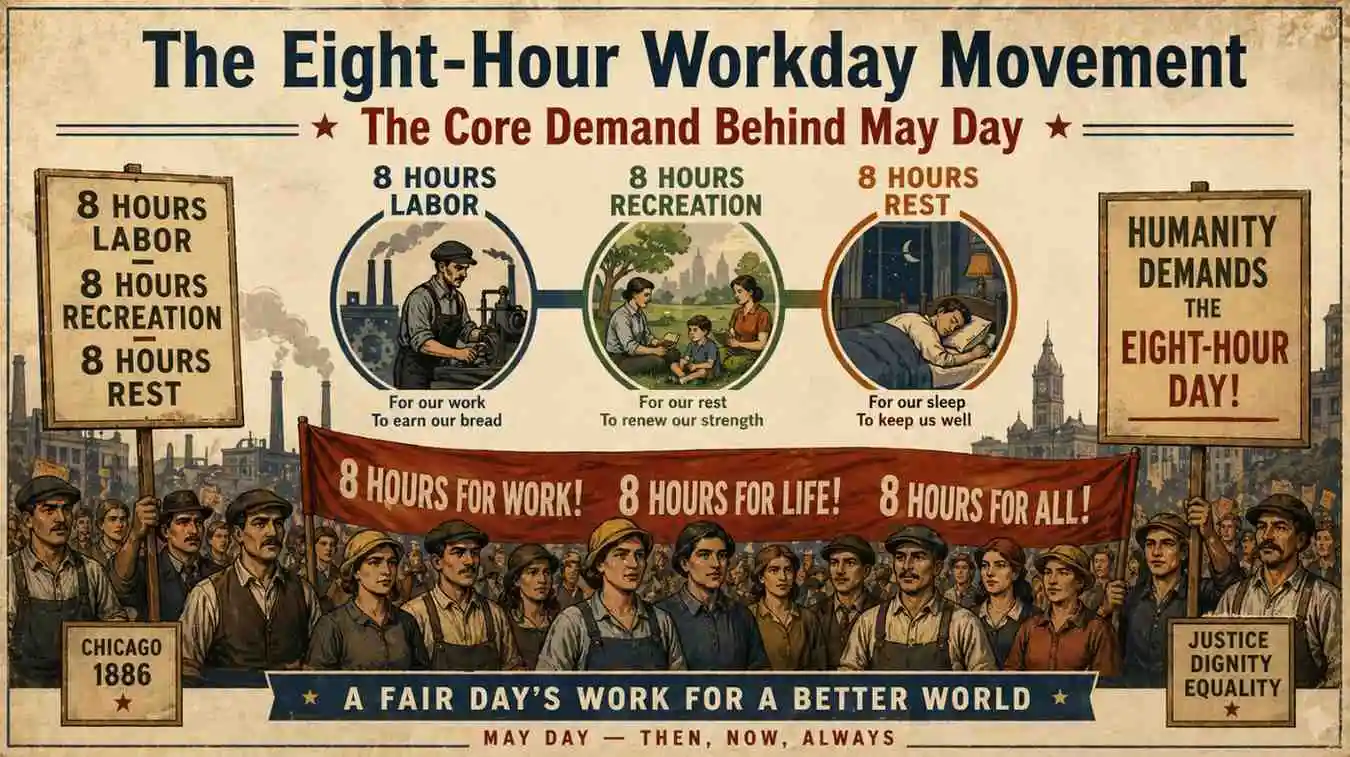
At the heart of every May Day protest — in 1886 and today — lies a deceptively simple demand: eight hours of work, eight hours of rest, eight hours of what you will. The slogan, popularised by Welsh social reformer Robert Owen as far back as the 1810s, expressed a revolutionary idea at the time: that a worker's time did not belong entirely to the person who paid them. The fight for the eight-hour day is one of the most sustained, consequential, and ultimately successful campaigns in the history of organised labour.
Before the eight-hour movement gained legal traction, 10 to 16-hour workdays were standard across the industrialised world. In textile mills, coal mines, and steel factories, workers had no legal right to rest breaks, no minimum wage, and no recourse if injured on the job. Fatigue-related industrial accidents were so common they were treated as an unremarkable feature of working life. Children worked alongside adults in the same brutal conditions.
The National Labour Union in the United States had pushed for eight-hour legislation as early as 1866. Some US government workers achieved the shorter day through legislation in 1868, but it remained largely unenforced in private industry. The breakthrough came gradually. Ford Motor Company's introduction of the eight-hour, five-day working week in 1914 — driven partly by Henry Ford's productivity research showing that rested workers produced more efficiently — helped shift corporate attitudes in America. The argument that worker welfare and business efficiency were compatible, not contradictory, turned out to be powerful with employers who had resisted on ideological grounds.
At the international level, the breakthrough was more decisive. The International Labour Organization, founded in 1919, made the eight-hour day one of its very first acts. ILO Convention No. 1 — Hours of Work (Industry) Convention, 1919 — enshrined the eight-hour day and 48-hour week as international standards. This placed the demand that workers had marched, struck, and died for over three decades into the framework of international law.
Today, the eight-hour day is legally mandated in most countries, though enforcement remains deeply uneven. Informal workers, domestic workers, agricultural workers, and most gig workers regularly work far beyond eight hours without legal protection or overtime pay. In India, the Factories Act, 1948, limits the working day to nine hours and the working week to 48 hours for factory workers — but these protections do not extend automatically to the hundreds of millions who work outside registered factories.
Key Takeaways:
- The eight-hour workday slogan — "8 hours labour, 8 hours recreation, 8 hours rest" — was articulated by Robert Owen as early as the 1810s, decades before Haymarket.
- Before the movement succeeded, 10 to 16-hour workdays were the industrial norm worldwide, with children working alongside adults.
- Ford Motor Company's 1914 adoption helped shift corporate thinking by demonstrating measurable productivity gains from shorter hours.
- The ILO's very first convention (1919) enshrined the eight-hour day in international labour law — a landmark achievement of the labour movement.
- The eight-hour standard remains unenforced for hundreds of millions of informal, gig, agricultural, and domestic workers globally.
Global Recognition — How the World Adopted May 1
The spread of May Day as a recognised day of labour solidarity is one of the fastest examples of cross-border cultural and political adoption in modern history. Within just two years of the Second International's 1889 declaration, May Day demonstrations were held across Europe, Latin America, and parts of Asia. Within a decade, it had become a fixture in the political calendars of socialist and trade union movements on every inhabited continent. The pace of this adoption is remarkable even by today's standards of viral spread — and it happened without the internet.
The Russian Revolution of 1917 gave May Day a particularly prominent position in global political culture. In the Soviet Union, May 1 became a grand state occasion — marked by massive military parades through Moscow's Red Square, attended by the entire Soviet leadership, and broadcast to the world as a display of socialist achievement and solidarity. This association with Soviet-style communist governance had two effects: it deepened May Day's significance in countries aligned with or sympathetic to the Soviet bloc, and it deepened Western liberal governments' discomfort with the occasion.
That discomfort had real political consequences. The United States and Canada retained their September Labour Day rather than adopting May 1, partly to avoid any identification with what Cold War-era officials called "communist agitation." The UK, while observing May Day informally for decades, did not make it a public holiday until 1978 — and even then, the decision was politically contested.
Today, May 1 is a national public holiday in over 160 countries, making it one of the most widely observed commemorations on earth. Countries as politically divergent as China, Cuba, Germany, Brazil, Kenya, South Korea, India, and Turkey all observe May Day — though the form the observance takes varies enormously. The ILO notes that the day cuts across political systems: democratic, authoritarian, market-capitalist, and state-socialist governments alike have found reasons to acknowledge it.
Key Takeaways:
- May Day spread rapidly after 1889 — reaching Europe, Latin America, and Asia within a decade, without modern communications infrastructure.
- Soviet adoption of May 1 as a grand state occasion gave it strong, lasting associations with communist governance that shaped Western attitudes.
- The US and Canada deliberately retained their September Labour Day to avoid socialist associations — a politically motivated divergence.
- Over 160 countries now observe May 1 as an official public holiday, making it one of the world's most geographically universal commemorations.
- The day cuts across political systems — democratic and authoritarian governments alike acknowledge it, though the form of observance differs dramatically.
International Workers' Day in India — Labour Day's Indian Journey
India's connection to International Workers' Day is both historic and deeply textured by its own social and political context. The country observed its first-ever Labour Day on May 1, 1923, in Madras (now Chennai) — making it one of the earliest nations in Asia to formally mark the occasion. The event was organised by the Labour Kisan Party of Hindustan, led by Comrade Singaravelu Chettiar, a pioneering Tamil labour leader, social reformer, and one of the earliest Indian intellectuals to engage seriously with Marxist thought while remaining rooted in the Indian classical tradition.
That 1923 celebration carried two distinctions that cemented its place in Indian history. First, it was the first occasion on which the red flag — now universally associated with the global labour movement — was officially hoisted in India. Second, it was held simultaneously at two locations in the city: Marina Beach and Triplicane Beach, to accommodate the large number of participants and to symbolise the democratic and inclusive spirit of the movement. Singaravelu's decision to hold the event publicly, in a colonial context where such assemblies carried significant legal and personal risk, was an act of profound political courage.
May Day Across Indian States
In several Indian states, May 1 carries a significance that goes beyond the labour movement. It also marks the formation anniversaries of Maharashtra and Gujarat — both carved out of the former Bombay State on May 1, 1960, following the successful Samyukta Maharashtra and Mahagujarat movements that demanded linguistically organised states. In Maharashtra, the day is known as Maharashtra Din (Maharashtra Day), and in Gujarat as Gujarat Day. This overlap means that in these two states, May Day carries simultaneously the weight of workers' rights history and the pride of regional statehood — a layering of meaning that is uniquely Indian.
In Kerala, Tamil Nadu, and West Bengal — states with historically powerful trade union cultures and strong Left political traditions — May Day is observed with particular intensity. Parties and unions affiliated with CITU (Centre of Indian Trade Unions), INTUC (Indian National Trade Union Congress), AITUC (All India Trade Union Congress), and other federations hold large-scale rallies, public meetings, and cultural programmes. In recent years, these platforms have been used to raise demands around minimum wage revision, implementation of India's four Labour Codes, social security for unorganised workers, and rights for gig and platform workers.
India's labour context gives May Day an urgency that is hard to overstate. The country is home to over 500 million workers in the informal or unorganised sector — among the largest informal workforces on earth. The vast majority of these workers have no access to formal labour law protections, no employer contribution to provident fund or health insurance, no paid leave, and no recourse to a labour tribunal. For them, May Day is not historical commemoration. It is a statement of what they do not yet have.
Key Takeaways:
- India's first Labour Day was celebrated on May 1, 1923, in Madras, organised by Comrade Singaravelu Chettiar of the Labour Kisan Party of Hindustan.
- It was the first time the red flag was hoisted in India — a landmark moment in the country's labour and political history.
- May 1 also marks the formation anniversaries of Maharashtra (Maharashtra Din) and Gujarat (Gujarat Day) since 1960, adding regional identity to the day's significance.
- Kerala, Tamil Nadu, and West Bengal have the country's most intense May Day observances, driven by powerful trade union cultures and Left political movements.
- India's 500+ million informal workers remain largely outside formal labour law protections, making May Day demands urgently contemporary rather than merely historical.
Legal Framework for Workers — Laws Born from Labour Struggles
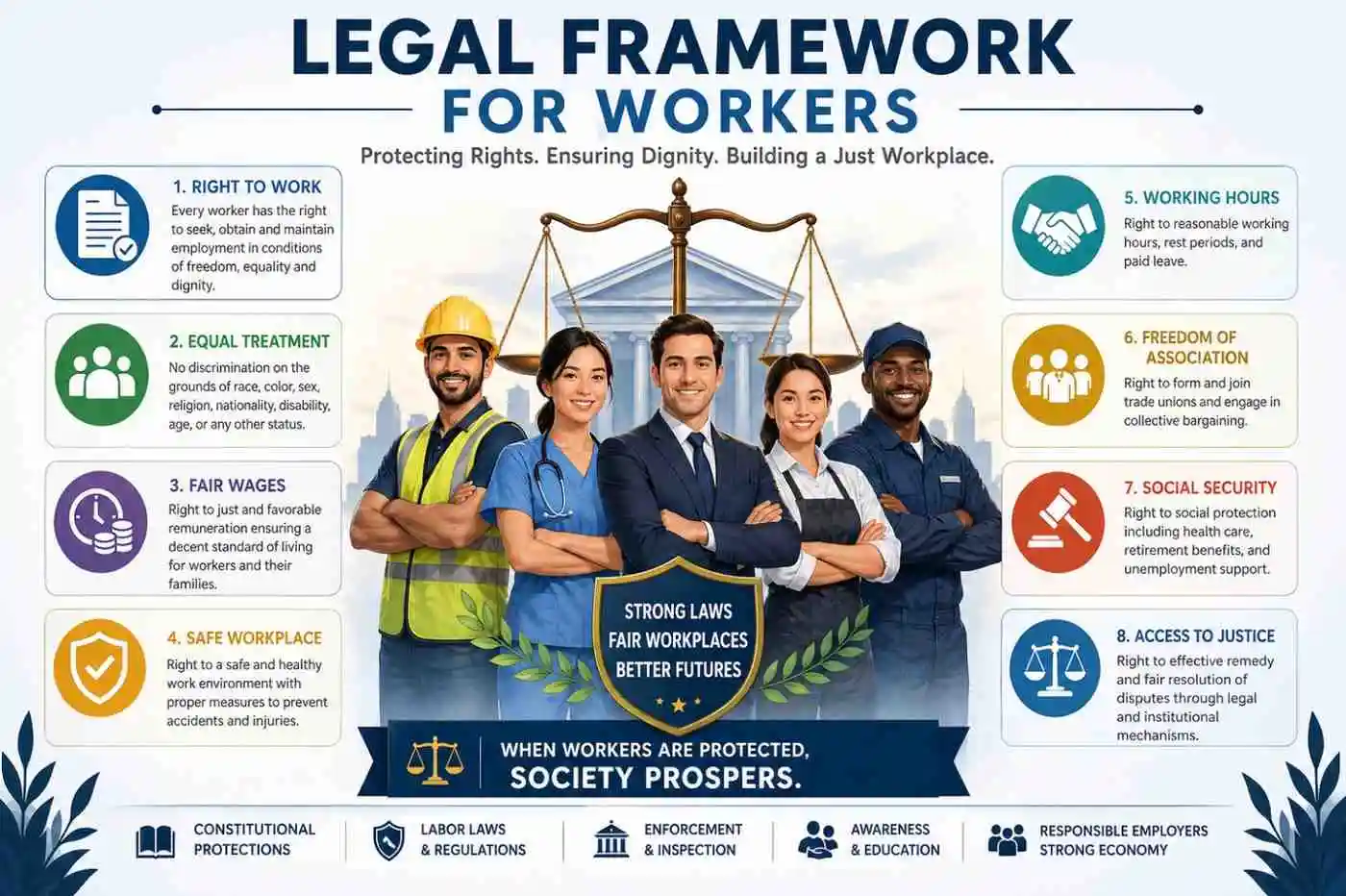
Every labour law on the books today carries the invisible signature of workers who once marched, struck, or were imprisoned to make it happen. The legal architecture protecting workers — from minimum wage statutes to occupational safety codes — did not emerge from the benevolence of governments or the enlightenment of corporate owners. It was built, piece by piece, through organised labour pressure over more than a century. Understanding this legal framework is essential to understanding what May Day actually achieved — and what it is still fighting to achieve.
International Legal Milestones
At the international level, the ILO has adopted over 190 conventions since its founding in 1919. The most foundational of these are the eight core conventions that together form the ILO Declaration on Fundamental Principles and Rights at Work, adopted in 1998. These eight conventions cover four areas: freedom of association and the right to collective bargaining (Conventions 87 and 98); the elimination of all forms of forced or compulsory labour (Conventions 29 and 105); the effective abolition of child labour (Conventions 138 and 182); and the elimination of discrimination in employment (Conventions 100 and 111). These conventions represent the absolute floor of labour rights — the minimum that the international community considers non-negotiable.
India's Labour Law Architecture
India's labour law framework is among the world's most extensive and, historically, among its most complex. For decades, the country operated under more than 44 central labour laws and hundreds of additional state-level laws — a system so fragmented that compliance was nearly impossible for small employers and enforcement was nearly impossible for the government. The result, paradoxically, was that a very elaborate legal structure coexisted with widespread non-compliance, particularly in the informal sector.
Between 2019 and 2020, the National Democratic Alliance government undertook a major consolidation, compressing the 44 central laws into four Labour Codes. The Code on Wages, 2019, established the concept of a universal minimum wage applicable across all sectors and employment types — a significant departure from the previous patchwork of sector-specific minimums. The Industrial Relations Code, 2020, governs trade unions, collective bargaining, and industrial disputes, while relaxing some conditions around retrenchment in larger establishments. The Code on Social Security, 2020, extends social security provisions to new categories of workers, including — for the first time in Indian legal history — gig workers and platform workers. The Occupational Safety, Health and Working Conditions Code, 2020, consolidates safety norms across industries.
The codes have been passed by Parliament but their implementation remains pending in most states as of 2024, due to complex rule-framing requirements and political considerations. Trade unions across the ideological spectrum have raised concerns that certain provisions — particularly those easing retrenchment conditions — could weaken protections for workers rather than strengthen them.
Key Takeaways:
- Labour laws globally emerged through sustained workers' movements, not through spontaneous government or corporate benevolence.
- The ILO's eight core conventions (under the 1998 Declaration) form the absolute global minimum for labour rights: association, bargaining, no forced labour, no child labour, no discrimination.
- India's four Labour Codes (2019–2020) replaced 44+ central labour laws in the most significant consolidation of Indian labour law in independent history.
- The Code on Social Security, 2020, is historically significant for defining and extending social security coverage to gig and platform workers for the first time.
- Implementation of the new Labour Codes is still pending in most Indian states as of 2024, with trade union concerns about certain provisions ongoing.
The International Labour Organization — The Global Guardian of Workers
The International Labour Organization is the only United Nations agency built on a tripartite structure — meaning its governance includes not just governments, but employers' organisations and workers' representatives in equal and formal measure. Every major decision at the ILO involves all three. This structure was revolutionary when it was established in 1919 as part of the Treaty of Versailles — the document that formally ended World War I — and it remains distinctive within the global institutional architecture today.
The ILO was founded on a foundational insight: that lasting peace requires social justice. As its Constitution states explicitly, "universal and lasting peace can be established only if it is based upon social justice." The post-war architects who created the ILO understood that the revolutionary pressure that had exploded in Russia in 1917 and threatened to spread across Europe was driven significantly by the desperate conditions of industrial workers. The ILO was, in part, a strategic response to that pressure — an attempt to reform capitalism enough to prevent it from being overthrown.
The ILO's mandate today covers an enormous range: setting international labour standards through conventions and recommendations, promoting decent work globally, supporting the extension of social protection systems, conducting research and publishing global labour data, and facilitating tripartite dialogue between governments, employers, and workers. Its Decent Work Agenda, articulated in 1999, frames four strategic pillars around which global labour policy should be organised: employment creation, rights at work, social protection, and social dialogue. These four pillars remain the central framework for ILO programming and are referenced extensively in national labour policy documents, including India's.
According to the ILO's World Employment and Social Outlook reports, global labour force participation has not fully recovered to pre-COVID-19 levels in many regions. Labour income inequality — the share of national income going to workers as wages versus the share going to owners as profits — has widened in most major economies over the past two decades. The ILO estimates that approximately 2 billion people worldwide work in the informal economy, without formal contracts, legal protections, social security coverage, or stable incomes. This number — two billion — is the most important single statistic for understanding why May Day's agenda remains radically incomplete.
Key Takeaways:
- The ILO is the only UN agency with tripartite governance — governments, employers, and workers each hold formal, equal representation.
- It was founded in 1919 with the conviction that social justice is a structural precondition for lasting international peace.
- Its Decent Work Agenda (1999) organises global labour policy around four pillars: employment creation, rights at work, social protection, and social dialogue.
- Approximately 2 billion people globally work in the informal economy without basic legal protections or social security — the central challenge of 21st-century labour rights.
- The ILO's conventions, while not automatically legally binding, set the international standards that national laws are expected to reflect and progressively implement.
Labour Day vs Workers' Day — Why the US and Canada Celebrate Differently
One of the most commonly asked questions about May Day is a deceptively simple one: why do the United States and Canada celebrate Labour Day in September rather than May 1? The answer is both historically specific and politically revealing. It is a story of deliberate divergence, Cold War anxieties, and the power of governments to shape public memory by deciding which holidays to institutionalise and which to quietly sideline.
The US and Canadian Labour Day, observed on the first Monday of September, predates the global May Day tradition by only a few years. Canadian trade unions had been organising September parades since 1872. The US Congress made Labour Day a federal holiday in 1894 — a decision signed into law by President Grover Cleveland just six days after his administration deployed federal troops to crush the Pullman Strike in Chicago, a violent intervention that killed approximately 30 workers. The timing was not coincidental. By offering workers a sanitised, government-approved "Labour Day" in September, Cleveland was attempting both a political gesture toward workers and a quiet burial of the May 1 tradition, with its associations with anarchism, socialism, and the Haymarket dead.
The strategy largely worked within US and Canadian borders. Through the first half of the 20th century — and especially during the Cold War era, when association with communist movements was politically and professionally toxic — May Day in the United States was viewed with deep suspicion by mainstream political culture. American unions affiliated with the AFL-CIO (American Federation of Labor and Congress of Industrial Organizations) largely embraced the September holiday and kept their distance from international May Day politics.
The result is a striking global divergence. May 1 is a day of marches, political demands, and worker solidarity across Europe, Asia, Latin America, and Africa. In the United States and Canada, the first Monday of September is primarily the unofficial end of summer — associated with barbecues, back-to-school shopping, and the final long weekend before autumn. The political content has been largely drained from the occasion.
Key Takeaways:
- The US and Canada observe Labour Day on the first Monday of September — a deliberate political choice to avoid identification with the socialist May Day tradition.
- The US September holiday was signed into law in 1894 just days after federal troops crushed the Pullman Strike — a gesture of political management rather than genuine labour solidarity.
- The Cold War deepened American discomfort with May Day, associating it with communist movements rather than general workers' rights advocacy.
- May Day globally retains a strong protest and political demands character; US Labour Day has become primarily a consumer and end-of-summer holiday.
- Over 160 countries follow the May 1 tradition; only two major liberal democracies observe a separate September Labour Day.
How International Workers' Day is Celebrated Around the World
The form that May Day takes varies enormously across the globe — from solemn candlelight vigils to thunderous street marches to state-televised military parades. What unites all these forms is the acknowledgement of a common truth: that labour is the foundation of human civilisation, and those who labour deserve recognition, respect, and rights.
In Western Europe, May Day retains its character as an active platform for trade union advocacy. In Germany, the country's largest trade union federation, the DGB, organises rallies in every major city. Speeches focus on current issues — minimum wage levels, pension reform, conditions in the gig economy. In France, the tradition of gifting lily of the valley flowers on May 1 coexists with major trade union marches through Paris. In Italy and Spain, labour confederations coordinate national demonstrations that frequently draw hundreds of thousands of participants.
In countries with socialist or communist governance traditions, May Day takes on a state character. Cuba holds mass rallies at Havana's Revolution Square, attended by hundreds of thousands. Vietnam observes the day with state-organised events and patriotic programming. China's May Day is the launchpad for its Golden Week holiday — a seven-day national break that generates hundreds of millions of domestic journeys and is one of the world's largest annual movements of people. The labour rights dimension of the occasion is somewhat subsumed in China by the tourism and consumer spending focus of the Golden Week.
In Latin America, May Day has historically been one of the most politically charged occasions of the civic calendar. In Brazil, presidents have traditionally used May 1 to announce new social welfare programmes and minimum wage revisions — recognising the political significance of the audience. In Chile, which witnessed the brutal suppression of labour movements under the Pinochet dictatorship from 1973 to 1990, May Day carries an element of mourning and historical reckoning alongside the celebration. In Mexico City, union marches involving millions of workers have become among the most photographed civic events in the country.
In India, the character of May Day observance varies sharply by state. In Kerala, Tamil Nadu, and West Bengal — where trade union culture is deepest — public meetings, rallies, and political speeches dominate the day. In Maharashtra and Gujarat, May Day doubles as Maharashtra Din and Gujarat Day, adding regional cultural celebrations to the labour solidarity observance. In states with weaker union cultures and dominant informal economies, May Day passes with less visible public marking.
Key Takeaways:
- In Western Europe, May Day is an active platform for trade union advocacy on current issues — wages, pensions, gig economy conditions.
- In socialist-governed countries (Cuba, Vietnam, China), May Day takes on a state character with organised, government-associated events.
- In Latin America, May Day is deeply politically charged — used by presidents to announce social measures, and carrying historical memory of labour movement repression.
- In India, the most intense observances are in Kerala, Tamil Nadu, and West Bengal, with Maharashtra and Gujarat adding regional statehood celebrations.
- The global diversity of May Day observance reflects how different political histories produce different relationships with the labour movement's legacy.
Challenges Workers Still Face — The Unfinished Agenda
If the labour movement's work were done, there would be no need for May Day marches. The reality, 139 years after the Haymarket Affair, is that the promises embedded in International Workers' Day remain only partially fulfilled for hundreds of millions of workers worldwide. The challenges that confront workers today are both old — poverty wages, unsafe workplaces, child labour — and genuinely new — algorithmic management, platform work, and climate-related job displacement. Recognising both is essential to understanding what May Day means in the 21st century.
Wage Inequality and the Living Wage Gap
Global wage growth has persistently lagged behind productivity growth over the past two decades. Workers are producing more value per hour worked than ever before in history, yet their real wages — adjusted for inflation — have stagnated or declined in many countries and sectors. The gap between the highest and lowest earners within countries has widened dramatically. ILO data consistently shows that the labour income share — the proportion of national income going to workers as wages — has declined in most major economies since the 1980s, while the capital income share going to owners as profits has increased correspondingly.
In India, real wage growth for informal workers has remained sluggish even as corporate profits recovered strongly after the COVID-19 pandemic. The Economic Survey 2023 acknowledged this divergence. The minimum wage in many Indian states — particularly for agricultural and domestic workers — remains below any reasonable definition of a living wage: an income sufficient to cover basic needs for a worker and their family.
Occupational Safety and Workplace Deaths
The ILO estimates that approximately 2.3 million workers die from work-related causes every year. This figure includes fatalities from industrial accidents, but also — and this is less discussed — the slow deaths caused by occupational diseases. Silicosis from mining, asbestosis from insulation and construction work, cancer from chemical exposure, hearing loss from industrial noise. Construction, agriculture, and mining remain the three most dangerous sectors globally, and they also happen to be sectors where informal employment is most prevalent and regulatory enforcement is most inconsistent.
In India, construction site fatalities and chemical plant accidents regularly make news without triggering systemic regulatory response. The Vizag gas leak of 2020, the Bhilai steel plant accidents, and numerous construction site collapses illustrate how occupational safety remains a gap between legal standards and practical reality.
Child Labour and Forced Labour
The ILO's 2022 Global Estimates on Child Labour found that 160 million children were engaged in child labour globally — a number that had increased by approximately 8 million since 2016, reversing a decade of progress. COVID-19's economic disruptions pushed millions of families into deeper poverty, driving children back into work to supplement household incomes. Girls are disproportionately pushed into domestic child labour, which is among the hardest to detect and regulate.
Forced labour is another dimension of the unfinished agenda. The ILO estimates that 27.6 million people globally are in conditions of forced labour — working under coercion, threat, or deception with no ability to leave without penalty. Domestic work, manufacturing supply chains, agricultural supply chains (particularly in cocoa, coffee, and cotton production), and construction are the sectors with the highest forced labour concentration.
Key Takeaways:
- Global wage growth has lagged behind productivity gains for decades, with the labour income share declining in most major economies since the 1980s.
- An estimated 2.3 million workers die from work-related causes annually — occupational safety remains critically underfunded and underenforced globally.
- 160 million children are in child labour globally (ILO, 2022) — a number that increased during the COVID-19 pandemic, reversing years of previous progress.
- 27.6 million people are in forced labour worldwide, concentrated in domestic work, manufacturing, and agricultural supply chains.
- India's 500+ million informal workers remain largely outside the formal labour law safety net, making these challenges acutely pressing domestically.
The Gig Economy and Workers' Rights — May Day's New Battleground
The most consequential challenge to the labour movement in the first decades of the 21st century may not come from a factory floor or a coal mine. It comes from an app. The rise of the gig economy — encompassing platform workers such as ride-hailing drivers, food delivery agents, freelance designers, short-task workers, and remote contractors operating through digital platforms — has created a new and rapidly growing class of workers who are structurally excluded from the very protections that May Day's history fought to establish.
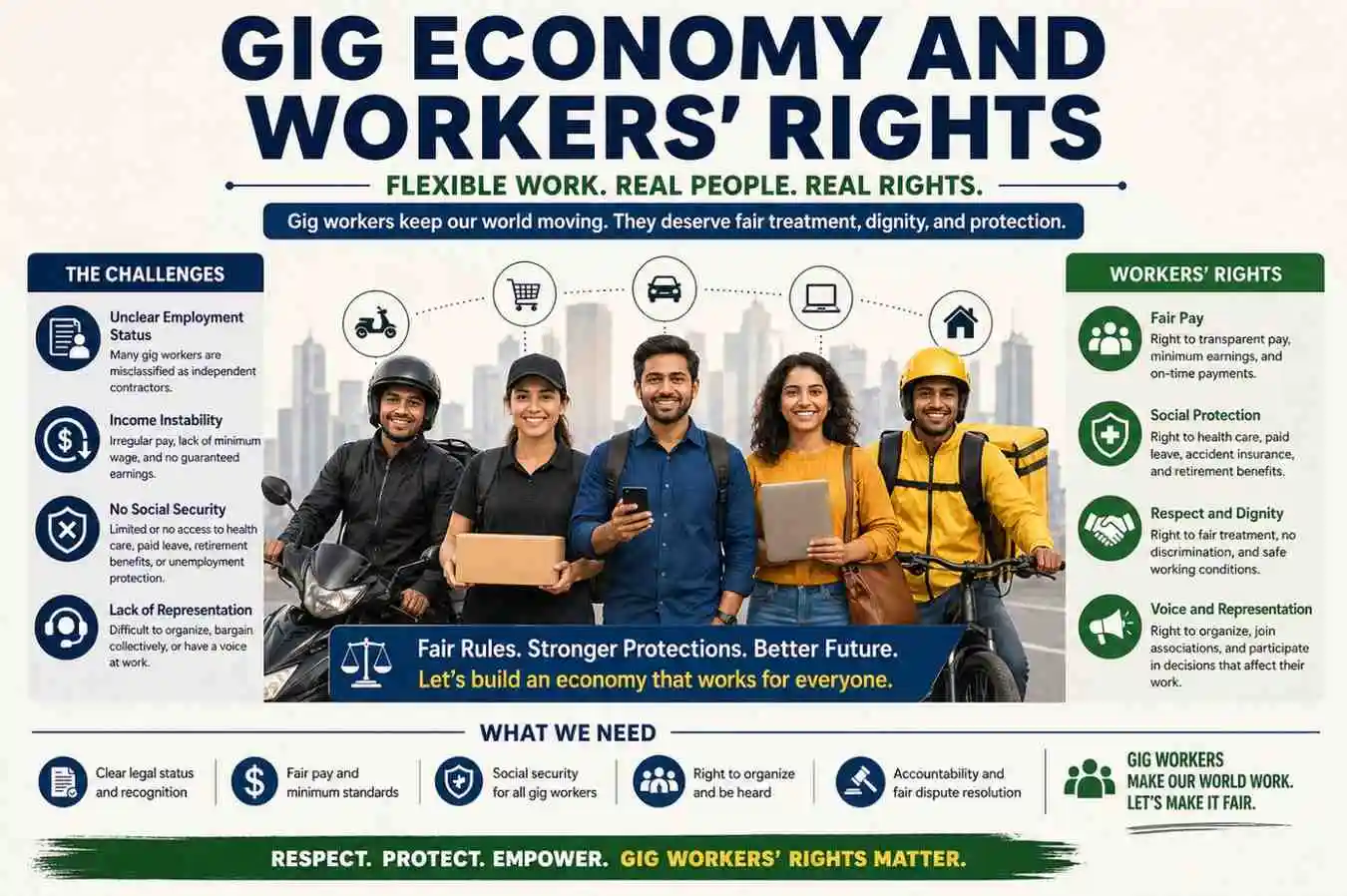
Platform companies universally classify their workers as "independent contractors" rather than employees. This single classification decision has enormous legal consequences. As independent contractors, gig workers typically receive no minimum wage guarantee for their hours (only a piece-rate for completed tasks), no employer contribution to provident fund or pension, no paid sick leave or annual leave, no employer-provided health insurance, and no right to collective bargaining or trade union membership. They bear the full financial risk of their work — the cost of their vehicle, fuel, phone, data plan, and any health consequences of their labour — while the platform extracts a commission or fee from every transaction they complete. Critics of this model argue, with considerable force, that it is not genuine entrepreneurship but rather a digital reinvention of precarious labour, stripped of the protections that previous generations of workers died to establish.
India is one of the world's largest and fastest-growing gig economies. The NITI Aayog's 2022 report, titled India's Booming Gig and Platform Economy, estimated that India had 7.7 million gig workers in 2020–21, a number projected to reach 23.5 million by 2029–30. Gig work in India spans a wide spectrum — from relatively high-income freelance software developers and graphic designers to low-income delivery workers and domestic task workers who earn piece-rates with no income floor.
For the first time in Indian legal history, the Code on Social Security, 2020, formally defines the terms "gig worker" and "platform worker" in statute. It also creates the legal basis for extending social security benefits — including life and disability insurance, health and maternity benefits, and old age protection — to gig workers. However, as of 2024, the specific rules governing how this will be funded, administered, and accessed have not been finalised in most states. The promise of the code remains unrealised for the millions it was designed to protect.
Globally, courts and legislatures are beginning to push back against the independent contractor model. In the United Kingdom, a landmark 2021 Supreme Court ruling held that Uber drivers are "workers" (an intermediate legal category under UK law) rather than independent contractors — entitling them to minimum wage, holiday pay, and pension contributions. France, Spain, and several other European jurisdictions have seen similar reclassification decisions. Most significantly, the European Union's Platform Work Directive, finalised in 2024, establishes a legal presumption of employment status for platform workers — meaning that platforms must affirmatively prove their workers are genuinely independent contractors, reversing the previous burden. This is potentially the most significant global legal development for gig workers' rights since the ILO conventions of 1919.
Key Takeaways:
- Gig workers, classified as independent contractors, are structurally excluded from minimum wage guarantees, paid leave, provident fund, health insurance, and the right to unionise.
- India has 7.7 million gig workers (2020–21), projected to reach 23.5 million by 2029–30 (NITI Aayog, 2022).
- India's Code on Social Security, 2020, defines gig and platform workers in law for the first time, creating a basis for extending social security — but implementation rules remain pending.
- The UK Supreme Court ruled in 2021 that Uber drivers are "workers" entitled to minimum wage and holiday pay — a major precedent.
- The EU's Platform Work Directive (2024) establishes a legal presumption of employment for platform workers — the most significant global gig economy legal development in decades.
Future Outlook — Where Labour Rights Are Heading
The labour movement was born in an era of steam engines and factory whistles. It now faces a future defined by machine learning algorithms, climate disruption, and the collapse of traditional employment relationships. The challenges ahead are unlike anything that the founders of May Day could have anticipated. Yet the core questions they asked remain stubbornly, urgently relevant: Who captures the gains from new technologies? Who bears the risks? What do those who organise production owe to those who do the actual work?
Automation and the Future of Employment
A World Economic Forum Future of Jobs Report estimated that automation and artificial intelligence could displace tens of millions of jobs globally over the coming decade — particularly in manufacturing, logistics, data entry, and customer service — while simultaneously creating new roles in technology, green energy, and care work. The challenge is not simply the net number of jobs created versus destroyed; it is the distribution of those gains and losses. New jobs will cluster in high-skill, high-education categories in urban centres. Displaced jobs will disproportionately affect low-wage, lower-education workers in regions where alternative employment options are scarce.
For the labour movement, the automation challenge demands new policy frameworks: robust retraining and lifelong learning systems, portable social security that follows workers across jobs rather than being tied to a single employer, and potentially some form of redistribution of the productivity gains from automation — through mechanisms that range from strengthened corporate taxation to universal basic income models.
Climate Change and the Just Transition
Decarbonising the global economy — the process of shifting away from fossil fuels that is necessary to address climate change — will eliminate millions of jobs in coal mining, oil and gas extraction, petro-chemical manufacturing, and combustion engine production. These are not abstract numbers; they are communities, often entire towns in regions like the US Rust Belt, Germany's Rhine valley, or India's coal belt states in Jharkhand, Odisha, and Chhattisgarh, that have been economically organised around a single industry for generations.
The concept of "just transition" — ensuring that workers and communities in carbon-intensive industries are not left behind as the economy decarbonises — has become a central framework in both labour rights and climate policy discussions. The ILO's Guidelines for a Just Transition (2015), the Paris Agreement's preamble, and the European Union's Just Transition Mechanism all acknowledge that climate action and workers' rights must be pursued together, not in opposition. India's coal sector alone employs hundreds of thousands of direct workers and millions more in ancillary services — making a just transition plan not a luxury but a social stability necessity.
Universal Social Protection
Perhaps the most important policy frontier for labour rights in the coming decade is extending social protection to the informal economy at scale. The ILO's Social Protection Floor Initiative calls for a minimum level of social security for every person — including access to healthcare, income support during illness and old age, and maternity protection — regardless of their employment type or sector. As of recent ILO data, only 47 percent of the global population has access to at least one form of social protection benefit. The remaining 53 percent — disproportionately concentrated in low- and middle-income countries, in informal employment, and among women — are one health emergency, one bad harvest, or one employer bankruptcy away from destitution.
For India, extending social protection to its informal sector is arguably the defining labour policy challenge of the next decade. The mechanisms being discussed include universal health coverage through Ayushman Bharat, portable social security accounts linked to Aadhaar, and the operationalisation of the gig worker provisions under the Code on Social Security, 2020.
Key Takeaways:
- Automation may reshape employment patterns dramatically — the challenge is distributing gains equitably and supporting displaced workers through retraining and portable social security.
- "Just transition" — protecting workers in carbon-intensive industries as economies decarbonise — is an emerging framework where climate policy and labour rights must be addressed together.
- Only 47 percent of the global population currently has access to any form of social protection — extending this is the defining frontier of 21st-century labour rights.
- India's coal sector employs hundreds of thousands directly; a credible just transition plan is essential as decarbonisation policy advances.
- The labour movement's future relevance will depend on how effectively it adapts its demands and organising strategies to address gig work, automation, and climate transition simultaneously.
Frequently Asked Questions
1. Why is May 1 celebrated as International Workers' Day?
May 1 was chosen in memory of the Haymarket Affair of 1886 in Chicago, where workers striking for an eight-hour workday were met with police violence that shocked the industrialised world. The Second International — a global coalition of socialist and labour parties — formally declared May 1 as International Workers' Day in 1889, with the first global observance on May 1, 1890. The date has since become one of the most widely observed commemorations globally, marking both the sacrifices of past labour movements and the ongoing demands of workers worldwide. Over 160 countries now observe it as a public holiday.
2. When did India first celebrate Labour Day, and who organised it?
India first celebrated Labour Day on May 1, 1923, in Madras (now Chennai). It was organised by Comrade Singaravelu Chettiar of the Labour Kisan Party of Hindustan. The occasion was historically significant for two reasons: it was the first time the red flag was officially hoisted in India, and it was held simultaneously at two locations — Marina Beach and Triplicane Beach — to accommodate large public participation. Singaravelu's decision to hold the event publicly in colonial India, where such assemblies carried significant legal and personal risk, marked a foundational moment in India's labour history.
3. Is there a difference between Labour Day and International Workers' Day?
In most countries, Labour Day and International Workers' Day refer to the same May 1 observance and are used interchangeably. The significant exception is the United States and Canada, which observe their own Labour Day on the first Monday of September. This September holiday has a different historical origin and a more celebratory, less explicitly political character. The US and Canadian governments deliberately retained the September holiday in the late 19th century to avoid association with the socialist and internationalist May Day tradition. Outside the US and Canada, May 1 is the universal reference date for labour commemoration.
4. Is it a misconception that May Day was created by communists?
Yes, this is a widespread and significant misconception. International Workers' Day originated from events in the United States — specifically the American labour movement's campaign for an eight-hour workday and the Haymarket Affair of 1886. The socialist Second International formalised the date in 1889, but the movement itself was a broad-based workers' rights campaign that included trade unionists of many political persuasions. The Soviet Union's later adoption of May Day as a grand state occasion contributed to the false equation of May Day with communism specifically. In reality, May Day predates the founding of the Soviet Union by over three decades and originated in one of the world's most ardently capitalist countries.
5. What is the significance of May 1 for Maharashtra and Gujarat specifically?
Beyond being International Workers' Day, May 1 is also the formation anniversary of both Maharashtra and Gujarat. Both states were carved out of the former Bombay State on May 1, 1960, following successful regional movements — the Samyukta Maharashtra movement and the Mahagujarat movement — that demanded linguistically organised states in post-independence India. Maharashtra observes the day as Maharashtra Din, and Gujarat as Gujarat Day, with regional cultural celebrations adding to the labour solidarity observance. This layering of meanings makes May 1 one of the most symbolically dense dates in the Indian civic calendar.
6. What are India's four Labour Codes and why are they important?
India's four Labour Codes — the Code on Wages (2019), the Industrial Relations Code (2020), the Code on Social Security (2020), and the Occupational Safety, Health and Working Conditions Code (2020) — consolidated over 44 central labour laws into a streamlined framework. The most historically significant is the Code on Social Security, 2020, which for the first time in Indian legal history formally defines gig workers and platform workers and creates a legal basis for extending social security protections to them. These codes are important for UPSC Mains answers on labour reform, governance, and economic development. As of 2024, implementation remains pending in most states.
7. How does the gig economy challenge traditional labour rights frameworks?
Gig economy platforms classify workers as independent contractors rather than employees, which removes their entitlement to minimum wage guarantees, paid leave, employer provident fund contributions, health insurance, and collective bargaining rights. Workers bear all operational risks while platforms extract fees from every transaction. India's NITI Aayog projects the gig workforce could reach 23.5 million by 2029–30, making this one of the country's most pressing labour policy challenges. Courts in the UK, France, and Spain have begun reclassifying platform workers as employees. The EU's Platform Work Directive (2024) creates a legal presumption of employment for platform workers — a landmark development that may influence global regulatory frameworks.
Conclusion
International Workers' Day is not merely a holiday — it is a living historical argument. It argues that human dignity does not stop at the factory gate. That the person who builds your house, delivers your food, mines the coal that powers your city, or writes the code that runs your phone deserves not just wages, but safety, security, and respect. The International Workers' Day history and significance traced through this article connects Chicago's Haymarket Square in 1886 to Chennai's Marina Beach in 1923 to the legislative chambers where India's Labour Codes were debated in 2019 and 2020 — and to the delivery riders navigating traffic today with no minimum wage guarantee and no sick leave. The thread is unbroken.
Five things to carry from this article: first, labour rights are not given — they are won, at significant cost. Second, the eight-hour day was once a radical demand and is now considered common sense — which tells you something important about how radical demands age. Third, India's own labour movement has deep and proud roots, and the 1923 Madras celebration deserves far more recognition than it typically receives. Fourth, the gig economy represents a 21st-century regression toward the precarious labour conditions that previous generations spent a century organising against — and it demands a 21st-century legal and political response. Fifth, the ILO's framework — imperfect as any international institution must be — remains the best global tool available for advancing the dignity of those who work.
Watch two things in the coming years to track the actual direction of labour rights in India: whether the four Labour Codes' implementation gathers momentum in state capitals, and whether the social security provisions for gig workers move from legislative text to practical reality. Those two developments will tell you more about the future of May Day's promise than any parade or speech.