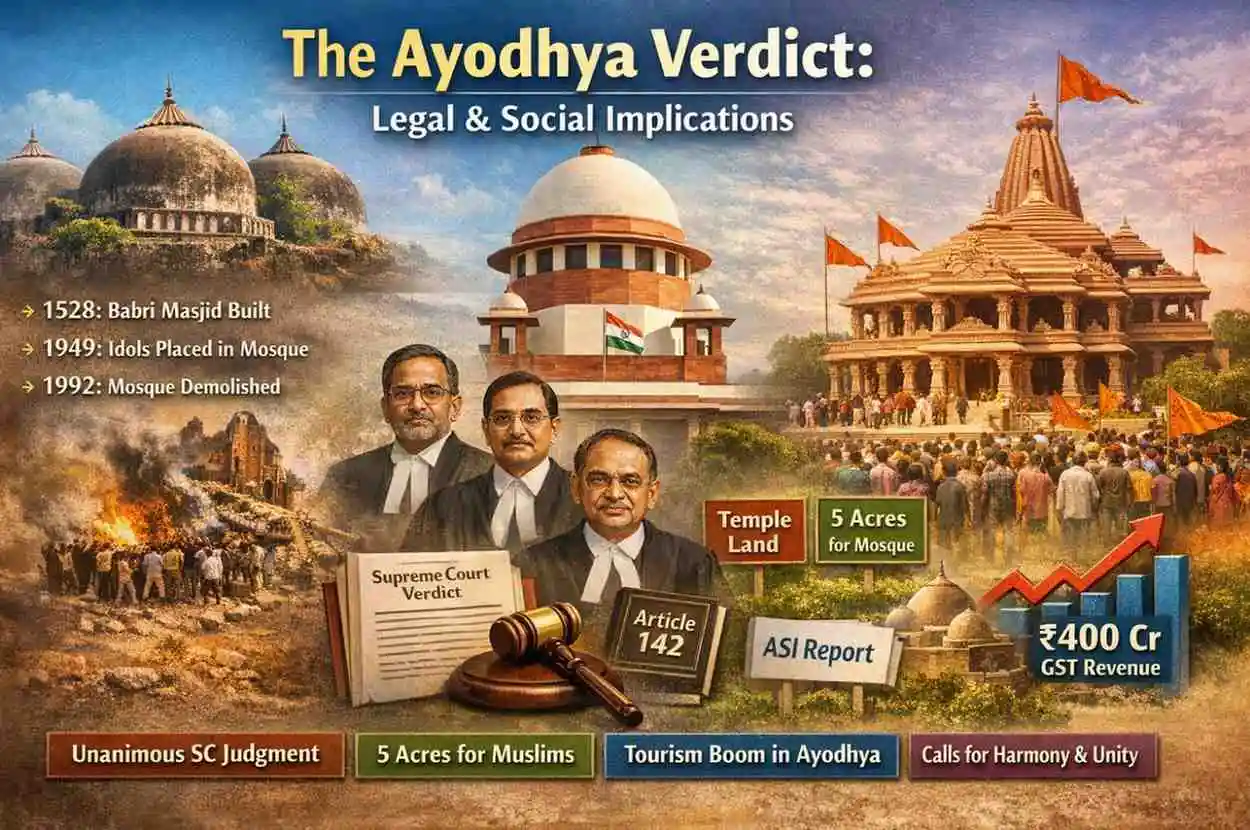
The Ayodhya dispute has long stood as one of India’s most complex and emotionally charged legal battles, intertwining history, religion, and constitutional law. The final judgment delivered by the Supreme Court of India in November 2019 marked a decisive moment in resolving a conflict that spanned centuries. At its core, the case revolved around a contested site in Ayodhya, believed by many Hindus to be the birthplace of Lord Ram and previously occupied by the Babri Masjid.
This verdict was not merely a legal resolution; it carried deep social, political, and economic implications. By addressing historical grievances while attempting to uphold constitutional principles, the judgment reshaped public discourse and influenced India’s trajectory in multiple dimensions.
Historical Background of the Dispute
The Ayodhya conflict traces its origins back to the 16th century, making it one of the longest-running disputes in Indian history. The construction of the Babri Masjid in 1528 under the Mughal Empire laid the foundation for competing claims over the land. Over time, religious sentiments and historical narratives contributed to the intensification of the dispute.
The first legal intervention occurred in 1885, when Mahant Raghubar Das sought permission to build a temple near the mosque. Although the request was denied, it marked the beginning of formal legal proceedings. The situation escalated dramatically in 1949 when idols of Lord Ram were placed inside the mosque, leading to its closure and a prolonged legal battle.
The demolition of the Babri Masjid in 1992 represented a turning point, sparking nationwide unrest and deepening communal divisions. This event underscored the urgent need for judicial resolution, ultimately leading to decades of litigation culminating in the Supreme Court verdict.
-
1528: Construction of Babri Masjid by Mir Baqi
-
1885: First legal suit by Mahant Raghubar Das
-
1949: Idols placed inside the mosque structure
-
1992: Demolition leading to nationwide riots
-
Long-standing legal battles culminating in 2019 judgment
Key Legal Milestones Leading to the Verdict
The legal journey of the Ayodhya case involved multiple courts, extensive evidence, and competing claims from various parties. One of the most significant milestones was the 2010 judgment by the Allahabad High Court, which proposed a three-way division of the disputed land among the Sunni Waqf Board, Nirmohi Akhara, and Ram Lalla.
While this decision attempted to balance interests, it was challenged by all parties, leading to an appeal in the Supreme Court. The apex court undertook a comprehensive review of historical records, legal claims, and archaeological findings before delivering its final judgment in 2019.
This long legal process demonstrated the judiciary’s role in addressing sensitive issues while maintaining constitutional integrity. It also highlighted the challenges of adjudicating disputes involving faith and historical narratives.
-
2010: Allahabad High Court orders land division
-
Appeals filed by all parties involved
-
Extensive hearings and examination of evidence
-
Final resolution delivered by the Supreme Court
The 2019 Supreme Court Verdict
The 2019 judgment stands as a landmark decision in Indian legal history. Delivered unanimously by a five-judge Constitution Bench, the verdict sought to provide a definitive resolution to the dispute. Spanning over 1,000 pages, it carefully analyzed legal principles, historical evidence, and constitutional provisions.
The court awarded the entire disputed 2.77-acre land to the deity Ram Lalla Virajman, recognizing it as a juridical entity. At the same time, it directed the government to allocate five acres of alternative land to the Sunni Waqf Board for the construction of a mosque. This dual approach aimed to ensure fairness while acknowledging competing claims.
The invocation of Article 142 allowed the court to exercise extraordinary powers to achieve “complete justice,” including granting representation to the Nirmohi Akhara in the temple trust.
-
Unanimous verdict by a five-judge bench
-
Entire disputed land awarded for temple construction
-
Alternative land allocated for mosque
-
Use of Article 142 for equitable resolution
-
Recognition of Ram Lalla as a legal entity
Role of Archaeological Evidence
A critical component of the court’s decision was the report submitted by the Archaeological Survey of India (ASI). The findings indicated the presence of a pre-existing non-Islamic structure beneath the mosque, which influenced the court’s conclusions.
However, the judgment carefully noted that archaeological evidence alone could not determine ownership. Instead, it was considered alongside historical records, testimonies, and legal arguments. This balanced approach reflected the court’s attempt to base its decision on a combination of empirical evidence and legal reasoning.
The reliance on ASI findings sparked debate among scholars and critics, highlighting the complexities of interpreting historical evidence in legal contexts.
-
ASI report suggested pre-existing structure
-
Evidence used in conjunction with legal arguments
-
Not the sole basis for the verdict
-
Generated debate on interpretation of history
Constitutional and Legal Implications
The Ayodhya verdict has far-reaching implications for constitutional law in India. It reaffirmed the judiciary’s authority to resolve disputes involving religious sentiments while upholding the rule of law. By invoking Article 142, the court demonstrated its ability to deliver equitable outcomes in complex cases.
The judgment also addressed the illegality of the 1992 demolition, explicitly stating that it was a violation of the law. This acknowledgment reinforced the principle that unlawful actions cannot be legitimized, even if subsequent developments favor a particular outcome.
Furthermore, the case set important precedents regarding the treatment of religious entities as legal persons and the role of evidence in disputes involving faith.
-
Strengthened judicial authority in sensitive cases
-
Reinforced rule of law and constitutional values
-
Recognized illegality of the 1992 demolition
-
Set precedents for future legal disputes
Social Impact and Public Sentiment
The social impact of the Ayodhya verdict was immediate and widespread. Public reactions varied across communities, reflecting a mix of relief, acceptance, and criticism. An analysis of social media data indicated a notable shift toward positive emotions such as trust and optimism following the judgment.
For many, the verdict represented closure to a long-standing conflict. However, others viewed it as raising concerns about secularism and minority rights. Despite differing opinions, the peaceful response across the country was widely seen as a positive outcome.
The judgment also influenced public discourse, encouraging discussions on unity, coexistence, and the role of the judiciary in addressing sensitive issues.
-
Mixed but largely peaceful public reactions
-
Increase in positive sentiment post-verdict
-
Ongoing debates on secularism and justice
-
Encouraged dialogue on national unity
Economic Transformation of Ayodhya
One of the most visible outcomes of the verdict has been the economic transformation of Ayodhya. Following the construction and opening of the Ram temple in January 2024, the city experienced a dramatic surge in tourism.
Visitor numbers skyrocketed from approximately 1.7 lakh annually to over 11 crore within six months. This influx of pilgrims and tourists has significantly boosted local businesses, infrastructure development, and employment opportunities.
The rise in GST collections, reportedly reaching around ₹400 crore, highlights the economic revival triggered by increased activity in the region. Ayodhya is rapidly emerging as a major religious tourism hub, contributing to regional and national economic growth.
-
Massive increase in tourist footfall
-
Growth in local businesses and infrastructure
-
Significant rise in tax revenue
-
Emergence as a key pilgrimage destination
Religious Harmony and Continuing Debates
The Ayodhya verdict aimed to achieve judicial closure while promoting social harmony. By providing land for both a temple and a mosque, the court sought to balance competing religious interests. However, the decision also sparked ongoing debates about its broader implications.
Critics argue that the judgment may reflect a shift toward majoritarian perspectives, raising questions about the protection of minority rights. Supporters, on the other hand, view it as a pragmatic solution that acknowledges historical realities while fostering peace.
The long-term impact on communal relations will depend on how society interprets and builds upon the verdict. Efforts to promote dialogue and mutual respect remain crucial in ensuring lasting harmony.
-
Attempt to balance religious interests
-
Ongoing debates on majoritarianism
-
Importance of dialogue and coexistence
-
Long-term impact still evolving
Conclusion
The Ayodhya verdict represents a defining moment in India’s legal and social history. By resolving a centuries-old dispute, the Supreme Court provided a framework for addressing complex issues involving faith, history, and law. The judgment not only clarified legal ownership but also set important precedents for constitutional interpretation.
While the verdict has contributed to economic growth and a sense of closure for many, it also continues to inspire debate on secularism, justice, and national identity. Ultimately, its true significance lies in how it shapes future discourse and fosters a more inclusive and harmonious society.
The Ayodhya case serves as a reminder of the judiciary’s critical role in navigating sensitive issues and the importance of upholding constitutional values in a diverse nation.