Click below to generate summary
Economics is one of the most important social sciences that shapes how individuals, businesses, and governments make decisions. From buying daily essentials to framing national policies, economic principles influence almost every aspect of life. At its core, economics helps us understand how limited resources are used to satisfy unlimited human wants.
Over time, the meaning and scope of economics have evolved significantly. Early economists focused on wealth creation, while modern thinkers emphasize human welfare, scarcity, and efficient resource allocation. Today, economics is not just about money—it is about choices, trade-offs, and the well-being of society.
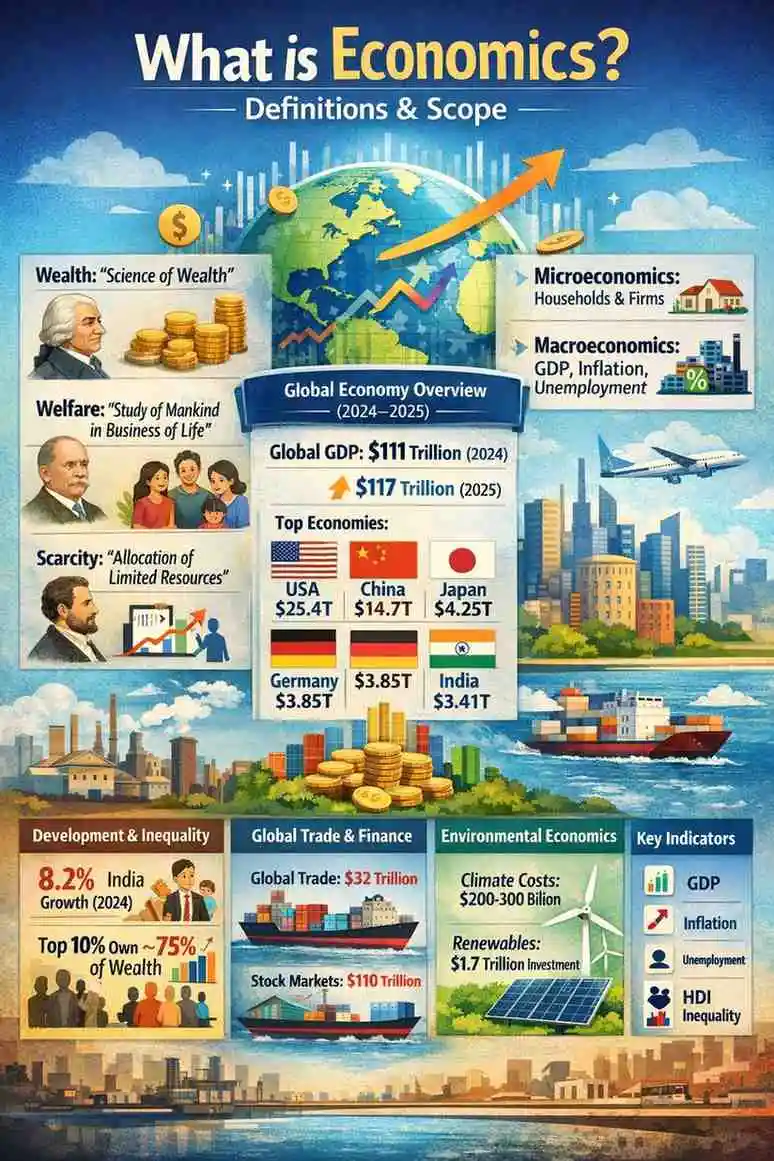
With global GDP exceeding $111 trillion in 2024 and economies becoming increasingly interconnected, understanding economics is more relevant than ever.
Foundational Definitions of Economics
Economics has been defined in different ways by various economists, reflecting changes in societal priorities and intellectual perspectives. These definitions help us understand how the discipline has evolved over time.
The earliest definition focused on wealth creation, emphasizing production and accumulation. Later, economists shifted attention toward human welfare, considering how economic activities impact people's lives. The modern definition centers on scarcity, recognizing that resources are limited while human wants are unlimited.
- Wealth Definition: Economics as the science of wealth, focusing on production and accumulation.
- Welfare Definition: Economics as a study of human well-being and everyday life activities.
- Scarcity Definition: Economics as the study of allocating limited resources efficiently.
- Reflects evolution from material wealth to human-centric development.
- Highlights decision-making under constraints.
Historical Development of Economic Thought
The study of economics has evolved over centuries, influenced by industrialization, globalization, and technological advancement. Early economic thought emerged during the 18th century when scholars began analyzing trade, markets, and production systems.
The Industrial Revolution marked a turning point, expanding the scope of economics to include labor, capital, and industrial growth. In the 20th century, global events such as economic depressions and financial crises led to the development of macroeconomic theories and policy frameworks.
Today, economics integrates behavioral insights, data analytics, and global perspectives to address complex challenges such as inequality, climate change, and technological disruption.
- Originated in the 18th century with classical economic theories.
- Expanded during industrialization and globalization.
- Influenced by global crises like financial downturns and pandemics.
- Modern economics includes behavioral and environmental aspects.
- Continues to evolve with technological and social changes.
Microeconomics and Macroeconomics
Economics is broadly divided into two main branches: microeconomics and macroeconomics. These branches help analyze different levels of economic activity and decision-making.
Microeconomics focuses on individual units such as households, firms, and markets. It examines how prices are determined, how consumers behave, and how businesses make production decisions. Macroeconomics, on the other hand, studies the economy as a whole, including national income, inflation, and unemployment.
Together, these branches provide a comprehensive understanding of how economies function at both local and global levels.
- Microeconomics:
- Studies individual behavior and decision-making.
- Focuses on supply, demand, pricing, and market structures.
- Examines consumer and producer choices.
- Macroeconomics:
- Analyzes aggregate economic indicators.
- Focuses on GDP, inflation, and unemployment.
- Helps governments design economic policies.
- Both are interrelated and essential for policy and analysis.
Scope of Economics in the Modern World
The scope of economics has expanded far beyond traditional boundaries. Today, it covers a wide range of areas including development, finance, international trade, environment, and public policy.
Economics plays a critical role in shaping decisions at all levels—from individuals managing budgets to governments designing fiscal policies. It also helps address global challenges such as poverty, inequality, and climate change.
- Covers production, consumption, and distribution of resources.
- Includes fields like development economics and environmental economics.
- Influences public policy and governance.
- Helps in solving real-world problems.
- Integrates with other disciplines like sociology and psychology.
Global Economic Overview (2024–2025)
The global economy continues to grow steadily, reflecting resilience despite challenges such as inflation and geopolitical tensions. The world’s GDP is estimated at $111.1 trillion in 2024 and is projected to reach $117.2 trillion in 2025.
Growth rates remain stable at around 3.2% to 3.3%, indicating moderate but consistent expansion. India stands out as the fastest-growing major economy, with an 8.2% growth rate in 2024 and a projected 7.4% for FY 2025–26.
- Global GDP (2024): ~$111.1 trillion.
- Projected GDP (2025): ~$117.2 trillion.
- Global growth rate: ~3.2% annually.
- India growth rate: 8.2% (2024).
- Reflects steady global economic recovery.
Major Economies of the World
Economic power is concentrated among a few leading nations that dominate global production and trade. These economies significantly influence global markets, investment flows, and policy trends.
The United States remains the largest economy, followed by China, Japan, Germany, and India. These countries contribute a significant share of global GDP and play a crucial role in shaping international economic policies.
- United States: ~$25.43 trillion GDP.
- China: ~$14.72 trillion GDP.
- Japan: ~$4.25 trillion GDP.
- Germany: ~$3.85 trillion GDP.
- India: ~$3.41 trillion GDP.
- These economies drive global trade and innovation.
Sectoral Composition of the Economy
An economy is typically divided into three main sectors: agriculture, industry, and services. The contribution of each sector reflects the level of development and structural transformation of an economy.
Globally, the services sector dominates, accounting for over 66% of total output. Industry contributes around 26%, while agriculture accounts for a smaller share, highlighting the shift toward knowledge-based and service-driven economies.
- Services: ~66.24% of global GDP.
- Industry: ~25.97%.
- Agriculture: ~4.02%.
- Developed economies rely heavily on services.
- Developing economies still depend on agriculture and industry.
Economic Impact on Society
Economics has a direct and profound impact on people's lives. It determines income levels, employment opportunities, and access to goods and services.
Economic growth improves living standards, while unemployment and inflation can reduce purchasing power. Globally, unemployment is around 5%, but informal employment accounts for over 60% of the workforce, especially in developing countries.
- Economic growth improves living standards.
- Global unemployment rate: ~5%.
- Informal employment: over 60%.
- Inflation affects purchasing power.
- Strong economies create more opportunities.
Development Economics and Inequality
Development economics focuses on improving living conditions, reducing poverty, and promoting sustainable growth. Over the past few decades, significant progress has been made in reducing extreme poverty.
However, inequality remains a major challenge. The top 10% of the global population owns around 75% of wealth, while the bottom 50% owns less than 2%. This imbalance highlights the need for inclusive growth policies.
- Extreme poverty reduced from 36% (1990) to ~8–9% (2023).
- Wealth inequality remains high globally.
- Top 10% own ~75% of wealth.
- Bottom 50% own less than 2%.
- Inclusive development is essential.
Social Effects of Economics
Economics plays a crucial role in shaping social outcomes such as education, health, and gender equality. Higher income levels generally lead to better access to education and healthcare.
Developed countries have literacy rates close to 100%, while developing countries range between 60% and 80%. Similarly, healthcare spending varies widely, affecting overall quality of life.
- Higher GDP leads to better education outcomes.
- Literacy rates: 95–100% in developed nations.
- Healthcare spending: $4,000–$10,000 per person in rich countries.
- Gender wage gap: women earn ~20% less globally.
- Female labor participation is lower than men.
International Economics and Globalization
International economics examines trade, exchange rates, and global economic interactions. With global trade valued at around $32 trillion annually, countries are increasingly interconnected.
Globalization has enabled access to cheaper goods and advanced technology, but it has also led to challenges such as job outsourcing and cultural homogenization.
- Global trade value: ~$32 trillion.
- Major exporters: China, USA, Germany.
- Exchange rates influence trade and investment.
- Globalization increases efficiency.
- Also creates economic risks and dependencies.
Financial Systems and Markets
Financial systems are essential for economic growth as they facilitate investment, savings, and capital allocation. Global stock markets are valued at approximately $110 trillion, reflecting their importance in wealth creation.
Central banks play a key role in managing the economy by controlling interest rates and money supply. Institutions like national banks influence inflation and economic stability.
- Global stock market value: ~$110 trillion.
- Major exchanges include global financial hubs.
- Central banks regulate money supply.
- Interest rates influence borrowing and spending.
- Financial systems support economic growth.
Economic Crises and Risks
Economies are vulnerable to shocks and crises that can disrupt growth and stability. Events like financial crises and pandemics highlight the interconnected nature of global economies.
The 2008 financial crisis and the COVID-19 pandemic caused significant economic disruptions, including job losses and GDP contractions. Global debt has reached around $300 trillion, raising concerns about financial sustainability.
- 2008 crisis caused global downturn.
- COVID-19 led to ~-3% GDP contraction.
- Global debt: ~$300 trillion.
- Crises affect employment and growth.
- Risk management is crucial.
Environmental and Sustainable Economics
Modern economics increasingly focuses on sustainability and environmental protection. Climate change has significant economic costs, with global losses estimated at $200–300 billion annually.
The transition to a green economy is gaining momentum, with global renewable energy investments reaching approximately $1.7 trillion per year.
- Climate-related losses: $200–300 billion annually.
- Renewable investment: ~$1.7 trillion.
- Focus on sustainable development.
- Balancing growth and environment is essential.
- Green economy is the future.
Behavioral and Modern Economics
Traditional economics assumes rational decision-making, but behavioral economics recognizes that human behavior is often irrational. Psychological factors influence economic choices, leading to biases and errors.
Concepts like loss aversion and bounded rationality help explain real-world decision-making. These insights are widely used in marketing and public policy.
- Humans do not always act rationally.
- Loss aversion affects decision-making.
- Behavioral insights improve policy design.
- Used in marketing strategies.
- Enhances understanding of real behavior.
Key Economic Indicators
Economic indicators are essential tools for measuring and analyzing economic performance. They help policymakers, businesses, and individuals make informed decisions.
Indicators like GDP, inflation, unemployment, and inequality provide insights into economic health and trends.
- GDP: Measures total economic output.
- Inflation Rate: Indicates price stability.
- Unemployment Rate: Reflects job availability.
- HDI: Measures human development.
- Gini Coefficient: Indicates income inequality.
Current Trends in Economics (2025–2026)
The field of economics continues to evolve with emerging trends shaping the global landscape. Technological advancements, digital transformation, and shifting labor markets are redefining economic systems.
Artificial intelligence and automation are transforming industries, while the gig economy is creating new employment opportunities. At the same time, concerns about inequality and supply chain disruptions are gaining attention.
- Rise of AI and automation.
- Growth of digital economy.
- Expansion of gig economy.
- Increasing inequality concerns.
- Supply chain restructuring globally.
Conclusion
Economics is a dynamic and evolving discipline that plays a central role in shaping the modern world. From its early focus on wealth to its current emphasis on scarcity, welfare, and sustainability, economics has continuously adapted to changing realities.
Understanding economics helps individuals make better decisions, businesses operate efficiently, and governments design effective policies. It provides insights into global challenges such as inequality, climate change, and economic instability.
In a world of limited resources and unlimited wants, economics remains a powerful tool for creating a more balanced, efficient, and equitable society. Ultimately, economics is not just about money—it is about human choices, opportunities, and the future of our world.
Studylab24
100 Like · 4K views