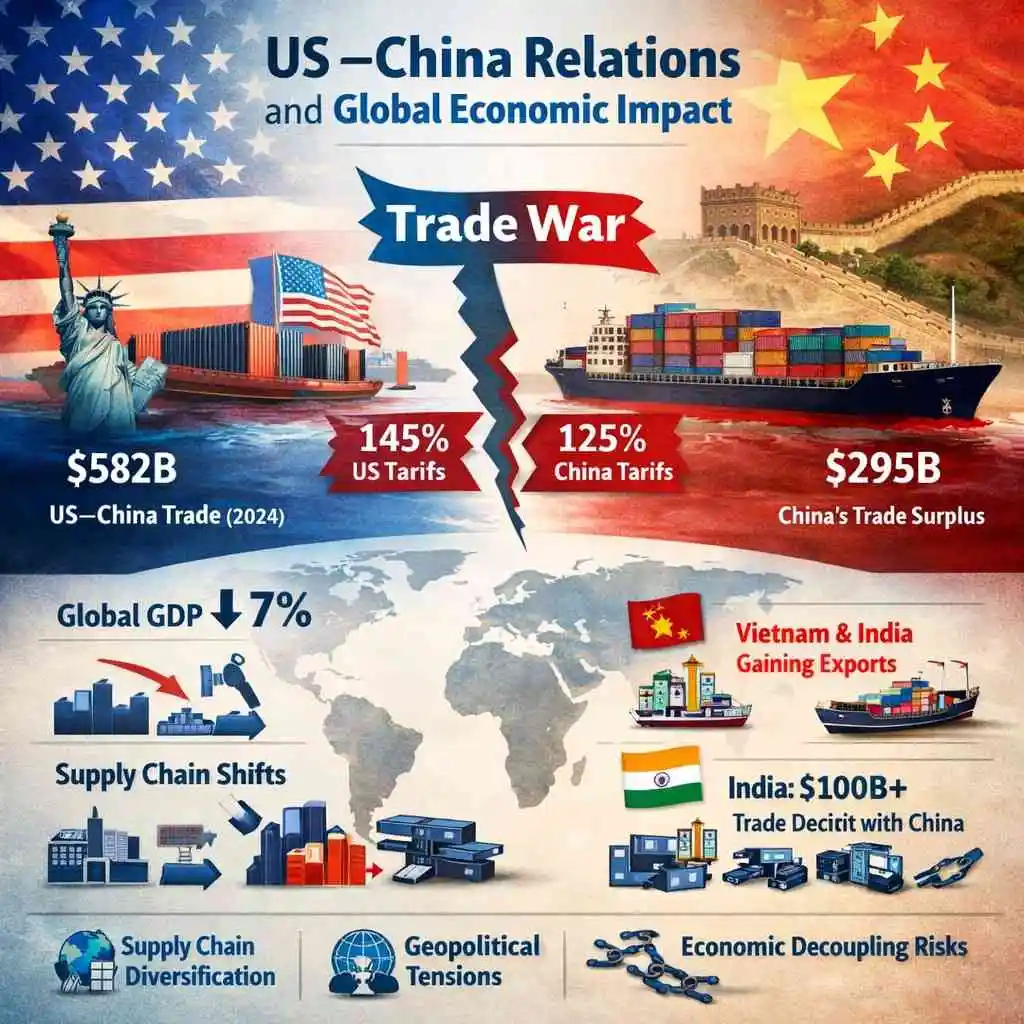
The relationship between the United States and China has become one of the most defining forces shaping the modern global economy. As the two largest economies in the world, their interactions influence trade flows, investment patterns, supply chains, and technological innovation across continents. The scale of their economic engagement is immense, with bilateral trade reaching approximately $582 billion in 2024, reflecting deep interdependence despite rising tensions.
However, this relationship is no longer defined purely by cooperation. Increasing geopolitical rivalry, trade disputes, and technological competition have transformed it into a complex mix of collaboration and confrontation. The consequences extend far beyond these two nations, affecting global growth, emerging markets, and international trade systems.
Overview of US–China Economic Relations
The economic relationship between the US and China is characterized by both deep interdependence and significant imbalance. While trade volumes remain high, structural differences and trade asymmetries have created persistent tensions. The US relies heavily on imports from China, while China benefits from a large trade surplus.
In 2024, the US imported goods worth $438.9 billion from China, highlighting the scale of dependency on Chinese manufacturing. Meanwhile, China maintained a trade surplus of approximately $295 billion with the US, reflecting its dominance in exports.
Despite ongoing disputes, both countries remain central to global trade systems. Their combined influence accounts for a meaningful share of global trade flows, making their relationship critical to economic stability worldwide.
-
Bilateral trade stood at $582 billion in 2024
-
US imports from China totaled $438.9 billion
-
China’s trade surplus reached around $295 billion
-
Both economies play a key role in global trade flows
-
Economic interdependence remains strong despite tensions
Trade War and Economic Conflict
The trade war between the US and China marked a turning point in global economic relations. Initiated through aggressive tariff policies, it quickly escalated into a broader economic confrontation involving technology, investment, and strategic industries.
The US imposed tariffs as high as 145% on Chinese imports, prompting China to retaliate with tariffs of up to 125%. These measures significantly disrupted trade flows, increased costs for businesses, and created uncertainty in global markets.
Beyond tariffs, the conflict expanded into critical sectors such as semiconductors, artificial intelligence, and rare earth minerals. Investment restrictions and export controls further intensified the divide, signaling a long-term shift toward economic decoupling.
-
US tariffs on Chinese goods reached 145%
-
China imposed retaliatory tariffs up to 125%
-
Chinese exports to the US declined by 34.5% in 2025
-
Conflict expanded into technology and critical resources
-
Investment restrictions added to economic fragmentation
Impact on Global Trade and Economic Growth
The ripple effects of US–China tensions are felt across the global economy. Since global trade contributes roughly 25% of global GDP, disruptions in trade between these two giants have far-reaching consequences.
Trade conflicts reduce efficiency, increase costs, and slow down economic growth. According to estimates, prolonged tensions could reduce bilateral trade by up to 80%, significantly affecting global supply chains and production networks.
Moreover, economic decoupling between the US and China could lead to a long-term reduction in global GDP by approximately 7%. This highlights the systemic importance of their relationship and the risks associated with prolonged conflict.
-
Global trade accounts for about 25% of global GDP
-
US–China tensions could reduce bilateral trade by 80%
-
Potential global GDP loss estimated at around 7%
-
Increased trade barriers raise production costs
-
Economic uncertainty impacts global investment flows
Supply Chain Disruptions and Realignment
One of the most visible impacts of US–China tensions is the restructuring of global supply chains. Companies are increasingly adopting a “China+1 strategy,” seeking to diversify manufacturing bases beyond China.
Countries such as Vietnam, India, and other ASEAN nations are emerging as alternative production hubs. However, complete decoupling remains unlikely due to the deeply interconnected nature of global supply chains.
Many industries still depend on Chinese intermediate goods, making it difficult to fully shift production. As a result, supply chains are evolving rather than breaking apart entirely.
-
Companies are diversifying production locations
-
Vietnam, India, and ASEAN countries are gaining importance
-
China remains a key supplier of intermediate goods
-
Supply chains are becoming more resilient but complex
-
Full decoupling is unlikely in the near term
Trade Diversion and Emerging Trends
Rather than reducing global trade, US–China tensions are reshaping trade routes. This phenomenon, known as trade diversion, involves shifting trade flows from one country to another without reducing overall trade volumes.
For example, Vietnam has overtaken China in certain US trade segments as of 2026 trends. This indicates that global trade is being rerouted rather than diminished.
Such shifts create opportunities for emerging economies while also increasing competition. Businesses are adjusting sourcing strategies to minimize risks associated with geopolitical tensions.
-
Trade is being redirected rather than reduced
-
Vietnam gained market share in US trade segments
-
Emerging economies are benefiting from shifts
-
Companies are diversifying sourcing strategies
-
Global trade networks are becoming more dynamic
Impact on India’s Trade and Economy
India finds itself in a unique position amid US–China tensions. As a major emerging economy, it is both affected by disruptions and presented with new opportunities.
India’s trade relationships with both the US and China are significant. While it enjoys a surplus with the US, it faces a large deficit with China. This dual dynamic creates both strategic advantages and economic challenges.
India’s growing role in global trade makes it a key player in the evolving economic landscape, particularly as companies seek alternatives to China.
-
India is closely tied to both US and Chinese economies
-
Trade dynamics create both opportunities and risks
-
Strategic positioning enhances India’s global role
-
Supply chain shifts are increasing India’s relevance
-
Economic outcomes depend on structural reforms
India–US Trade Relations
The United States is India’s largest trading partner, reflecting strong economic ties between the two countries. Bilateral trade reached $131.8 billion in FY2025, showcasing steady growth.
India enjoys a trade surplus with the US, estimated between $30 billion and $35 billion. This surplus supports India’s economic growth and strengthens its export sector.
Increasing cooperation in technology, services, and manufacturing further enhances this relationship, positioning India as a key partner for the US.
-
Bilateral trade reached $131.8 billion in FY2025
-
India maintains a $30–35 billion trade surplus
-
Strong growth in goods and services trade
-
Increasing collaboration in technology sectors
-
US remains India’s top trading partner
India–China Trade Relations
Despite geopolitical tensions, China remains India’s second-largest trading partner. Bilateral trade stood at approximately $127.7 billion in FY2025.
However, the relationship is heavily imbalanced. India faces a massive trade deficit exceeding $100 billion, driven by high imports and relatively low exports.
This imbalance highlights structural challenges in India’s economy and its dependence on Chinese manufacturing.
-
Bilateral trade reached $127.7 billion
-
India faces a deficit of over $100 billion
-
Imports from China far exceed exports
-
Trade imbalance remains a major concern
-
Economic dependence poses strategic risks
Structural Challenges for India
India’s trade deficit with China is rooted in structural issues within its economy. The country relies heavily on Chinese imports for key industrial components, limiting its domestic manufacturing capabilities.
Critical sectors such as electronics, electric vehicle batteries, solar panels, and machinery are dominated by Chinese imports. At the same time, India’s exports to China remain relatively low, ranging between $14 billion and $21 billion.
Addressing these structural weaknesses is essential for reducing dependency and improving trade balance.
-
Heavy reliance on Chinese imports in key sectors
-
Dominance of China in industrial product categories
-
Limited export capacity to China
-
Infrastructure and logistics challenges
-
Need for domestic manufacturing growth
Opportunities for India from US–China Tensions
The shifting global landscape presents significant opportunities for India. As companies move production away from China, India is emerging as a potential alternative manufacturing hub.
Exports to the US have increased, with India exporting goods worth $87.4 billion in 2024. Sectors such as electronics, pharmaceuticals, and IT services are experiencing growth.
Government initiatives like Production Linked Incentive (PLI) schemes are further supporting manufacturing expansion and attracting foreign investment.
-
Rising exports to the US market
-
Growth in electronics and pharmaceutical sectors
-
Increased foreign investment in manufacturing
-
Government support through PLI schemes
-
Potential to become a global manufacturing hub
Challenges Facing India
Despite the opportunities, India faces several challenges in fully capitalizing on global shifts. Imports from China have risen by approximately 25%, indicating continued dependence.
Infrastructure gaps, higher logistics costs, and regulatory hurdles limit India’s competitiveness. Additionally, the trade deficit with China continues to widen, crossing $100 billion.
Addressing these issues is crucial for India to strengthen its position in global trade.
-
Rising imports from China increase dependency
-
Trade deficit continues to grow
-
Infrastructure and logistics inefficiencies
-
Regulatory challenges impact business environment
-
Need for improved export competitiveness
Changing Global Trade Patterns
US–China tensions are accelerating changes in global trade patterns. The world is gradually moving toward a more fragmented system, with regional trade blocs gaining prominence.
This shift could lead to economic bifurcation, where countries align with either US-led or China-led systems. Supply chains are becoming more regional and resilient, but also more expensive.
Such transformations are reshaping global economic structures and redefining trade relationships.
-
Emergence of regional trade blocs
-
Potential division into competing economic systems
-
Supply chains becoming more localized
-
Increased costs due to diversification
-
Greater focus on resilience over efficiency
Key Statistics Summary
A snapshot of key data highlights the scale and impact of US–China relations on the global economy.
-
US–China trade: $582 billion (2024)
-
China’s surplus with US: $295 billion
-
India–US trade: $131.8 billion (FY25)
-
India–China trade: $127.7 billion (FY25)
-
India’s trade deficit with China: $100 billion+
-
Potential global GDP loss: ~7%
-
Global trade share in GDP: ~25%
Conclusion
US–China relations are no longer just about trade; they represent a broader geopolitical and technological rivalry that is reshaping the global economy. The ongoing tensions have disrupted traditional trade patterns, accelerated supply chain diversification, and introduced new uncertainties into international markets.
The world is gradually transitioning toward a multipolar trade system, where economic power is distributed across multiple regions rather than concentrated in a few dominant economies. This shift creates both risks and opportunities for countries worldwide.
India stands at a strategic crossroads in this evolving landscape. On one hand, it is well-positioned to benefit from supply chain shifts and increased global investment. On the other hand, structural challenges such as trade deficits, infrastructure gaps, and dependence on imports must be addressed to fully realize its potential.
Ultimately, the future of the global economy will depend on how the US and China manage their relationship. Whether through cooperation, competition, or conflict, their actions will continue to shape economic outcomes for decades to come.