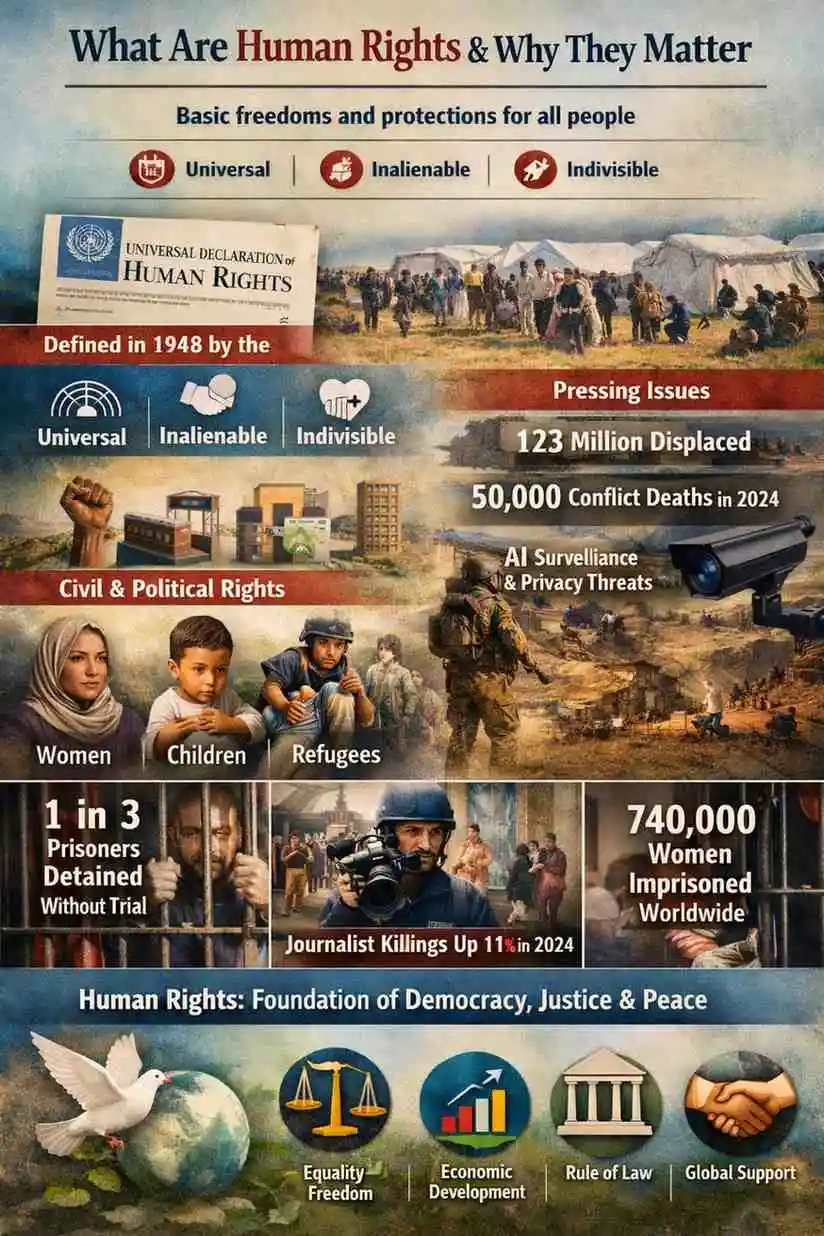
Human rights are the foundation of a fair and just world. They represent the basic freedoms and protections that every individual deserves simply by being human. Regardless of nationality, gender, religion, or social status, these rights ensure dignity, equality, and respect for all. Over time, they have become a guiding framework for governments, institutions, and societies striving to create a more balanced and humane world.
The modern understanding of human rights was formally established in 1948 through the Universal Declaration of Human Rights, a landmark document adopted by the United Nations. Today, human rights are more relevant than ever, especially in a rapidly changing global landscape shaped by conflict, inequality, and technology.
Understanding the Concept of Human Rights
Human rights are not privileges granted by governments—they are inherent to every person. These rights are designed to protect individuals from abuse, ensure fairness, and promote opportunities for growth. The idea is simple yet powerful: every human life has equal value.
The Universal Declaration of Human Rights defines a wide range of rights, from the right to life and liberty to education and freedom of expression. It is also the most translated document in the world, available in 577 languages, showing its global importance.
-
Human rights are universal, meaning they apply to everyone
-
They are inalienable and cannot be taken away unjustly
-
They are indivisible, meaning all rights are equally important
-
They promote equality and prevent discrimination
-
They provide a moral and legal framework for societies
Types of Human Rights with Examples
Human rights can be categorized into different types based on their function and purpose. Understanding these categories helps explain how rights operate in real-life situations.
Civil and political rights focus on individual freedoms, while economic, social, and cultural rights ensure access to basic needs and opportunities. Together, they create a balanced system that supports human dignity.
-
Civil Rights: Freedom of speech, right to privacy, right to a fair trial
-
Political Rights: Right to vote, participate in government
-
Economic Rights: Right to work, fair wages, safe working conditions
-
Social Rights: Access to healthcare, education, housing
-
Cultural Rights: Freedom to practice traditions and beliefs
These categories highlight the importance of protecting both freedom and well-being, making the “types of human rights with examples” essential for understanding their real-world impact.
Importance of Human Rights in Society
The importance of human rights in society goes beyond legal frameworks—it directly affects how people live, interact, and grow. Societies that respect human rights tend to be more stable, prosperous, and inclusive.
Human rights create a sense of security and trust among citizens. When people feel protected, they are more likely to contribute positively to their communities and economies.
-
Promote equality and reduce discrimination
-
Encourage social harmony and cooperation
-
Support economic growth and development
-
Improve education and healthcare systems
-
Build trust between governments and citizens
Countries with strong human rights protections often experience higher levels of development, better public services, and greater overall well-being.
Why Human Rights Are Important in Democracy
Democracy and human rights are deeply interconnected. A functioning democracy relies on the protection of individual freedoms, while human rights ensure that democratic systems remain fair and inclusive.
Without human rights, democracy cannot exist in its true form. Freedom of expression, the right to vote, and access to justice are essential elements that allow citizens to participate in governance.
-
Protect freedom of speech and expression
-
Ensure fair and transparent elections
-
Promote accountability in leadership
-
Safeguard minority rights
-
Strengthen the rule of law
This explains clearly why human rights are important in democracy—they empower citizens and maintain balance in governance systems.
Examples of Human Rights Violations
Despite global progress, violations remain widespread. Understanding examples of human rights violations helps highlight the urgency of addressing these issues.
Recent data shows that human rights violations were documented in over 150 countries. These violations range from unlawful detention to restrictions on free speech and violent conflict.
-
1 in 3 prisoners globally are detained without proper sentencing
-
Around 50,000 deaths occurred in conflicts in 2024
-
Journalist killings increased by 11% in 2024
-
Over 740,000 women are imprisoned worldwide
-
Forced labor and modern slavery continue to affect thousands
These figures demonstrate that while human rights frameworks exist, enforcement remains a significant challenge.
Current Human Rights Issues 2025
The global human rights landscape in 2025 is complex and evolving. Several pressing issues continue to impact millions of people worldwide.
From displacement to political repression, current human rights issues 2025 reflect the challenges of a rapidly changing world.
-
123.2 million people were forcibly displaced by the end of 2024
-
Climate change displaced 250 million people over the last decade
-
Armed conflicts and repression of dissent are increasing
-
Global human development is at a 35-year low
-
Regions in Africa and Asia still lag in protections
These challenges highlight the need for stronger international cooperation and more effective policies.
Impact of AI on Human Rights
Technology is reshaping the human rights landscape, particularly through artificial intelligence. While AI offers many benefits, it also presents new risks.
The impact of AI on human rights is becoming a growing concern, especially with the rise of surveillance systems and data monitoring.
-
AI is used to monitor citizens in multiple countries
-
Over $2 billion has been invested in surveillance technologies
-
Freedom of expression is being restricted through digital tracking
-
Privacy rights are increasingly under threat
-
Lack of regulation creates risks for civil liberties
Balancing innovation with ethical responsibility is essential to ensure technology supports rather than harms human rights.
Vulnerable Groups and Human Rights Challenges
Certain groups are more vulnerable to human rights violations due to social, economic, or political factors. Protecting these populations is crucial for achieving equality.
Women, children, refugees, and minorities often face systemic barriers that limit their access to basic rights and opportunities.
-
Women face inequality and higher imprisonment rates
-
Children are vulnerable to exploitation and lack of education
-
Refugees face displacement and lack of legal protection
-
Minorities often experience discrimination and marginalization
-
Poverty increases vulnerability to abuse
Addressing these challenges requires targeted policies and inclusive approaches.
Global Efforts to Protect Human Rights
Efforts to protect human rights have grown significantly over the years. Organizations, governments, and activists work together to promote justice and accountability.
Programs led by the United Nations and other global institutions provide support to victims and promote awareness.
-
49,000+ torture survivors received support globally
-
10,500+ victims of modern slavery were assisted
-
International laws and treaties promote accountability
-
NGOs play a key role in advocacy and awareness
-
Education campaigns help spread awareness
These efforts show that progress is possible, even in challenging circumstances.
Human Rights as a Driver of Development
Human rights are not just ethical principles—they are essential for development. Countries that prioritize human rights tend to achieve better outcomes in multiple areas.
The connection between rights and development is clear: when people are free and protected, they can contribute more effectively to society.
-
Higher economic growth in rights-respecting countries
-
Better education and healthcare outcomes
-
Reduced poverty and inequality
-
Increased political stability
-
Stronger institutions and governance
This reinforces the idea that human rights are a foundation for long-term progress.
The Future of Human Rights
Looking ahead, the future of human rights will depend on global cooperation, innovation, and accountability. While progress has been made, challenges remain.
Emerging issues such as climate change, digital surveillance, and global inequality will shape the next phase of human rights development.
-
Need for stronger international laws and enforcement
-
Importance of regulating emerging technologies
-
Increased focus on climate justice
-
Greater role of education and awareness
-
Collaboration between governments and organizations
The future will require a balance between growth, innovation, and protection of human dignity.
Conclusion
Human rights are the backbone of a just and equitable world. They protect individuals, empower communities, and create the conditions necessary for peace and development. From their formal recognition in the Universal Declaration of Human Rights to their ongoing evolution in today’s world, these rights remain essential.
Despite significant progress, challenges such as conflict, inequality, and technological risks continue to threaten human dignity. Addressing these issues requires collective effort, strong policies, and a commitment to justice.
Ultimately, human rights are not just moral ideals—they are practical tools for building a better future. By understanding and protecting them, societies can move closer to a world defined by equality, freedom, and respect for all.