Click below to generate summary
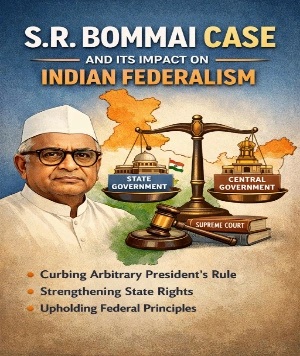
The evolution of Indian democracy has been shaped by several landmark judgments, but few have had as deep and lasting an impact as the S.R. Bommai v. Union of India (1994) case. This judgment fundamentally altered how power is distributed between the Centre and the States, reinforcing the idea that India is not a unitary system but a federal structure with strong constitutional safeguards.
Before this case, the Central Government frequently used Article 356 to dismiss state governments, often on questionable grounds. This practice created political instability and weakened the democratic mandate of elected representatives. The Bommai judgment introduced critical checks and balances, ensuring that constitutional provisions are not misused for political advantage.
Understanding Article 356 and Its Original Purpose
Article 356 was included in the Constitution to address situations where a state government fails to function according to constitutional provisions. In such cases, the President can assume control of the state, effectively placing it under central rule.
The framers of the Constitution intended this provision to be used sparingly and only in extreme circumstances. However, over time, it became a political tool rather than a constitutional safeguard.
Instead of addressing genuine governance breakdowns, Article 356 was often invoked to remove opposition-led governments. This misuse raised serious concerns about the erosion of federal principles and the concentration of power at the Centre.
Important points:
- Article 356 deals with failure of constitutional machinery
- Allows imposition of President’s Rule in states
- Intended as an emergency provision
- Frequently misused for political purposes
- Led to weakening of state autonomy
Historical Misuse Before 1994
Between 1950 and 1994, Article 356 was invoked more than 90 times. In many instances, the dismissal of state governments was driven by political considerations rather than genuine constitutional crises.
This frequent use created a pattern where elected governments were removed without giving them a fair opportunity to prove their majority. Such actions undermined democratic values and raised questions about the fairness of the system.
The need for judicial intervention became increasingly evident as concerns about the misuse of power grew stronger.
Key observations:
- Over 90 instances of Article 356 usage
- Average use ranged between 2.2 to 3.1 times per year
- Often targeted opposition-led governments
- Undermined democratic mandates
- Highlighted need for constitutional safeguards
The Background of the S.R. Bommai Case
The case originated in Karnataka, where S.R. Bommai was serving as Chief Minister under the Janata Dal government. His tenure lasted from August 1988 to April 1989.
In April 1989, the Governor reported that the government had lost its majority due to defections. Based on this report, the Central Government dismissed the Bommai government without allowing it to prove its majority on the floor of the Assembly.
This decision raised serious constitutional questions, particularly regarding the role of the Governor and the limits of central power.
Key facts:
- S.R. Bommai was Chief Minister of Karnataka
- Government dismissed on April 21, 1989
- Governor cited loss of majority
- No floor test was conducted
- Triggered a constitutional challenge
Expansion to Other States and Broader Issues
The case was not limited to Karnataka. It also included similar dismissals in states such as Meghalaya, Nagaland, Madhya Pradesh, Rajasthan, and Himachal Pradesh.
These cases revealed a broader pattern of misuse, indicating that the problem was systemic rather than isolated. The Supreme Court recognized the need to establish clear guidelines to prevent such practices in the future.
By examining multiple cases together, the Court was able to address the issue comprehensively and provide a unified legal framework.
Important points:
- Included multiple states beyond Karnataka
- Showed a recurring pattern of misuse
- Highlighted systemic issues
- Required a comprehensive legal approach
- Strengthened the scope of the judgment
The Nine-Judge Constitution Bench
Given the importance of the issues involved, the case was referred to a nine-judge Constitution Bench of the Supreme Court. This itself reflects the significance of the matter.
The bench delivered its judgment on March 11, 1994, after an extensive examination of constitutional provisions, historical precedents, and democratic principles.
The verdict became a milestone in Indian constitutional law, setting standards that continue to guide governance today.
Key features:
- Heard by a nine-judge Constitution Bench
- Judgment delivered on March 11, 1994
- Detailed constitutional interpretation
- Addressed multiple legal issues
- Established binding precedents
Judicial Review: Bringing Accountability to Power
One of the most important outcomes of the judgment was the introduction of judicial review over the imposition of President’s Rule. Prior to this, such decisions were largely considered beyond the scope of judicial scrutiny.
The Court ruled that it has the authority to examine whether the proclamation was based on relevant material or whether it was made in bad faith.
This marked a major shift towards accountability and transparency in governance.
Key aspects:
- President’s Rule subject to judicial review
- Courts can examine validity of decisions
- Focus on objective evidence
- Prevents misuse of power
- Strengthens rule of law
The Floor Test Rule: A Democratic Safeguard
The judgment clearly established that the only legitimate way to determine whether a government has majority support is through a floor test in the Legislative Assembly.
The Governor’s subjective opinion cannot replace this democratic process. This principle ensures that elected representatives decide the fate of the government.
It also prevents premature dismissal based on assumptions or political pressure.
Key elements:
- Floor test is mandatory to prove majority
- Governor’s opinion is not final
- Ensures transparency in decision-making
- Protects democratic mandate
- Reduces arbitrary dismissals
Parliamentary Approval and Oversight
The Court also clarified that the dissolution of a Legislative Assembly cannot take place immediately after the proclamation of President’s Rule.
Instead, the proclamation must be approved by both Houses of Parliament within two months. Until then, the Assembly can only be suspended.
This ensures that the Central Government remains accountable and does not act unilaterally.
Important points:
- Assembly initially kept under suspension
- Dissolution requires parliamentary approval
- Two-month time limit
- Ensures checks and balances
- Prevents misuse of authority
Federalism as Part of the Basic Structure
The judgment reaffirmed that federalism is a fundamental feature of the Constitution and forms part of its basic structure. This means it cannot be altered even through constitutional amendments.
By recognizing federalism as a core principle, the Court strengthened the autonomy of states and limited the power of the Centre.
This interpretation ensures long-term protection of the federal framework.
Key insights:
- Federalism recognized as basic structure
- Cannot be altered by amendments
- Strengthens state autonomy
- Limits central dominance
- Ensures constitutional stability
Secularism and Constitutional Integrity
In addition to federalism, the Court also emphasized that secularism is a basic feature of the Constitution. This aspect became relevant in cases where state governments were dismissed on grounds related to religious issues.
The judgment made it clear that governance must align with constitutional values, including secularism.
This reinforced the importance of maintaining constitutional integrity in all decisions.
Key points:
- Secularism declared a basic feature
- Linked governance with constitutional values
- Prevents misuse of religion in politics
- Strengthens democratic principles
- Ensures inclusive governance
Power to Restore Dismissed Governments
One of the most powerful aspects of the judgment was granting courts the authority to restore a dismissed government if the proclamation is found unconstitutional.
This ensures that wrongful dismissals can be corrected, and democratic governance can be reinstated.
It also acts as a strong deterrent against misuse of power.
Key features:
- Courts can revive dismissed governments
- Legislative Assembly can be restored
- Protects electoral mandate
- Ensures justice
- Acts as deterrence
Impact on Indian Federalism
The impact of the S.R. Bommai case on Indian federalism has been far-reaching. It redefined the relationship between the Centre and the States by introducing safeguards against arbitrary intervention.
The judgment reinforced the idea that states are not subordinate entities but equal partners in the federal system.
This shift strengthened the democratic framework and ensured greater balance in governance.
Major impacts:
- Strengthened cooperative federalism
- Reduced central interference
- Promoted balance of power
- Increased accountability
- Protected democratic values
Decline in Misuse of Article 356
After the judgment, the use of Article 356 declined significantly. This indicates that the guidelines laid down by the Supreme Court were effective in curbing misuse.
The shift reflects a move towards more responsible governance and respect for constitutional principles.
It also demonstrates the power of judicial intervention in shaping political practices.
Key outcomes:
- Significant reduction in usage
- Greater constitutional discipline
- Decline in politically motivated actions
- Strengthened institutions
- Improved governance practices
The 1999 Bihar Example
The real impact of the judgment was evident in 1999 when the Central Government attempted to dismiss the Bihar government led by Rabri Devi.
However, it faced resistance in the Rajya Sabha and was forced to reinstate the government. This showed that the principles established in the Bommai case were being actively applied.
It also highlighted the importance of parliamentary oversight in preventing misuse of power.
Key takeaways:
- Demonstrated practical application
- Reinforced accountability
- Prevented arbitrary dismissal
- Strengthened parliamentary role
- Validated judicial principles
Strengthening State Autonomy and Cooperative Federalism
The judgment emphasized that states are not mere extensions of the Centre but have their own constitutional authority.
This reinforced the concept of cooperative federalism, where both levels of government work together while respecting each other’s powers.
It also encouraged decentralization and better governance.
Important aspects:
- States recognized as independent units
- Reduced central dominance
- Encouraged cooperation
- Strengthened governance
- Promoted decentralization
Long-Term Constitutional Importance
Even decades later, the S.R. Bommai case continues to influence Indian constitutional law. It is frequently cited in legal discussions and remains a cornerstone of federal governance.
The principles laid down in this case have ensured stability and accountability in the political system.
Its relevance continues to grow as India navigates complex political challenges.
Key significance:
- Continues to guide legal interpretation
- Serves as a landmark precedent
- Strengthens democratic institutions
- Ensures constitutional accountability
- Promotes long-term stability
Conclusion: A Pillar of Indian Democracy
The S.R. Bommai judgment stands as a pillar of Indian democracy. It transformed the way constitutional powers are exercised and ensured that democratic principles are upheld.
By limiting the misuse of Article 356, the judgment restored faith in the system and strengthened the federal structure of the country.
It serves as a reminder that constitutional provisions must be used responsibly and that democracy thrives when power is balanced and accountable.
Studylab24
100 Like · 4K views