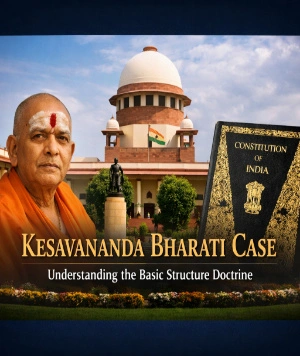
The development of constitutional law in India has been shaped by several landmark judicial decisions. Among these, the Kesavananda Bharati case stands as one of the most influential rulings in the country’s legal history. The judgment fundamentally reshaped the relationship between Parliament and the Constitution by establishing limits on the power of constitutional amendments. It confirmed that while the legislature has authority to amend the Constitution, it cannot alter its core identity.
The decision was delivered in 1973 by the Supreme Court of India and involved intense legal arguments about the nature of constitutional authority. At the center of the case was a question that went beyond ordinary legal interpretation: could Parliament modify any part of the Constitution without restriction, or were there foundational principles that must remain untouched? The Court’s answer created the Basic Structure Doctrine, a principle that continues to influence constitutional governance today.
This doctrine ensures that democratic values, institutional balance, and individual rights remain protected even when political majorities attempt sweeping constitutional changes. Because of its far-reaching impact on constitutional interpretation and governance, the case is widely regarded as a turning point in Indian constitutional law.
Historical Context of the Constitutional Debate
Before the Kesavananda Bharati judgment, India witnessed intense debates about whether Parliament could amend fundamental rights. These discussions emerged from earlier judicial decisions that attempted to define the limits of constitutional amendments. The question was not merely legal but also political, as it involved balancing legislative authority with constitutional safeguards.
During the early decades after independence, Parliament introduced several constitutional amendments aimed at implementing social and economic reforms. Some of these amendments affected property rights and other fundamental rights, leading to legal challenges. The Supreme Court initially allowed Parliament broad amendment powers, but later judgments began placing restrictions.
The constitutional debate reached a critical stage after the Golaknath case in 1967. In that decision, the Court ruled that Parliament could not amend fundamental rights at all. This created tension between the judiciary and the legislature, prompting Parliament to pass amendments intended to restore its authority. These developments eventually led to the legal confrontation that became the Kesavananda Bharati case.
Important contextual developments included:
-
Early constitutional amendments aimed at implementing land reforms.
-
Judicial decisions examining the scope of Parliament’s amendment powers.
-
Growing conflict between legislative authority and constitutional safeguards.
-
The 1967 Golaknath judgment restricting amendments to fundamental rights.
-
Parliament’s response through further constitutional amendments.
The Petition and the Beginning of the Case
The case began when Kesavananda Bharati, the head of the Edneer Mutt in Kerala, challenged state land reform legislation that affected the property owned by the religious institution. The legal dispute initially focused on whether the government could limit property rights through legislative reforms.
However, the case quickly expanded into a much broader constitutional challenge. The petitioner argued that recent constitutional amendments had given Parliament unlimited authority to change the Constitution. If such authority existed, it could potentially undermine fundamental rights and the structure of the Constitution itself.
The legal challenge raised profound questions about constitutional supremacy and the balance of power among state institutions. The Supreme Court agreed to hear the matter because it involved fundamental issues about the interpretation of the Constitution.
Important aspects of the petition included:
-
The petitioner was the leader of a religious institution in Kerala.
-
The challenge arose from land reform laws affecting the Mutt’s property.
-
The case questioned the validity of certain constitutional amendments.
-
It raised broader concerns about unlimited amendment power.
-
The Supreme Court recognized the issue as a major constitutional question.
The Constitutional Amendments Under Challenge
The legal arguments in the case focused on three major constitutional amendments introduced by Parliament. These amendments were designed to clarify and expand the legislature’s power to amend the Constitution, especially in relation to fundamental rights.
The 24th Amendment explicitly stated that Parliament had the power to amend any part of the Constitution. It also made it mandatory for the President to give assent to constitutional amendment bills. This change aimed to remove doubts raised by earlier judicial decisions.
The 25th Amendment sought to limit judicial review in matters related to property rights and certain economic reforms. It introduced provisions that reduced the scope of courts to examine laws enacted under specific constitutional directives.
The 29th Amendment added certain land reform laws to the Ninth Schedule of the Constitution. Laws placed in this schedule were intended to be protected from judicial scrutiny.
These amendments became the central subject of constitutional scrutiny in the case. Key elements of the challenge included:
-
The 24th Amendment asserting Parliament’s unlimited amendment power.
-
The 25th Amendment restricting judicial review in certain situations.
-
The 29th Amendment placing land reform laws in the Ninth Schedule.
-
Concerns about potential erosion of fundamental rights.
-
Questions about whether constitutional identity could be altered.
The Longest Hearing in Supreme Court History
The proceedings in the Kesavananda Bharati case became one of the most extensive hearings ever conducted by the Supreme Court of India. Because the issues involved fundamental questions about constitutional interpretation, the Court assembled the largest bench in its history.
A total of thirteen judges heard the case, reflecting the importance and complexity of the issues. The hearings lasted for sixty-eight days, making it the longest case ever argued before the Court at that time.
Legal arguments examined constitutional philosophy, comparative constitutional law, and historical interpretations of amendment powers. Lawyers presented detailed analyses of constitutional systems from numerous countries to support their positions.
The extensive nature of the proceedings highlighted the seriousness of the constitutional issues involved.
Key facts about the hearing include:
-
A thirteen-judge bench considered the case.
-
Hearings lasted sixty-eight days.
-
It became the longest case argued in the Court’s history.
-
Lawyers referenced constitutional models from more than seventy countries.
-
The proceedings involved complex arguments on constitutional theory.
Key Legal Figures in the Case
Several prominent legal experts played crucial roles in presenting arguments during the case. Their advocacy shaped the constitutional debate and influenced the final judgment.
The petitioner’s side was led by Nani Palkhivala, one of India’s most respected constitutional lawyers. He argued that Parliament’s power to amend the Constitution must be limited to prevent the destruction of its fundamental framework.
Palkhivala was assisted by other notable legal experts, including Fali Nariman and Soli Sorabjee. Their arguments focused on protecting constitutional principles and preserving democratic values.
On the government’s side, the state was represented by distinguished lawyers including H. M. Seervai and Niren De. They argued that Parliament must have broad authority to amend the Constitution in order to implement social and economic reforms.
Important legal participants included:
-
Kesavananda Bharati as the petitioner.
-
Nani Palkhivala as the lead counsel for the petitioner.
-
Fali Nariman assisting the petitioner’s legal team.
-
Soli Sorabjee contributing to constitutional arguments.
-
H. M. Seervai representing the state’s perspective.
-
Niren De presenting arguments for the government.
The Supreme Court’s Historic Verdict
After months of hearings and deliberations, the Supreme Court delivered its decision on April 24, 1973. The judgment was extremely close, reflecting deep divisions among the judges.
By a narrow majority of seven to six, the Court ruled that Parliament has the power to amend the Constitution. However, it cannot destroy or alter the fundamental framework of the Constitution. This principle became known as the Basic Structure Doctrine.
The final written judgment exceeded seven hundred pages and included eleven separate opinions from the judges. Each opinion offered different reasoning, but the majority agreed on the core principle limiting amendment powers.
This verdict balanced two competing concerns: the need for constitutional flexibility and the need to protect fundamental values.
Key aspects of the verdict include:
-
Decision delivered on April 24, 1973.
-
Majority ruling of seven judges against six.
-
Recognition of Parliament’s amendment power.
-
Establishment of limits through the Basic Structure Doctrine.
-
Judgment exceeding seven hundred pages with multiple opinions.
Understanding the Basic Structure Doctrine
The Basic Structure Doctrine is the central outcome of the case and remains one of the most important principles in Indian constitutional law. According to this doctrine, certain fundamental features of the Constitution cannot be altered through amendments.
The Court did not provide an exhaustive list of these features, recognizing that constitutional interpretation may evolve over time. Instead, it identified core principles that form the foundation of the constitutional framework.
By protecting these foundational elements, the doctrine ensures that constitutional amendments cannot undermine democratic governance, individual rights, or institutional balance.
The doctrine effectively created a safeguard that protects the Constitution from drastic changes that could damage its identity.
Important aspects of the doctrine include:
-
Limits placed on Parliament’s amendment power.
-
Protection of essential constitutional principles.
-
Recognition of the Constitution’s fundamental identity.
-
Judicial authority to review constitutional amendments.
-
Continued evolution through later court decisions.
Pillars of the Basic Structure
Although the Court did not produce a fixed list, several constitutional features have been recognized as part of the basic structure through this and later judgments. These principles represent the core identity of the Constitution and cannot be destroyed or altered.
These elements collectively ensure that governance remains democratic, balanced, and respectful of individual rights. They also maintain the institutional framework necessary for constitutional functioning.
Over time, the judiciary has reaffirmed these pillars in subsequent cases, reinforcing their significance.
Major pillars include:
-
Supremacy of the Constitution.
-
Separation of powers between legislature, executive, and judiciary.
-
Republican and democratic form of government.
-
Secular character of the Constitution.
-
Federal structure of governance.
-
Judicial review by independent courts.
-
Protection of individual dignity and freedom.
Comparison with the Golaknath Judgment
The Kesavananda Bharati ruling partly reconsidered the earlier decision in the Golaknath case. In Golaknath, the Supreme Court had concluded that Parliament could not amend fundamental rights at all.
This interpretation created significant constraints on legislative authority. Critics argued that it limited Parliament’s ability to pursue social and economic reforms through constitutional changes.
In the later case, the Court modified this approach. It allowed Parliament to amend fundamental rights but insisted that such amendments must not damage the Constitution’s basic structure.
This balanced approach attempted to reconcile constitutional flexibility with the preservation of fundamental principles.
Important points in the comparison include:
-
Golaknath prohibited amendments to fundamental rights.
-
Kesavananda allowed amendments with certain limits.
-
The later decision introduced the Basic Structure Doctrine.
-
It balanced legislative authority with constitutional safeguards.
-
The ruling provided a more flexible constitutional interpretation.
Immediate Aftermath of the Judgment
The consequences of the judgment were immediate and dramatic. Shortly after the verdict, the government took a controversial step related to judicial appointments.
Two days after the decision, three senior judges who had supported the majority opinion were superseded in the appointment of the Chief Justice of India. Instead, Justice A. N. Ray was appointed as Chief Justice.
This move sparked significant debate within legal and political circles. Critics viewed it as an attempt to influence judicial independence, while supporters defended it as a constitutional prerogative of the government.
Regardless of the political controversy, the judgment itself continued to influence constitutional interpretation in subsequent decades.
Key developments after the verdict included:
-
Appointment of Justice A. N. Ray as Chief Justice of India.
-
Supersession of three senior judges who supported the majority.
-
Debate over judicial independence and executive authority.
-
Continued influence of the Basic Structure Doctrine in later cases.
-
Expansion of the doctrine through subsequent judicial decisions.
Long-Term Impact on Constitutional Governance
Over time, the doctrine established in the Kesavananda Bharati case has become a cornerstone of constitutional law in India. Courts have relied on it to examine constitutional amendments and ensure that they do not undermine foundational principles.
The doctrine has been applied in several later cases involving constitutional interpretation. It serves as a safeguard against potential misuse of amendment powers by political majorities.
By preserving the balance between legislative authority and constitutional stability, the doctrine has contributed to the durability of India’s constitutional framework.
The case also strengthened the judiciary’s role as a guardian of constitutional values.
Long-term effects include:
-
Establishment of judicial review over constitutional amendments.
-
Protection of democratic governance and institutional balance.
-
Strengthening of constitutional supremacy.
-
Continued relevance in modern constitutional cases.
-
Recognition of the judiciary as a constitutional guardian.
Conclusion
The Kesavananda Bharati case remains one of the most influential judgments in the history of Indian constitutional law. By introducing the Basic Structure Doctrine, the Supreme Court ensured that the Constitution could evolve through amendments without losing its fundamental identity. The ruling balanced the authority of Parliament with the need to preserve essential constitutional values.
The case also demonstrated the judiciary’s role in safeguarding democratic principles and protecting the constitutional framework from drastic changes. Its impact continues to shape constitutional interpretation decades after the verdict was delivered.
Today, the doctrine serves as a powerful reminder that a constitution is more than a legal document. It represents the foundational principles that guide governance, protect rights, and maintain institutional balance. The judgment therefore stands as a defining moment in the evolution of constitutional democracy in India.