Click below to generate summary
Chipko Movement: A Landmark in Environmental History
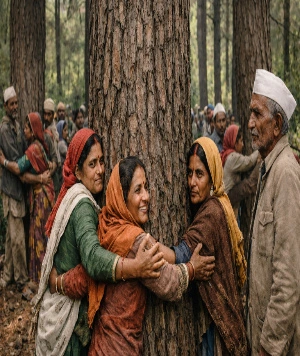
The Chipko Movement is one of the most powerful examples of grassroots environmental activism in the world. Originating in the Himalayan region of Uttarakhand in the 1970s, it was a non-violent protest aimed at protecting forests from commercial exploitation. The word “Chipko” translates to “to hug” or “to cling,” reflecting the unique method adopted by villagers—embracing trees to prevent them from being cut down.
This movement was not just about saving trees; it was about protecting livelihoods, preserving ecological balance, and challenging unjust economic practices. It combined environmental awareness with social justice, making it a turning point in India’s environmental history.
Historical Background and Origin of the Movement
The roots of the Chipko Movement can be traced to the growing dissatisfaction among local communities over forest policies that prioritized commercial interests over local needs. The official beginning is marked in April 1973 in Mandal village of Chamoli district.
The immediate cause was the government’s decision to deny villagers access to ash trees for making agricultural tools, while allowing a sports goods company to cut the same trees. This highlighted the inequality in resource allocation and triggered protests by local communities.
The forests in the Himalayan region were central to the lives of villagers. They provided fuelwood, fodder, water security, and protection from natural disasters such as landslides. Losing forests meant losing their means of survival.
- Started in Mandal village, Chamoli district (1973)
- Triggered by unfair forest resource allocation
- Highlighted conflict between local needs and commercial interests
- Forests were essential for livelihood and survival
- Sparked widespread community resistance
The Reni Village Incident: A Defining Moment
A major turning point in the movement occurred on March 26, 1974, in Reni village. When loggers arrived to cut trees, the men of the village were away. At this critical moment, Gaura Devi led a group of 27 women to confront the loggers.
These women placed themselves between the axes and the trees, hugging the trunks and refusing to move. Their courage and determination forced the loggers to retreat. This act saved approximately 2,000 trees and brought national attention to the movement.
The Reni incident became a symbol of resistance and highlighted the crucial role of women in environmental protection.
- Led by Gaura Devi and local women
- Protected around 2,000 trees
- Demonstrated non-violent resistance
- Became the defining symbol of the movement
- Highlighted women's leadership and courage
Leadership and Key Personalities
The success of the Chipko Movement was driven by visionary leaders who organized protests, mobilized communities, and brought attention to the cause.
Chandi Prasad Bhatt played a foundational role by establishing the Dasholi Gram Swarajya Mandal (DGSM). He emphasized community-based forest management and sustainable development.
Sunderlal Bahuguna, a Gandhian thinker, expanded the movement’s reach through advocacy and public awareness campaigns. His slogan “Ecology is the permanent economy” became widely recognized.
Other important contributors included Dhoom Singh Negi, Sudesha Devi, Bachni Devi, and Govind Singh Rawat, who helped sustain the movement at the grassroots level.
- Chandi Prasad Bhatt organized early protests
- Sunderlal Bahuguna spread the movement nationally
- Strong grassroots leadership
- Emphasis on sustainability and conservation
- Collective effort from multiple activists
Expansion and Scale of the Movement
Between 1972 and 1979, the Chipko Movement spread across more than 150 villages in the Himalayan region. It included at least 12 major protests and numerous smaller demonstrations.
This widespread participation showed that environmental issues were deeply connected to everyday life. The movement became a mass campaign rather than a localized protest, uniting communities across regions.
The movement also inspired similar initiatives in other parts of India, showing its far-reaching impact.
- Spread across 150+ villages
- Included 12 major protests
- Numerous smaller demonstrations
- Became a mass movement
- Inspired environmental activism across India
Ecological Impact and Environmental Benefits
The Chipko Movement had a profound impact on the environment. It is credited with saving approximately 2 million trees from deforestation. In addition to preventing tree cutting, activists also promoted reforestation, planting over one million trees.
Forests play a critical role in maintaining ecological balance. They prevent soil erosion, regulate water cycles, and support biodiversity. By protecting forests, the movement helped safeguard these ecological functions.
The movement also raised awareness about the importance of sustainable resource use and environmental conservation.
- Saved around 2 million trees
- Promoted reforestation (over 1 million trees planted)
- Prevented soil erosion and landslides
- Supported biodiversity conservation
- Encouraged sustainable practices
Policy Changes and Government Intervention
One of the most significant achievements of the Chipko Movement was its influence on government policy. After sustained protests and advocacy, Sunderlal Bahuguna appealed to Indira Gandhi.
In 1980, the government imposed a 15-year ban on commercial tree felling in the Himalayan forests. This ban also restricted green felling above 1,000 meters.
This decision marked a major victory for environmental conservation and demonstrated the power of grassroots movements in shaping public policy.
- 15-year ban on commercial felling (1980)
- Protection of forests above 1,000 meters
- Recognition of environmental concerns
- Strengthened conservation policies
- Set precedent for future environmental laws
Trans-Himalayan March and Awareness Efforts
To spread awareness about environmental issues, Sunderlal Bahuguna undertook a 5,000 km padyatra between 1981 and 1983.
This journey covered vast regions of the Himalayas and helped educate people about the importance of forests. It also brought attention to environmental issues at the national and international levels.
The march played a crucial role in connecting communities and strengthening the movement.
- 5,000 km foot march
- Conducted between 1981–1983
- Raised awareness across regions
- Connected different communities
- Promoted environmental education
Role of Women and Ecofeminism
One of the most unique aspects of the Chipko Movement was the central role played by women. Rural women were directly dependent on forests for their daily needs, such as collecting firewood, fodder, and water.
Their involvement transformed the movement into a powerful example of ecofeminism, which links environmental conservation with women's rights. Women not only participated but also led many protests, demonstrating their leadership and resilience.
The movement empowered women and gave them a voice in decision-making processes.
- Women were the backbone of the movement
- Led protests and resistance efforts
- Highlighted ecofeminism
- Emphasized livelihood dependence on forests
- Empowered rural women
Impact on Human Life and Society
The Chipko Movement had a lasting impact on human life, particularly in rural communities. By protecting forests, it ensured the availability of essential resources and improved living conditions.
It also promoted awareness about environmental issues and encouraged sustainable practices. Communities became more united and proactive in protecting their environment.
The movement highlighted the importance of balancing development with environmental protection.
- Improved access to forest resources
- Strengthened community bonds
- Raised environmental awareness
- Promoted sustainable living
- Empowered local populations
Ecological Significance and Long-Term Effects
From an ecological perspective, the movement played a crucial role in preserving biodiversity and maintaining environmental balance. Forests are essential for climate regulation, water conservation, and soil protection.
By preventing deforestation, the movement contributed to long-term sustainability and resilience against environmental challenges.
It also influenced environmental policies and practices beyond India.
- Preserved biodiversity
- Reduced soil erosion
- Improved water conservation
- Prevented ecological imbalance
- Supported climate stability
Global Recognition and Awards
The Chipko Movement received widespread recognition for its innovative approach to environmental conservation. In 1982, Chandi Prasad Bhatt received the Ramon Magsaysay Award for Community Leadership.
In 1987, the movement was honored with the Right Livelihood Award, also known as the Alternative Nobel Prize. Later, in 2009, Sunderlal Bahuguna was awarded the Padma Vibhushan.
These recognitions highlighted the global importance of the movement.
- Ramon Magsaysay Award (1982)
- Right Livelihood Award (1987)
- Padma Vibhushan (2009)
- Global recognition of grassroots activism
- Inspired international movements
Influence on Other Environmental Movements
The success of the Chipko Movement inspired several other environmental movements in India and around the world. One notable example is the Appiko Movement in Karnataka, which adopted similar methods to protect forests.
Globally, the movement became a model for non-violent environmental activism and community participation.
- Inspired Appiko Movement
- Influenced global environmental campaigns
- Promoted non-violent protest methods
- Encouraged community involvement
- Strengthened environmental activism
Lessons and Modern Relevance
The lessons of the Chipko Movement are highly relevant today. With increasing environmental challenges such as climate change and deforestation, the need for sustainable practices is more urgent than ever.
The movement teaches the importance of community participation, environmental awareness, and long-term thinking in development policies.
- Importance of sustainability
- Value of community involvement
- Need for environmental awareness
- Relevance in climate change discussions
- Model for grassroots activism
Conclusion: Legacy of the Chipko Movement
The Chipko Movement remains a powerful symbol of environmental protection and social justice. It demonstrated that ordinary people, through collective action and non-violent resistance, can bring about significant change.
Its legacy continues to inspire environmental movements worldwide, emphasizing the need for sustainable development and harmony between humans and nature.
As the world faces growing ecological challenges, the principles of the Chipko Movement provide valuable guidance for building a sustainable future.
Studylab24
100 Like · 4K views