Click below to generate summary
A Case That Redefined Freedom in India
Sometimes, the biggest constitutional revolutions begin with the smallest disputes. In India, one such moment came not from a massive political crisis, but from a simple question: Can the government take away your passport without telling you why?
This question led to the historic judgment in Maneka Gandhi v. Union of India—a case that completely reshaped the meaning of “life and personal liberty” under Article 21 of the Constitution.
Before this decision, fundamental rights were interpreted narrowly, almost mechanically. After it, they became dynamic, expansive, and deeply connected to human dignity. Today, many of the rights we take for granted—privacy, clean environment, fair trial—exist because of this transformation.
The Historical Shift: From Technical Law to Real Justice
To understand the importance of this case, we need to go back to the early years of constitutional interpretation.
In A.K. Gopalan v. State of Madras, the Supreme Court adopted a very strict and narrow view of Article 21. The phrase “procedure established by law” was interpreted to mean that as long as a law was passed by the legislature, it was valid—even if it was unfair or unjust.
This approach had two major consequences. First, it allowed the State to restrict personal liberty without needing to justify fairness. Second, it treated fundamental rights like isolated compartments—Article 14 (equality), Article 19 (freedoms), and Article 21 (life and liberty) were seen as completely separate.
The Maneka Gandhi case changed this entire framework.
When the government impounded Maneka Gandhi’s passport without giving any reasons, she challenged the action as arbitrary and unconstitutional. The Supreme Court used this opportunity to rethink its earlier approach.
Instead of focusing only on whether a law existed, the Court asked a deeper question: Is the law fair?
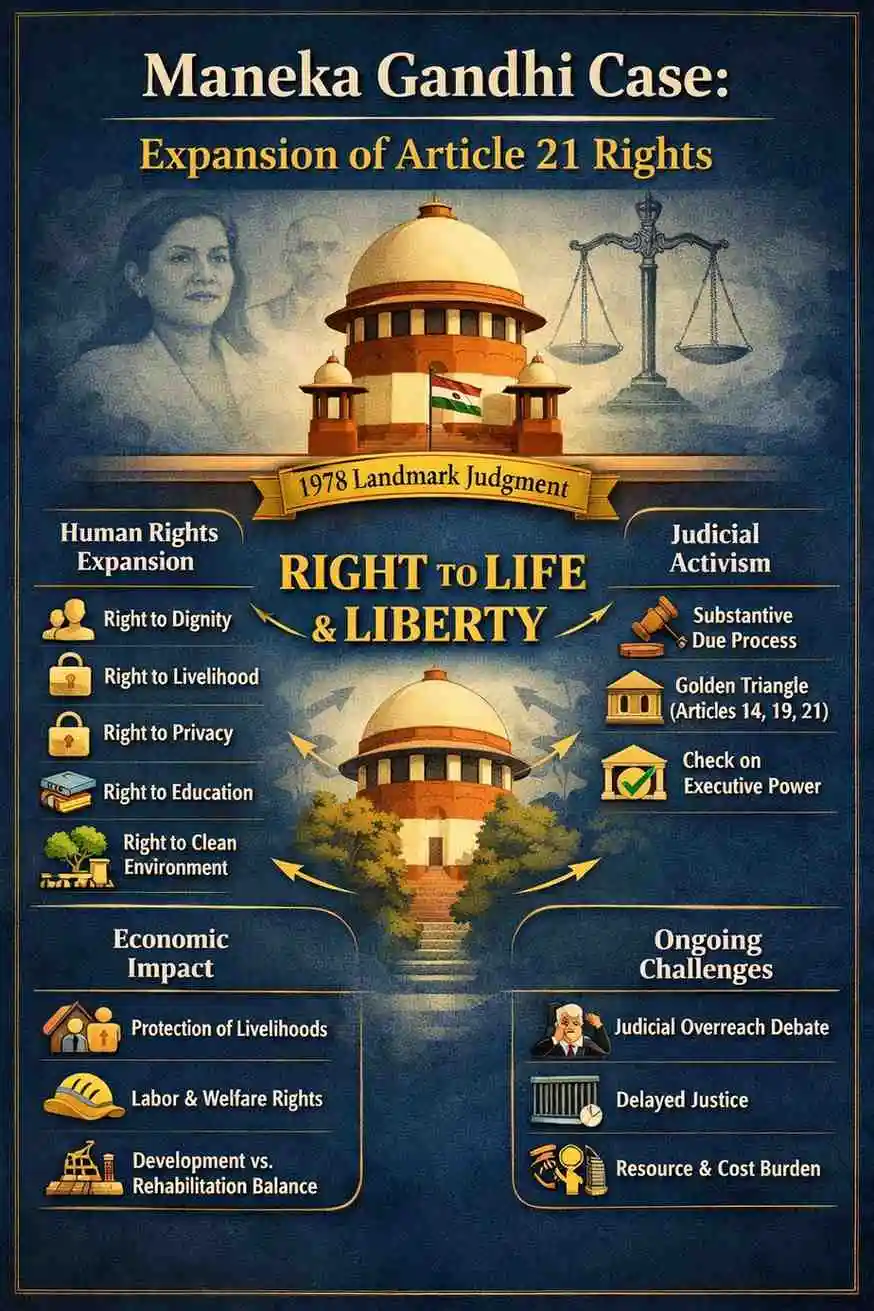
The answer became a constitutional principle. The Court held that any procedure depriving a person of liberty must be fair, just, and reasonable. This effectively introduced the idea of substantive due process into Indian law—without actually amending the Constitution.
Even more importantly, the Court connected Articles 14, 19, and 21 into what is now known as the Golden Triangle. This meant that any law affecting personal liberty must also satisfy equality and freedom standards.
Key Insights
- Article 21 moved from a narrow to a broad interpretation
- Fairness became a constitutional requirement
- Fundamental rights were integrated, not isolated
- The foundation of modern constitutionalism in India was laid
Social Impact: Making the Constitution People-Centric
The real power of the Maneka Gandhi judgment lies in how it changed everyday life.
After this case, Article 21 stopped being just a legal provision and became a source of human rights. Courts began interpreting “life” not as mere survival, but as a life with dignity.
Over time, this led to recognition of multiple rights—such as the right to livelihood, privacy, education, and a clean environment. These were not explicitly written in the Constitution but were derived from Article 21.
This shift also empowered ordinary citizens. Earlier, challenging the State required significant resources and legal knowledge. But with the rise of Public Interest Litigation (PIL), even marginalized groups could approach courts for justice.
The criminal justice system also underwent a transformation. Concepts like fair trial, legal aid, and speedy justice became essential parts of Article 21.
In essence, the Constitution became more responsive to human needs rather than just legal formalities.
Key Insights
- Article 21 evolved into a hub of human rights
- Citizens gained protection against arbitrary power
- PIL made justice accessible to the poor
- Criminal justice became more humane and rights-based
Economic Impact: From Growth to Rights-Based Development
While the case was constitutional in nature, its economic implications have been equally significant.
One of the most important developments was the recognition of the right to livelihood in Olga Tellis v. Bombay Municipal Corporation. The Court held that depriving someone of their livelihood is equivalent to depriving them of life.
This had a major impact on the informal sector, especially in urban areas. It provided protection against forced evictions and emphasized rehabilitation over displacement.
Additionally, labour rights began receiving more attention. Courts ensured that workers were entitled to fair wages and safe working conditions, linking these to dignity under Article 21.
At a broader level, the case influenced how development projects are planned. Governments now have to consider environmental impact, rehabilitation policies, and human dignity.
This has led to what can be called a rights-based development model—where economic growth must align with human welfare.
Key Insights
- Livelihood became part of the right to life
- Informal workers received legal protection
- Development projects must respect human rights
- Economic policy became more inclusive and humane
Political and Policy Impact: Rise of Judicial Activism
The Maneka Gandhi case also marked the beginning of a new era in Indian politics and governance—judicial activism.
Courts began interpreting the Constitution in a more dynamic and progressive manner. Instead of waiting for legislative action, they started expanding rights through judicial interpretation.
This created a strong check on executive power. Government actions could no longer be arbitrary—they had to pass tests of reasonableness and fairness.
As a result, policy-making also evolved. Laws are now drafted with greater emphasis on natural justice and procedural fairness.
However, this shift has not been free from criticism. Some argue that courts sometimes overstep their boundaries and interfere in policy matters, raising concerns about separation of powers.
Despite this debate, it is clear that the case strengthened democratic accountability.
Key Insights
- Judicial activism gained momentum
- Executive power became more accountable
- Laws increasingly reflect fairness and justice
- Debate over judicial overreach continues
Global Perspective: How India Stands Out
Globally, the expansion of Article 21 is considered a unique constitutional development.
In the United States, the concept of due process is explicitly mentioned in the Constitution. In the United Kingdom, rights are largely based on common law and parliamentary sovereignty.
India, however, achieved a similar outcome through judicial interpretation. Without changing the constitutional text, the Supreme Court effectively incorporated due process principles.
What makes India’s approach even more remarkable is its scope. While many countries focus mainly on civil and political rights, Article 21 extends to socio-economic rights as well—such as health, environment, and livelihood.
This makes India’s rights framework one of the most progressive in the world.
Key Insights
- India adopted due process through interpretation
- Article 21 has a broader scope than many global frameworks
- Includes socio-economic rights along with civil liberties
- Seen as a model of progressive constitutionalism
Current Relevance: Article 21 in Modern India
Even decades later, the impact of the Maneka Gandhi case continues to grow.
Article 21 is now one of the most frequently invoked provisions in the Supreme Court. A large number of Public Interest Litigations are based on it.
One of the most significant recent developments came in Justice K.S. Puttaswamy v. Union of India, where the right to privacy was recognized as a fundamental right.
In recent years, courts have also linked Article 21 to:
- Right to health (especially during COVID-19)
- Right to a clean environment
- Right to internet access
However, the growing importance of Article 21 has also contributed to an increasing judicial workload. With thousands of pending cases, ensuring timely justice remains a challenge.
Key Insights
- Article 21 is central to modern litigation
- New rights continue to emerge
- Privacy judgment expanded its scope further
- Judicial burden is increasing
Challenges: The Limits of Expansion
Despite its strengths, the expansion of Article 21 is not without challenges.
One major issue is the debate between judicial activism and overreach. Critics argue that courts sometimes step into areas meant for the legislature or executive.
Another concern is the implementation gap. While rights are well-established in theory, their realization on the ground remains uneven. Issues like prison conditions, delayed justice, and unequal access to courts persist.
The broad and evolving nature of Article 21 also creates uncertainty. Without clear boundaries, there is a risk of inconsistent judgments.
Finally, expanding rights places a financial burden on the State. Ensuring health, environment, and welfare requires significant resources.
Key Insights
- Risk of judicial overreach exists
- Gap between legal rights and reality remains
- Lack of clear limits creates uncertainty
- Expanding rights increases state responsibility
Conclusion: A Living Constitution in Practice
The Maneka Gandhi case was not just a legal judgment—it was a turning point in India’s constitutional journey.
It transformed Article 21 from a narrow procedural guarantee into a living, evolving right that touches every aspect of human life. By introducing fairness, integrating fundamental rights, and promoting judicial activism, it reshaped the relationship between the State and its citizens.
Today, Article 21 stands as the heart of Indian constitutional law—a powerful reminder that laws must not only exist but must also be just, fair, and humane.
FAQs
1. Why is the Maneka Gandhi case important?
It expanded Article 21 and established that laws affecting liberty must be fair, just, and reasonable.
2. What is the Golden Triangle of the Constitution?
It refers to the interconnection between Articles 14, 19, and 21.
3. How did Article 21 evolve after this case?
It expanded to include rights like privacy, livelihood, health, and environment.
4. What is substantive due process?
It means laws must be fair in content, not just in procedure.
5. Is Article 21 still relevant today?
Yes, it is the most widely used fundamental right in modern constitutional litigation.
Studylab24
100 Like · 4K views