Click below to generate summary
Introduction to Mahavir Jayanti
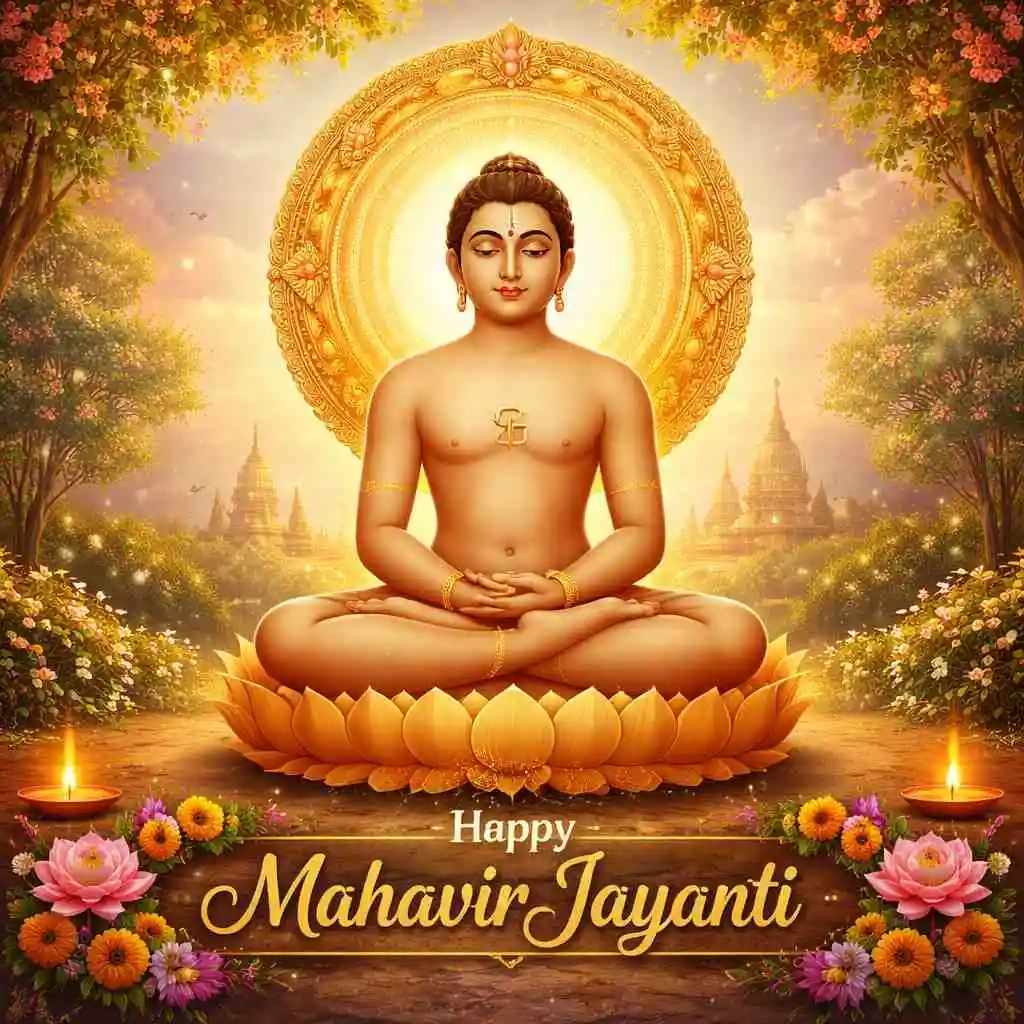
Every year, millions of Jains across India and around the world wake up before sunrise, prepare offerings of flowers and incense, and make their way to temples glowing with lamps and devotion. This is not just another public holiday on the calendar — it is Mahavir Jayanti, one of the most sacred observances in the Jain religious tradition and a day that carries the weight of 2,600 years of spiritual history.
But what exactly makes this festival so profoundly significant? Why do Jains, scholars, philosophers, and even non-Jain spiritual seekers pause on this day to reflect on the life of one extraordinary human being?
Mahavir Jayanti celebrates the birth anniversary of Lord Vardhamana Mahavir, the 24th and final Tirthankara (ford-maker or spiritual teacher) of the current cosmic cycle in Jainism. Born into royalty, he eventually chose the path of absolute renunciation, transforming himself through 12 years of intense meditation and austerity into a fully enlightened being — a Jina, or conqueror of the self.
His teachings did not arrive wrapped in complex metaphysics meant only for scholars. Instead, they spoke directly to the human condition: reduce harm, speak truthfully, release attachment, practice self-discipline, and take only what you need. These five principles — known as the Pancha Mahavrata — remain just as urgent and relevant in today's fast-paced, consumption-driven world as they were in 599 BCE.
Historical Background
To understand Mahavir Jayanti, you must first understand the historical canvas upon which Lord Mahavir's life was painted. Ancient India, around the sixth century BCE, was a land in spiritual and philosophical ferment. Vedic rituals had grown elaborate and often exclusionary. The common person struggled to find a path to liberation that did not require priestly mediation or elaborate sacrifice.
It was into this environment that Lord Mahavir was born — and his life would become a profound answer to those searching for a direct, personal path to spiritual freedom.
- Mahavir Jayanti falls on the 13th day of the bright half of the Hindu month of Chaitra (usually March or April).
- The festival has been celebrated continuously for over two millennia.
- It was officially recognized as a public holiday in India, reflecting the nation's deep respect for Jain contributions to culture and philosophy.
- Historical records, including Jain Agamas (sacred scriptures), provide detailed accounts of Lord Mahavir's birth and life.
- Ancient texts also corroborate Mahavir as a contemporary of Gautama Buddha, placing him firmly within a well-documented historical period.
This historical grounding gives Mahavir Jayanti a sense of authenticity and depth that elevates it far beyond a symbolic observance into a living connection with ancient wisdom.
Birth of Lord Mahavir
Lord Mahavir was born in 599 BCE in Kundagrama (modern-day Vaishali district, Bihar, India) to King Siddhartha and Queen Trishala of the Ikshvaku dynasty. His birth name was Vardhamana, meaning "one who grows" — a name that proved prophetic, as his spiritual influence only expanded over time.
According to Jain tradition, Queen Trishala experienced 14 auspicious dreams on the night she conceived Vardhamana, each interpreted by court astrologers as omens of a great soul entering the world. These dreams included a white elephant, a lion, the sun, and a garland of flowers — symbols of power, courage, illumination, and beauty.
- He was born into the Kshatriya (warrior) caste, providing him with privilege and access to knowledge.
- As a child, Vardhamana showed remarkable calmness, fearlessness, and compassion.
- His birth is celebrated each year with great joy because Jains believe his arrival marked the beginning of a new spiritual era.
- Different Jain sects observe slight variations in the dating, but the essence of the celebration remains unified.
- The Digambara sect places his birth in 598 BCE, while the Shvetambara sect uses 599 BCE — both honour the same extraordinary individual.
Early Life and Renunciation
Vardhamana grew up surrounded by luxury, education, and royal comfort. He married Yashoda and had a daughter named Priyadarshana. However, even amid worldly abundance, he felt a persistent pull toward deeper truths. At the age of 30, following the death of his parents, he renounced all material possessions — his palace, his family, his clothes — and became an ascetic.
For 12 years, he wandered through forests and villages, subjecting himself to extreme penance, enduring heat and cold, hunger and thirst, and the ridicule of those who did not understand his quest. He practised complete non-violence, refusing to harm even the smallest organisms. At the age of 42, under a sal tree near the Rijupalika River, he attained Kevala Jnana — omniscient knowledge, the highest state of spiritual enlightenment.
- He then became known as Mahavir (Great Hero) and Jina (Conqueror) — the origin of the term "Jainism."
- For the next 30 years, he travelled and taught across the Gangetic plains.
- He attained Moksha (liberation) at Pawapuri, Bihar, at the age of 72.
- His life story is a testament to the transformative power of discipline, compassion, and relentless self-inquiry.
Why Mahavir Jayanti Is Celebrated
Mahavir Jayanti is celebrated primarily to honour the birth of Lord Mahavir and to renew the Jain community's commitment to his teachings. It is a day of reflection, gratitude, and spiritual reorientation — a moment to ask oneself: how closely am I living the values of non-violence, truth, and simplicity?
Beyond personal renewal, the festival also serves a vital social function. It brings Jain communities together, strengthens cultural identity, and provides an opportunity to share Jain philosophy with those outside the tradition.
- It honours the memory of an enlightened teacher whose wisdom transcends religious boundaries.
- The day reminds practitioners to actively practise Ahimsa (non-violence) not just in action but in thought and speech.
- It serves as a communal reaffirmation of Jain values in an increasingly materialistic world.
- Schools, cultural organisations, and Jain institutions use the occasion to educate younger generations about their heritage.
- The festival fosters interfaith dialogue, as Mahavir's teachings on compassion and truth resonate across religious traditions.
Spiritual Significance
The spiritual significance of Mahavir Jayanti cannot be overstated. Lord Mahavir's enlightenment represents the ultimate aspiration of the Jain path — to liberate the soul from the cycle of birth, death, and rebirth through right knowledge, right faith, and right conduct.
Jains believe that each soul has the potential to attain the same level of purity and omniscience achieved by Lord Mahavir. His life, therefore, is not merely a historical account but a living roadmap for personal spiritual evolution. On Mahavir Jayanti, this belief is celebrated, deepened, and transmitted.
- The festival reinforces the Jain concept of Anekantavada — the many-sidedness of truth — encouraging tolerance and open-mindedness.
- It highlights the principle of Aparigraha (non-possessiveness), urging people to evaluate their relationship with material things.
- Spiritual discourses held on this day draw large gatherings seeking wisdom and guidance.
- The day is considered highly auspicious for fasting, meditation, and charitable acts.
- Many Jains observe complete silence for periods during the day as a form of inner contemplation.
Five Core Teachings
Lord Mahavir's five core teachings — often called the Pancha Mahavrata for monks and Pancha Anuvrata for laypeople — form the ethical backbone of Jainism and are the heart of what Mahavir Jayanti celebrates:
- Ahimsa (Non-violence): Avoid causing harm to any living being through thought, word, or action. This principle extends to animals, insects, plants, and even microorganisms, making Jains among the world's earliest advocates for environmental ethics.
- Satya (Truthfulness): Speak truth that is kind, necessary, and beneficial. Harmful truths should be withheld. This nuanced approach to honesty remains philosophically sophisticated even by modern standards.
- Asteya (Non-stealing): Do not take anything that has not been freely given. This principle also discourages exploitation in any form.
- Brahmacharya (Celibacy/Chastity): For monks, this means complete celibacy; for laypeople, it means fidelity and restraint in sensory pleasures.
- Aparigraha (Non-possessiveness): Limit the accumulation of material possessions. The more one clings, the more one suffers — a teaching strikingly resonant in today's consumer culture.
- These five vows guide every aspect of a devout Jain's daily life.
- They are considered the foundation of ethical conduct that leads to spiritual liberation.
- Modern interpretations apply these principles to business ethics, environmental activism, and social justice.
Rituals and Traditions
Mahavir Jayanti is a festival rich in ritual and tradition, each practice carrying deep symbolic and spiritual meaning. Unlike festivals centered on feasting or fireworks, this observance is characterised by its quiet devotion, acts of service, and communal prayer.
Temple Worship
On Mahavir Jayanti, Jain temples across India and abroad become centers of intense devotional activity. Statues of Lord Mahavir are given elaborate ritual baths — a ceremony called Abhisheka — using sacred substances such as milk, curd, ghee, honey, and saffron water. This ritual purification symbolises the cleansing of one's own soul.
- Devotees offer flowers, incense, lamps, rice, and sweets at the temple altar.
- Priests recite Jain prayers and hymns in praise of Lord Mahavir's qualities.
- Temples are adorned with colourful decorations, flags, and lights.
- Special exhibitions and displays about Lord Mahavir's life are set up within temple premises.
- Many temples offer free community meals (Prasad) to all visitors, regardless of faith.
Rath Yatra Processions
One of the most visually spectacular aspects of Mahavir Jayanti celebrations is the Rath Yatra — a grand chariot procession carrying the idol or image of Lord Mahavir through the streets. Thousands of devotees accompany the procession, singing hymns, carrying flowers, and chanting prayers.
- The Rath Yatra symbolises Lord Mahavir's journey from worldly life to spiritual liberation.
- Elaborately decorated chariots are pulled through town centers and marketplaces.
- Participants typically wear white clothing, symbolising purity and renunciation.
- The procession provides an opportunity for public spiritual expression and community bonding.
- In major cities like Mumbai, Ahmedabad, Jaipur, and Kolkata, these processions attract massive crowds and media coverage.
Charity and Donations
Lord Mahavir placed immense emphasis on dana (charity) as a spiritual practice. On Mahavir Jayanti, Jain individuals and organisations channel this teaching into large-scale charitable activities:
- Free medical camps and eye care clinics are organised in urban and rural areas.
- Blood donation drives are held by Jain youth organisations.
- Food and clothing distributions reach the homeless and underprivileged communities.
- Animal shelters and veterinary clinics receive financial support and volunteer time.
- Educational scholarships are announced for deserving students in honour of the occasion.
These acts of service are not performed for publicity but as sincere expressions of the core Jain value that all living beings deserve care and respect.
Celebrations Across India
Mahavir Jayanti is celebrated with tremendous enthusiasm across every region of India, with each state bringing its own unique cultural flavour to the observance.
In Gujarat and Rajasthan, where Jain populations are particularly concentrated, the celebrations are especially grand. Entire streets are decorated, businesses close as a mark of respect, and community halls fill with spiritual discourses.
In Bihar, which holds the distinction of being Lord Mahavir's birthplace, pilgrims travel from across the country to visit sacred sites including Kundagrama and Pawapuri — the place where he attained Nirvana.
In Maharashtra, particularly Mumbai, large Jain trusts organise multi-day events featuring classical music, spiritual lectures, and exhibitions on Jain art and history.
In Karnataka and Tamil Nadu, Jain communities participate in temple ceremonies and community service drives.
- National-level Jain organisations coordinate simultaneous events across 200+ cities.
- State governments in Jain-majority regions declare local public holidays.
- Cultural programmes featuring traditional Jain music and dance are held in schools and colleges.
- Television channels broadcast documentaries and devotional programmes dedicated to Lord Mahavir's life.
Global Observance
Mahavir Jayanti is not confined to India's borders. As the Jain diaspora has grown worldwide, so has the global footprint of this sacred celebration.
In the United States, Jain Centers in cities like New Jersey, Chicago, Houston, and Los Angeles organise community prayers, cultural events, and vegetarian food festivals. Many American Jain youth groups use the occasion to present Lord Mahavir's teachings in contemporary contexts.
In the United Kingdom, the Jain community in cities like Leicester and London organises interfaith events where Mahavir Jayanti becomes a platform for dialogue about non-violence and sustainability.
In Canada, Australia, Kenya, and Singapore, Jain communities maintain vibrant observance of the festival, ensuring that the diaspora remains connected to its spiritual roots.
- The United Nations has acknowledged Jainism's contributions to world peace through the lens of Ahimsa.
- Academic institutions globally host seminars on Jain philosophy on or around Mahavir Jayanti.
- Social media campaigns reach millions of people worldwide, spreading Mahavir's teachings digitally.
Cultural Relevance Today
In an era of climate change, political polarisation, and social inequality, the teachings of Lord Mahavir feel less like ancient wisdom and more like urgent modern prescriptions. Mahavir Jayanti serves as an annual reminder that the solutions to many contemporary crises may already exist within ancient philosophical traditions.
Non-violence and environmentalism: Ahimsa, extended to its logical conclusion, becomes a powerful environmental ethic. Jain communities have historically been advocates for vegetarianism, animal rights, and minimal ecological footprint — values that are increasingly mainstream today.
Non-possessiveness and minimalism: Aparigraha anticipates the modern minimalism movement, offering a spiritual framework for consuming less and living more meaningfully.
Truthfulness and social media: In an age of misinformation, Satya — speaking only what is true, kind, and necessary — is a radical and badly needed practice.
- Jain philosophy is increasingly being studied in business schools for its ethical framework.
- Environmental organisations cite Jain principles in policy discussions on sustainability.
- Mental health advocates draw parallels between Jain meditation practices and modern mindfulness.
- Young Jains are actively reinterpreting these teachings through social enterprise, activism, and technology.
FAQs
Q1: What is the significance of Mahavir Jayanti?
Mahavir Jayanti marks the birth anniversary of Lord Mahavir, the 24th Tirthankara of Jainism, born in 599 BCE. It is one of the most important Jain festivals, celebrated to honour his life and renew commitment to his five core teachings — non-violence, truth, non-stealing, chastity, and non-possessiveness. It is a day of prayer, fasting, charity, and community gathering for Jains worldwide.
Q2: How is Mahavir Jayanti celebrated?
Celebrations include temple visits, ritual bathing of Lord Mahavir's idol (Abhisheka), Rath Yatra processions, fasting, meditation, and charitable activities. Devotees dress in white and participate in community prayers and spiritual discourses. Large-scale events are organised by Jain trusts, and free medical or food camps are held to serve the wider public.
Q3: Is Mahavir Jayanti a public holiday in India?
Yes, Mahavir Jayanti is a gazetted public holiday in India, recognising the profound cultural and spiritual contribution of Lord Mahavir and the Jain community to Indian civilisation. Government offices, banks, and many businesses remain closed on this day across the country.
Q4: What are the five teachings of Lord Mahavir?
Lord Mahavir's five core teachings are: Ahimsa (non-violence), Satya (truthfulness), Asteya (non-stealing), Brahmacharya (chastity), and Aparigraha (non-possessiveness). Together, these form the Pancha Mahavrata for monks and Pancha Anuvrata for lay followers, guiding ethical living and spiritual progress.
Q5: When does Mahavir Jayanti fall in 2025?
In 2025, Mahavir Jayanti falls on April 10th. The date varies each year as it is determined by the Jain lunar calendar — specifically the 13th day (Trayodashi) of the bright fortnight of the month of Chaitra.
Conclusion
Mahavir Jayanti is far more than a birthday celebration — it is an annual invitation to examine how we live, how we treat others, and how closely our daily choices align with the values of compassion, honesty, and simplicity. Lord Mahavir's journey from privileged prince to enlightened sage is not just an inspiring story; it is a mirror held up to every human being, asking what we are willing to surrender in pursuit of a more meaningful existence.
The 15 facts and insights explored in this article reveal a festival of extraordinary depth — rooted in verifiable history, guided by a sophisticated ethical philosophy, expressed through vibrant and meaningful ritual, and increasingly relevant to the challenges of the contemporary world. Whether you are a lifelong Jain, a curious student of world religions, or simply someone seeking a more purposeful way of living, the wisdom of Mahavir Jayanti has something genuinely transformative to offer.
As the great Mahavir himself taught: "Live and let live." In four words, a complete philosophy — and in one festival, a whole civilisation's devotion to it.
Studylab24
100 Like · 4K views