Click below to generate summary
Introduction to the Formation of Rajasthan
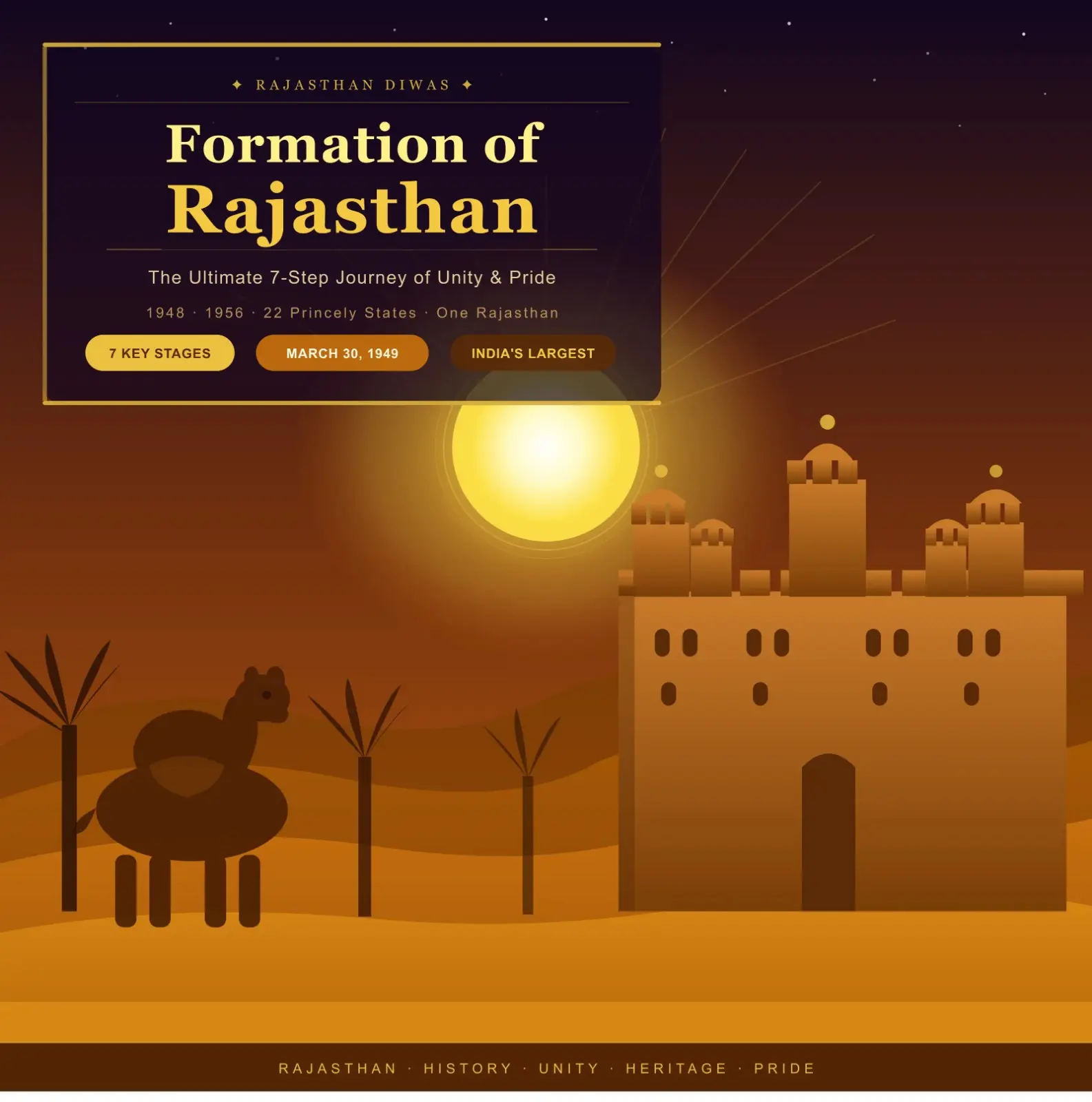
Imagine a vast land of golden deserts, majestic forts, brave warriors, and centuries-old royal dynasties — all coming together under one administrative roof. That is the extraordinary story of the formation of Rajasthan. Today, Rajasthan is India's largest state by area, stretching across 342,239 square kilometers of the northwestern subcontinent. But this unified identity did not happen overnight. It is the result of a carefully orchestrated, politically complex, and historically rich process that unfolded over several years following India's independence in 1947.
Before independence, the region known as Rajasthan was a patchwork quilt of over 20 princely states, each with its own ruler, laws, culture, and identity. These states were governed by powerful Rajput kings who had maintained their sovereignty under British suzerainty for centuries. When India gained independence, the challenge of integrating these proud and autonomous states into a democratic republic was enormous.
The process was neither simple nor without conflict. It demanded visionary leadership, sensitive diplomacy, and bold administrative reform. Under the able guidance of Sardar Vallabhbhai Patel and the tireless efforts of V. P. Menon, the integration of Rajputana into modern Rajasthan was executed in seven carefully planned stages between 1948 and 1956.
Historical Background of Rajasthan
To truly appreciate the formation of Rajasthan, one must first understand the historical landscape from which it emerged. The region has been inhabited for thousands of years and carries within it the legacy of some of the most powerful and proud dynasties in Indian history.
Rajputana Before Independence
Before independence, the region now called Rajasthan was officially known as Rajputana, meaning "Land of the Rajputs." It was home to powerful clans such as the Mewar, Marwar, Jaipur, Bikaner, Bundi, Kota, and Bharatpur dynasties. These were not mere ceremonial titles — these rulers commanded armies, collected taxes, administered justice, and maintained their own cultural traditions for generations.
Under British colonial rule, the princely states of Rajputana signed treaties with the British Crown, which allowed them internal autonomy in exchange for acknowledgment of British supremacy in foreign affairs and defense. This created a unique dual political reality: the rulers had genuine authority within their territories, but existed within the broader framework of the British Empire.
Key points to understand:
- Rajputana comprised 19 major princely states and 3 chiefships
- Each state had its own flag, currency (in some cases), and administrative systems
- British political agents supervised affairs but rarely interfered in day-to-day governance
- Cultural pride and regional identity were deeply embedded in each state
Role of Princely States
The princely states played a dual role in shaping Rajasthan's formation. On one hand, they were repositories of culture, art, architecture, and administration. On the other hand, their fierce independence and loyalty to local identity made the task of political integration incredibly challenging.
When the British announced the transfer of power in 1947, these princely states were given the option to join India, Pakistan, or remain independent. Most rulers in Rajputana initially showed reluctance to merge, fearing the loss of their privileges and sovereignty. It was at this critical juncture that the Indian government's strategy of diplomacy, incentives (privy purses), and firm persuasion came into play.
- Rulers were promised financial allowances (privy purses) post-merger
- Guarantees were given regarding personal properties and religious privileges
- Sardarmani Patel and Menon met personally with reluctant rulers to negotiate terms
- Some states like Bikaner were among the first to agree voluntarily
Importance of the Formation of Rajasthan
The formation of Rajasthan holds immense significance — not just for the state itself, but for the broader narrative of Indian national integration. It stands as one of the most complex and successful examples of democratic state-building in modern world history.
Without integration, Rajputana would have remained fragmented, economically weak, and administratively inefficient. The consolidation allowed for unified governance, better allocation of resources, coordinated development programs, and a shared cultural identity that transcended individual royal loyalties.
Key reasons why this formation matters:
- It proved that diverse kingdoms could unite under democratic governance
- It established a model for state reorganization that later guided the States Reorganisation Act of 1956
- It helped preserve the rich cultural heritage of the region under a stable administrative structure
- It enabled economic planning, irrigation projects, and infrastructure development at a regional scale
- It gave millions of citizens a unified civic identity as "Rajasthanis"
The 7 Stages of Formation of Rajasthan
The formation of Rajasthan was completed through seven distinct stages, each carefully planned and executed between March 1948 and November 1956.
Stage 1: Matsya Union (March 18, 1948)
The very first step in the formation of Rajasthan was the Matsya Union, established on March 18, 1948. This union brought together four princely states: Alwar, Bharatpur, Dhaulpur, and Karauli. The name "Matsya" was derived from an ancient region in Vedic geography that historically covered this area.
Shri Shobha Ram was appointed as the first Prime Minister of the Matsya Union, and Maharaja Uday Bhan Singh of Dhaulpur became its Rajpramukh (Governor). This initial union was a test case for the broader integration plan.
- Four states merged: Alwar, Bharatpur, Dhaulpur, Karauli
- Capital: Alwar
- Significance: First formal step toward Rajasthan's creation
Stage 2: Rajasthan Union (March 25, 1948)
Just a week later, on March 25, 1948, the Rajasthan Union was formed by merging nine smaller southern Rajputana states: Banswara, Bundi, Dungarpur, Jhalawar, Kishangarh, Kota, Pratapgarh, Shahpura, and Tonk.
The Maharawal of Dungarpur initially resisted but eventually joined. Maharao Bhim Singh of Kota was made the Rajpramukh, and Gokul Lal Asawa became the first Prime Minister of this union.
- Nine states merged into one unit
- Capital: Kota
- Significance: Expanded the base of integration beyond the Matsya region
Stage 3: United State of Rajasthan (April 18, 1948)
The third stage saw the United State of Rajasthan formed on April 18, 1948, when Mewar (Udaipur) — one of the most historically significant and prestigious states — joined the Rajasthan Union. This was a landmark moment because Mewar's Maharana had long resisted integration.
Maharana Bhopal Singh of Mewar became the Rajpramukh, and Manikya Lal Verma became the Prime Minister. The capital shifted to Udaipur.
- Mewar's entry gave the union historical prestige and legitimacy
- Capital: Udaipur
- Significance: The union gained a major cultural and political anchor
Stage 4: Greater Rajasthan (March 30, 1949)
This was arguably the most pivotal stage. On March 30, 1949 — now celebrated as Rajasthan Diwas — Greater Rajasthan was formed by merging four powerful states: Jaipur, Bikaner, Jodhpur, and Jaisalmer with the existing United State of Rajasthan.
Sardar Vallabhbhai Patel himself inaugurated this union in Jodhpur. Maharaja Sawai Man Singh II of Jaipur became the Rajpramukh, and Hiralal Shastri became the first Prime Minister.
- Largest and most significant merger in the process
- Capital: Jaipur
- March 30 is now celebrated as Rajasthan Diwas
- Significance: Gave Rajasthan its near-final geographical shape
Stage 5: United Rajasthan (May 15, 1949)
On May 15, 1949, the Matsya Union — which had been kept separate — was merged into Greater Rajasthan, creating the United Rajasthan. This brought Alwar, Bharatpur, Dhaulpur, and Karauli back into the main fold.
- Matsya Union formally dissolved
- States integrated: Alwar, Bharatpur, Dhaulpur, Karauli
- Significance: Geographical unity strengthened considerably
Stage 6: Rajasthan State (January 26, 1950)
On January 26, 1950 — the day India became a Republic — Sirohi was partially merged into Rajasthan (with Mount Abu and Delwara going to Bombay State temporarily). The unified entity was now officially called Rajasthan State, and Maharaja Sawai Man Singh II became its first Rajpramukh under the new constitutional framework.
- India becomes a Republic; Rajasthan gets constitutional status
- Partial merger of Sirohi
- Significance: Rajasthan now had a constitutional identity
Stage 7: Final Integration (November 1, 1956)
The seventh and final stage came with the States Reorganisation Act of 1956, which came into effect on November 1, 1956. Ajmer (a centrally administered territory), Abu Road (from Bombay State), and Sunel Tappa (from Madhya Bharat) were merged into Rajasthan. Simultaneously, the Sirohi confusion was resolved.
Mohanlal Sukhadia became the Chief Minister, and the role of Rajpramukh was replaced by an appointed Governor, Gurmukh Nihal Singh.
- Ajmer, Abu Road, Sunel Tappa merged
- Rajasthan achieved its current geographical boundaries
- Significance: The formation of Rajasthan was complete
Role of Leaders in Formation of Rajasthan
Political Visionaries
No discussion of the formation of Rajasthan is complete without acknowledging the towering figures who made it possible. Sardar Vallabhbhai Patel, often called the "Iron Man of India," was the chief architect of state integration across the country. His firm but diplomatic approach convinced even the most reluctant rulers to join the Indian Union.
V. P. Menon, Patel's trusted administrative partner, was the man who translated vision into action. His negotiating skills and political acumen helped craft the Instrument of Accession that most rulers eventually signed.
- Sardar Patel: Political will and national vision
- V. P. Menon: Administrative execution and diplomacy
- Hiralal Shastri and Manikya Lal Verma: Regional political leadership
Administrative Efforts
Behind every merger was a complex administrative machinery that had to harmonize different legal codes, revenue systems, languages, and governance structures. District administration had to be rebuilt from scratch in many areas.
- Revenue and land records were unified gradually
- Courts and police systems were integrated
- Civil services were restructured to replace royal administration
Cultural Integration After Formation
Rajasthan is not just a political entity — it is a living museum of culture. After the political integration, the state had to weave together diverse folk traditions, languages (Marwari, Mewari, Dhundhari, Hadoti), art forms, and festivals into a cohesive regional identity.
The state government actively promoted:
- Rajasthani folk music and dance (Ghoomar, Kalbeliya)
- Art and craft traditions (Blue Pottery, Block Printing)
- Cultural festivals like the Pushkar Fair and Desert Festival
- Rajasthani literature and language advocacy
Economic Impact of Formation of Rajasthan
Political unity created the conditions for economic development. Before integration, each princely state maintained its own trade barriers and infrastructure, making regional economic planning impossible.
After unification:
- The Bhakra-Nangal and Chambal valley projects brought irrigation to arid areas
- Road and rail connectivity improved dramatically
- Tourism emerged as a major economic driver leveraging royal palaces and forts
- Mining (especially marble and sandstone) became organized at scale
Administrative Reforms
Post-formation, Rajasthan underwent sweeping administrative reforms to bring governance in line with democratic principles:
- The Panchayati Raj system was introduced, empowering village-level governance
- District Collectors replaced the arbitrary rule of royal administrators
- Land reforms abolished the Jagirdari system, redistributing land to farmers
- A unified High Court was established at Jodhpur
Challenges Faced During Formation
The path to unification was not smooth. Several serious challenges had to be overcome:
- Ruler reluctance: Many maharajas were deeply attached to their sovereignty
- Cultural pride: Different communities identified with their local ruler, not a broader Rajasthani identity
- Administrative incompatibility: Legal systems, revenue structures, and police forces were wildly different across states
- Geographic vastness: Coordinating across the desert terrain was logistically challenging
- Communal sensitivities: Some border areas had mixed loyalties between India and Pakistan post-Partition
Why Rajasthan Formation Day Matters
Rajasthan Diwas is celebrated every year on March 30 to commemorate the formation of Greater Rajasthan in 1949. It is a day of state pride, cultural celebration, and historical reflection. Government offices, schools, and cultural organizations across the state mark the occasion with events, parades, and educational programs.
It matters because:
- It reminds citizens of the sacrifices and diplomacy that created their home state
- It celebrates the peaceful democratic integration of proud kingdoms
- It reinforces Rajasthani cultural identity on a national platform
- It educates younger generations about their historical roots
FAQs
Q1: When was Rajasthan officially formed?
Rajasthan was officially formed in seven stages between March 18, 1948 and November 1, 1956. The most celebrated date is March 30, 1949, when Greater Rajasthan was formed by merging the four major states of Jaipur, Jodhpur, Bikaner, and Jaisalmer. This day is observed annually as Rajasthan Diwas across the state.
Q2: How many princely states merged to form Rajasthan?
A total of 19 princely states and 3 chiefships (Lawa, Neemrana, and Kushalgarh) of the former Rajputana region merged to form modern Rajasthan. The process also included the centrally administered territory of Ajmer-Merwara, which was added in the final stage of integration in 1956.
Q3: Who is credited with leading the formation of Rajasthan?
Sardar Vallabhbhai Patel, India's first Home Minister, and his secretary V. P. Menon are widely credited with leading the integration of princely states into India. At the regional level, leaders such as Hiralal Shastri, Manikya Lal Verma, and Gokul Lal Asawa played crucial roles in shaping political consensus among local rulers and communities.
Q4: What was Rajasthan called before it was formed?
Before independence and the subsequent integration, the region was called Rajputana, meaning "Land of the Rajputs." The British used this name to refer to the collection of princely states in the northwestern part of the subcontinent, which was governed under the supervision of a British Political Agent based in what is now Ajmer.
Q5: Why is March 30 celebrated as Rajasthan Diwas?
March 30 is celebrated as Rajasthan Diwas because on this date in 1949, Greater Rajasthan was formed — the largest and most significant merger in the state's formation process. Sardar Vallabhbhai Patel personally inaugurated the event in Jodhpur. This merger brought together Jaipur, Bikaner, Jodhpur, and Jaisalmer, giving Rajasthan its near-final geographical identity.
Conclusion
The formation of Rajasthan is one of the most remarkable chapters in Indian political history. What was once a collection of proud, independent kingdoms — each with its own ruler, traditions, and identity — was transformed through diplomacy, vision, and democratic commitment into a unified state that today stands as the largest in India by area.
Across seven carefully executed stages spanning nearly a decade, Sardar Patel, V. P. Menon, and a host of regional leaders stitched together the complex tapestry of Rajputana into the vibrant, cohesive state of Rajasthan. The process was not without its difficulties — ruler reluctance, administrative incompatibility, and deep cultural pride were all formidable obstacles. Yet, the outcome was a triumph of democratic nation-building.
Today, Rajasthan is not just a geographical entity. It is a living testament to unity in diversity — where the desert meets history, where Rajput valor meets democratic governance, and where centuries-old culture thrives alongside modern development. Understanding the formation of Rajasthan is essential for anyone who wishes to understand India's remarkable journey from colonial empire to democratic republic.
Studylab24
100 Like · 4K views