Introduction to Ambedkar Jayanti
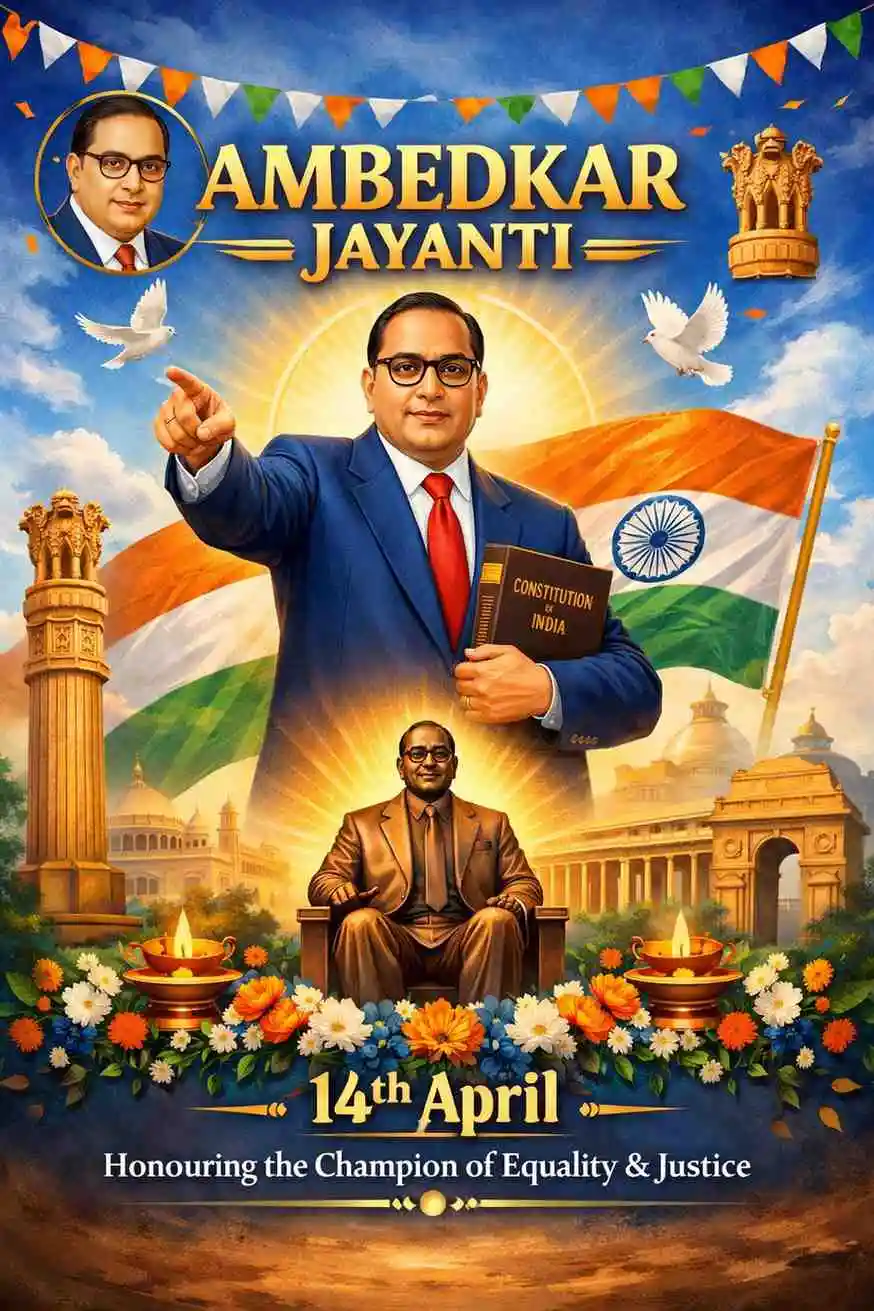
Every year on April 14, millions of people across India and around the world pause to honor one of the most transformative figures in modern history — Dr. Bhimrao Ramji Ambedkar. Known as Ambedkar Jayanti or Equality Day, this occasion is far more than a public holiday marked on the calendar. It is a living reminder that justice, dignity, and equality are not privileges — they are rights that every human being deserves, regardless of caste, gender, or social background.
But here is the uncomfortable truth: despite decades of legal reform and constitutional protections, social inequality still casts a long shadow in many corners of the world, including India. Millions of people continue to face discrimination based on their birth, not their character or capability. This is precisely why Ambedkar Jayanti remains urgently relevant — not just as a commemoration, but as a call to action.
Dr. Ambedkar's life story is the ultimate proof that systemic barriers can be dismantled through education, perseverance, and moral courage. Born into a marginalized community that was treated as untouchable by society, he rose to become one of India's most educated minds, the chief architect of the Indian Constitution, and a global icon of human rights. His journey from discrimination to distinction continues to inspire millions.
History of Ambedkar Jayanti
Understanding Ambedkar Jayanti requires going back to the roots — both to the life of the man being celebrated and to the historical context that made his contributions so extraordinary.
Birth of Dr. B.R. Ambedkar
Dr. Bhimrao Ramji Ambedkar was born on April 14, 1891, in Mhow, a small military cantonment town in present-day Madhya Pradesh, India. He was the fourteenth child of Ramji Maloji Sakpal, a soldier in the British Indian Army, and Bhimabai Sakpal. Born into the Mahar caste — a community classified as "untouchable" under the rigid Hindu caste hierarchy — Ambedkar experienced discrimination from the very beginning of his life.
Despite facing segregation in classrooms, denial of access to public spaces, and the crushing social stigma of untouchability, Ambedkar refused to accept the limitations that society imposed on him. With determination and a fierce love of learning, he earned multiple degrees — something nearly unimaginable for a person of his background at the time. He studied economics at Columbia University in New York and earned a doctorate from the London School of Economics, becoming one of the most academically accomplished Indians of his era.
His early experiences of humiliation and exclusion did not break him. Instead, they became the fuel for his lifelong mission to dismantle caste-based oppression and build a society grounded in equality and justice.
Why 14 April Matters
April 14 holds deep significance because it marks the birth anniversary of a man who literally rewrote the rules of a nation. The date was officially recognized as a public holiday in India to honor his extraordinary contributions. In many states, the day is declared a gazetted holiday, and the government of India has consistently acknowledged Ambedkar Jayanti as a moment of national reflection.
The fact that the day is called Equality Day in many circles reflects the broader symbolic weight it carries. It is not just about one individual — it is about a principle that Ambedkar dedicated his entire life to fighting for: the idea that every human being is equal in worth and dignity.
10 Powerful Facts About Ambedkar Jayanti
Here are ten facts that highlight the depth and significance of this remarkable day.
Public Holiday Status
Ambedkar Jayanti is a gazetted public holiday across India. Government offices, schools, banks, and many businesses remain closed. Several state governments, particularly Maharashtra, organize large-scale events, rallies, and tributes. The holiday was officially declared at the national level, reflecting the Indian government's recognition of Ambedkar's foundational role in shaping modern India.
Key insights from this section:
- April 14 is a central government-recognized holiday in India.
- Maharashtra, where Ambedkar lived much of his life, observes the day with especially large gatherings.
- The day is increasingly observed by the Indian diaspora in countries like the United States, United Kingdom, and Canada.
- Schools and colleges often hold special programs to educate younger generations about Ambedkar's legacy.
- Public statues of Dr. Ambedkar are garlanded and decorated across towns and cities nationwide.
Equality Day
The name "Equality Day" is deeply intentional. Ambedkar Jayanti is not simply about remembering a person — it is about recommitting to the values he stood for. Dr. Ambedkar believed passionately that a society divided by caste could never truly be free. His concept of equality was radical for his time: he argued that social democracy must accompany political democracy, or the entire system would be built on a hollow foundation.
Key insights from this section:
- Equality Day emphasizes social justice and constitutional rights over ceremonial remembrance.
- The day draws attention to ongoing issues of caste discrimination, gender inequality, and economic disparity.
- Civil rights organizations use Ambedkar Jayanti as a platform to launch awareness campaigns.
- The celebration bridges historical reflection with present-day activism.
- Schools often incorporate discussions on the Indian Constitution and Fundamental Rights during this period.
Additional notable facts about Ambedkar Jayanti include: the first official celebration was organized in 1928 by Janardan Sadashiv Ranapisay in Pune; Dr. Ambedkar's portrait was placed in the Central Hall of Parliament in 1990; he was posthumously awarded the Bharat Ratna, India's highest civilian honor, also in 1990; he converted to Buddhism in 1956, just weeks before his death, in a mass conversion ceremony attended by nearly half a million followers; and his 125th birth anniversary in 2016 was marked by the United Nations as a global acknowledgment of his international significance.
Dr. Ambedkar's Contribution to India
No discussion of Ambedkar Jayanti is complete without examining the extraordinary scope of Dr. Ambedkar's contributions. He was not just a social reformer — he was an economist, jurist, politician, philosopher, and one of the most prolific writers in Indian political history.
Architect of the Constitution
Perhaps Ambedkar's most enduring legacy is his role as the chief drafter of the Indian Constitution. As the Chairman of the Constitution's Drafting Committee, he worked tirelessly to create a document that would serve as the backbone of Indian democracy. The Indian Constitution came into effect on January 26, 1950, and it remains one of the most comprehensive constitutional documents in the world.
What made Ambedkar's approach unique was his insistence on embedding social justice directly into the constitutional framework. He championed provisions that abolished untouchability (Article 17), guaranteed equality before the law (Article 14), and prohibited discrimination on grounds of religion, race, caste, sex, or place of birth (Article 15). He also advocated strongly for reservations — affirmative action policies — for Scheduled Castes and Scheduled Tribes to provide historically marginalized communities with access to education and government employment.
Key insights from this section:
- Ambedkar chaired the Drafting Committee of the Indian Constitution.
- He ensured that the Constitution explicitly outlawed untouchability.
- Fundamental Rights guaranteed in the Constitution draw heavily from his vision of individual liberty and dignity.
- His economic thinking also influenced labor laws and policies related to workers' rights.
- He served as India's first Law Minister under Prime Minister Jawaharlal Nehru.
Champion of Social Equality
Beyond the Constitution, Ambedkar fought on multiple fronts against caste discrimination. He led the Mahad Satyagraha in 1927, a landmark protest that asserted the right of Dalits to use a public water tank — a seemingly small act that was, in reality, a seismic challenge to centuries of social exclusion. He also burned the Manusmriti, an ancient Hindu text that codified caste hierarchy, in a powerful act of symbolic defiance.
Ambedkar's conversion to Buddhism in October 1956 was another bold statement. He rejected the caste system embedded within Hinduism and embraced a faith he believed was rooted in reason, compassion, and equality. This act sparked a mass movement that continues to this day, with millions of Dalits identifying as Neo-Buddhists or Ambedkarites.
Key insights from this section:
- The Mahad Satyagraha of 1927 was a turning point in Dalit civil rights history.
- Ambedkar's conversion to Buddhism inspired a spiritual and social movement.
- He founded several organizations and political parties to advance Dalit rights.
- His writings, including "Annihilation of Caste," remain foundational texts in social justice discourse.
- He was a strong advocate for women's rights, pushing for the Hindu Code Bill to reform personal laws.
How Ambedkar Jayanti Is Celebrated
Across India and beyond, Ambedkar Jayanti is observed with a vibrant mix of public events, cultural programs, and educational initiatives that together keep his mission alive.
Processions and Tributes
One of the most visible ways the day is celebrated is through public processions. Massive gatherings take place in cities like Mumbai, Nagpur, New Delhi, and Pune, where followers dressed in blue — the color associated with the Dalit rights movement — march through the streets carrying portraits and flags. Statues of Dr. Ambedkar are cleaned, decorated with marigold garlands, and honored with offerings. Community leaders, politicians, and ordinary citizens gather to pay their respects, often delivering speeches that connect Ambedkar's vision to the challenges of the present day.
Key insights from this section:
- Blue is the symbolic color of Ambedkar Jayanti celebrations, representing Dalit identity and pride.
- Nagpur holds significance as the site of Ambedkar's conversion to Buddhism.
- Political leaders across party lines attend events, reflecting the broad national respect for Ambedkar.
- Digital tributes on social media have expanded the reach of celebrations globally.
- Cultural performances, including songs and plays about Ambedkar's life, are common at community events.
Educational Programs
Schools, colleges, and NGOs play a critical role in keeping Ambedkar's legacy alive through education. On and around April 14, institutions organize seminars, essay competitions, debates, film screenings, and lectures about his life and philosophy. These programs are especially important for younger generations who may not fully grasp the magnitude of what Ambedkar achieved or the conditions he overcame.
Libraries and educational organizations often release curated reading lists of his works, including "The Annihilation of Caste," "Buddha and His Dhamma," and his speeches before the Constituent Assembly. Government-run campaigns use this occasion to promote constitutional literacy and remind citizens of the rights and responsibilities enshrined in the document Ambedkar helped create.
Key insights from this section:
- Educational events help younger generations connect with Ambedkar's philosophy.
- His books are distributed freely by many organizations on Ambedkar Jayanti.
- Universities in India and abroad use the occasion to host academic conferences on caste, democracy, and human rights.
- The day promotes constitutional awareness and civic education.
- Documentary screenings and theatrical performances reach audiences beyond traditional academic settings.
Global Relevance of Ambedkar Jayanti
Dr. Ambedkar's ideas have long transcended the borders of India. His critiques of caste, class, and systemic oppression resonate powerfully with civil rights movements around the world. In the United States, scholars and activists have drawn explicit comparisons between the caste system and racial segregation. In African nations, his writings have been studied by those fighting against ethnic and class-based hierarchies. In Europe, diaspora communities celebrate the day in cities like London, Paris, and Amsterdam.
International organizations, including the United Nations, have recognized Ambedkar's contributions to human rights. His 125th birth anniversary saw commemorations at the United Nations headquarters, an acknowledgment that his vision of equality was not a regional issue but a universal aspiration.
The digital age has only amplified his global footprint. Social media campaigns, online lectures, and virtual events on Ambedkar Jayanti reach audiences far beyond the Indian subcontinent. Academic institutions worldwide now include his works in syllabi on political philosophy, postcolonial studies, and human rights law.
Key insights from this section:
- Ambedkar's philosophy is studied in universities across the United States, Europe, and Africa.
- The UN commemorated his 125th birth anniversary, recognizing his global impact.
- His critiques of caste have been linked to broader conversations about systemic racism worldwide.
- The Indian diaspora carries his legacy to international communities through cultural events.
- Digital platforms have made his writings and speeches accessible to a new global generation.
FAQs
What is Ambedkar Jayanti and why is it celebrated?
Ambedkar Jayanti is observed every year on April 14 to mark the birth anniversary of Dr. B.R. Ambedkar, the chief architect of the Indian Constitution and a leading champion of social equality. Also called Equality Day, it honors his lifelong fight against caste discrimination and his contributions to democracy, education, and human rights in India and around the world.
Why is Ambedkar Jayanti called Equality Day?
The day is called Equality Day because Dr. Ambedkar's entire life was dedicated to achieving social, political, and economic equality for all people, regardless of caste or background. His work on the Indian Constitution enshrined fundamental rights and abolished untouchability, making equality a legal right for every Indian citizen. The name reflects the enduring values he championed throughout his remarkable life.
What are the major contributions of Dr. B.R. Ambedkar to India?
Dr. Ambedkar's contributions include drafting the Indian Constitution, abolishing untouchability through law, championing reservations for marginalized communities, advocating for women's rights through the Hindu Code Bill, founding political parties and organizations for Dalit rights, and converting to Buddhism to reject the caste system. He also served as India's first Law Minister and left behind a vast body of writings on economics, law, and social justice.
How is Ambedkar Jayanti celebrated across India?
Ambedkar Jayanti is celebrated with public processions, floral tributes at Ambedkar statues, cultural performances, educational seminars, book distributions, and government-organized events. Participants often wear blue to symbolize Dalit identity and pride. The day is a national public holiday, and celebrations are particularly large in Maharashtra, Delhi, and Nagpur, which hold special historical significance in Ambedkar's life.
Is Ambedkar Jayanti recognized internationally?
Yes, Ambedkar Jayanti has gained increasing international recognition. The United Nations commemorated Dr. Ambedkar's 125th birth anniversary, and Indian diaspora communities hold events in countries including the United States, United Kingdom, and Canada. His ideas on caste, democracy, and human rights are studied in universities worldwide, and global civil rights scholars continue to draw on his work in contemporary discussions about systemic inequality and social justice.
Conclusion
Ambedkar Jayanti is more than a date on the calendar. It is a reminder of what one extraordinary human being — born into the most marginalized circumstances — was able to achieve through education, courage, and an unshakeable belief in the possibility of a just society. Dr. B.R. Ambedkar did not just change laws. He changed minds, challenged centuries of ingrained prejudice, and built the legal and moral architecture of a modern democracy.
His legacy asks something of each of us. It asks whether we are living up to the promise of equality that he embedded in the Indian Constitution. It asks whether we are doing enough to dismantle the invisible hierarchies that still exist in our homes, workplaces, and communities. And it asks whether we truly believe — as he did — that every human being is worthy of dignity, opportunity, and respect.
As we mark Ambedkar Jayanti each year, the goal should not merely be remembrance but recommitment. His life showed that change is possible. His Constitution gave us the tools to pursue it. On Equality Day and every day, the task is ours to carry forward.
Click below to generate summary