Imagine waking up every day not knowing whether your city is next. For millions of Ukrainians, this is not a hypothetical scenario — it is lived reality. Since Russia launched its full-scale invasion of Ukraine in February 2022, the world has watched in horror, confusion, and growing urgency as one of the most consequential conflicts of the 21st century has reshaped geopolitics, economies, and daily lives across the globe. What began as a regional military conflict has cascaded into a worldwide crisis that touches everything from grocery prices in Mumbai to energy bills in Berlin, from grain shipments in the Black Sea to semiconductor supply chains in Asia.
The core problem is painfully clear: a brutal, grinding war shows no sign of ending cleanly. Despite years of international pressure, sanctions, diplomatic talks, and military aid, neither side has achieved a decisive breakthrough. Ukraine fights for its sovereignty and territorial integrity. Russia insists on its strategic objectives. And the rest of the world pays a price — in rising inflation, disrupted energy markets, food insecurity, and a fracturing of the post-Cold War international order.
Overview of the Current Conflict
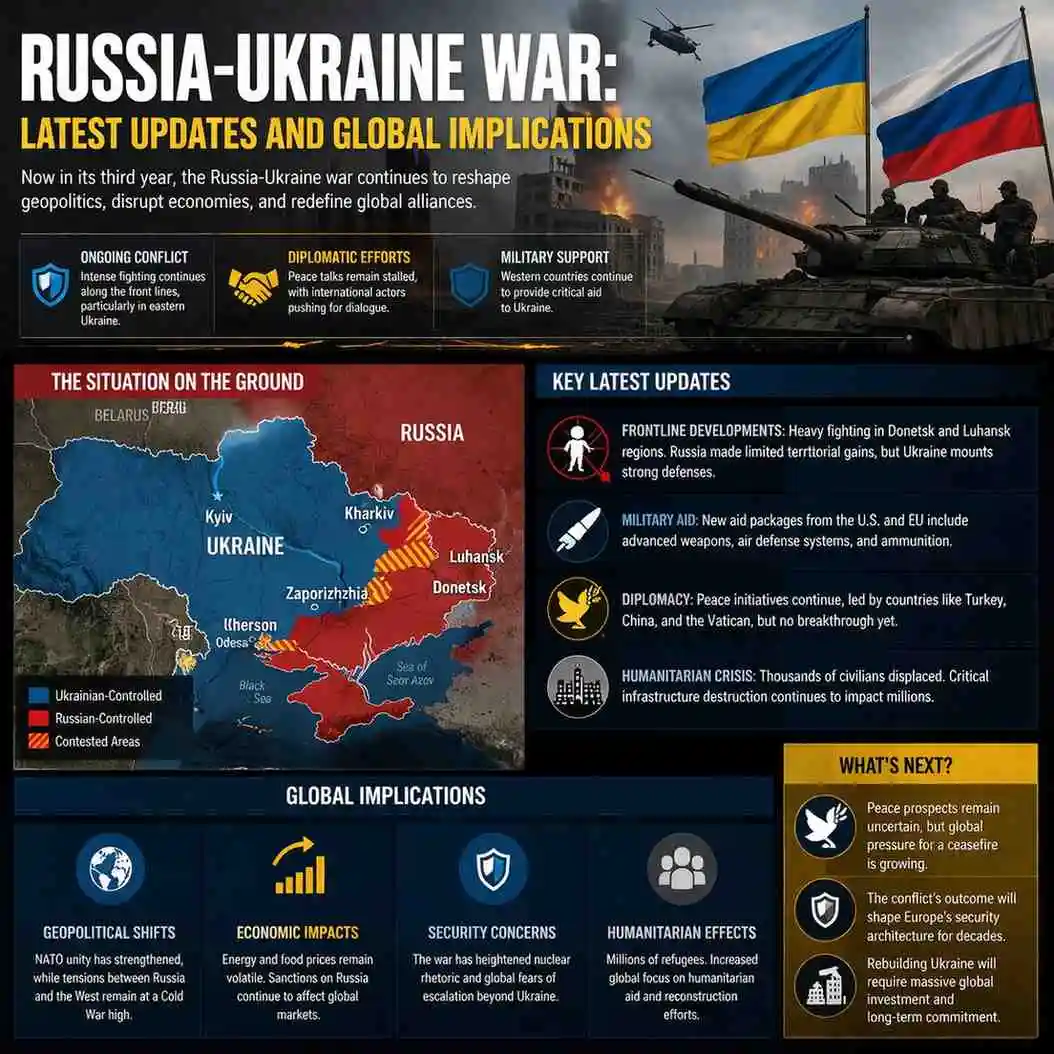
By 2026, the Russia-Ukraine war has entered what analysts describe as a prolonged attritional phase. The front lines, stretching over 1,000 kilometers across eastern and southern Ukraine, have shifted incrementally but remain broadly similar to where they stood in late 2023 — with Russia in control of portions of four Ukrainian oblasts it illegally annexed: Donetsk, Luhansk, Zaporizhzhia, and Kherson. However, Ukraine has not conceded these regions legally or militarily and continues to mount both defensive operations and targeted strikes deep inside Russian territory.
The war has claimed hundreds of thousands of lives on both sides, though precise figures remain difficult to verify given wartime information restrictions. Millions of Ukrainians have been internally displaced, and several million more have sought refuge in European Union countries, fundamentally transforming communities from Poland to Germany. Infrastructure destruction in Ukraine is estimated in the hundreds of billions of dollars, creating one of the largest post-war reconstruction challenges in modern history.
Key facts about the current state of the conflict:
- Over a 1,000-km front line remains largely static but dynamically contested
- Russia controls approximately 20% of Ukraine's pre-war territory
- Drone warfare has transformed offensive and defensive tactics on both sides
- Western military aid remains a critical lifeline for Ukraine's defense capabilities
- Civilian infrastructure including power grids, hospitals, and water systems continues to be targeted
Key Military Developments in 2026
The year 2026 has brought significant tactical shifts to the conflict. Both Russia and Ukraine have dramatically expanded their use of unmanned aerial vehicles, or drones, to conduct reconnaissance, strike supply lines, and attack critical infrastructure. Ukraine in particular has become a global leader in drone innovation, deploying long-range maritime drones that have successfully struck Russian naval vessels in the Black Sea — a strategic achievement that has helped restore partial Ukrainian grain export routes. Russia, meanwhile, has scaled up its use of Iranian-designed Shahed drones to overwhelm Ukrainian air defense systems through sheer volume.
On the ground, both armies have adopted trench warfare tactics reminiscent of World War I, with heavily fortified defensive lines making large territorial gains extremely costly. Ukraine has received advanced Western weapons systems including long-range artillery, tanks, and air defense batteries that have significantly improved its ability to hold ground. Russia has compensated for its equipment and personnel losses by increasing domestic weapons production and sourcing munitions from North Korea, creating a shadow supply chain that has extended the war's duration considerably.
Key military insights:
- Drone warfare has become the defining technology of this conflict
- Ukraine's maritime drone strikes have disrupted Russian Black Sea operations significantly
- North Korean ammunition supplies have bolstered Russian ground forces
- Western F-16 fighters have enhanced Ukraine's air defense and strike capabilities
- Artificial intelligence is being integrated into targeting and logistics on both sides
Diplomatic Efforts and Peace Talks
Diplomacy surrounding the Russia-Ukraine conflict has been as complicated as the battlefield itself. Despite numerous calls for ceasefire negotiations from global bodies including the United Nations, the African Union, and various European governments, substantive peace talks remain elusive. Ukraine insists on the restoration of its internationally recognized borders — including Crimea, annexed by Russia in 2014 — as a precondition for any sustainable peace. Russia, for its part, demands that Ukraine abandon its NATO aspirations and recognize Russian territorial gains as permanent.
China has positioned itself as a potential mediator, having put forward a 12-point peace proposal, though Western governments have been skeptical of Beijing's neutrality given its close ties with Moscow. Brazil and India have also attempted to play mediating roles, reflecting the desire of many Global South nations to see the conflict resolved without being drawn into a binary choice between Western and Russian camps. In 2026, backchannel negotiations have reportedly been underway, though no formal talks have been confirmed by either Ukraine or Russia.
Key diplomatic insights:
- Ukraine's red lines include full territorial restoration and war crime accountability
- Russia demands a NATO membership ban and recognition of occupied territories
- China's mediation role is viewed with skepticism by Western governments
- Global South nations increasingly push for negotiated settlements
- No formal peace framework has gained meaningful traction as of 2026
Economic Fallout Across the World
The Ukraine war's economic impact in 2026 continues to reverberate across global markets. When the conflict erupted, it triggered a commodity price shock that drove inflation to multi-decade highs in dozens of countries simultaneously. Although inflation has since moderated in many advanced economies thanks to aggressive central bank action, the underlying structural disruptions remain. Global trade routes have been rerouted, supply chains have been diversified at significant cost, and the economic decoupling between the West and Russia has accelerated in ways that will persist long after any eventual ceasefire.
Russia's economy has proved more resilient than early Western assessments predicted, largely due to a pivot toward Asian markets — particularly China and India — for its oil and gas exports. However, deep structural problems persist, including technological stagnation due to semiconductor export restrictions, a brain drain as educated professionals emigrate, and rising defense spending that crowds out social investment. Ukraine's economy, meanwhile, depends heavily on international financial support running into tens of billions of dollars annually just to maintain basic government functions.
Key economic insights:
- Global inflation was significantly accelerated by the war's commodity price shocks
- Russia has reoriented trade toward China, India, and other non-Western partners
- Ukraine's economy would collapse without sustained Western financial support
- Western sanctions have accelerated de-dollarization debates globally
- Defense spending worldwide has surged, with NATO members raising military budgets considerably
Energy Crisis and Oil Market Shifts
Perhaps no sector has felt the energy crisis from the Russia-Ukraine war more acutely than the global energy market. Russia was, before the war, Europe's dominant supplier of natural gas and a major global oil exporter. Sanctions, voluntary boycotts, and the deliberate destruction of the Nord Stream pipelines dramatically altered this picture. European nations scrambled to secure alternative energy sources — from liquefied natural gas shipped from the United States and Qatar to accelerated investments in renewable energy and nuclear power.
By 2026, Europe has largely weaned itself off Russian pipeline gas, though the transition came at enormous economic cost. Energy prices remain elevated compared to pre-war levels, squeezing households and energy-intensive industries alike. Meanwhile, Russia has redirected its oil exports to Asia, selling at discounted prices that still generate significant revenues. The global oil market now operates under a new normal defined by OPEC+ production decisions that carefully balance Russian and Saudi interests against Western pressure.
Key energy insights:
- Europe has fundamentally restructured its energy supply away from Russian gas
- LNG from the US and Qatar has partially replaced Russian pipeline gas in Europe
- Russia sells oil to Asia at discounted prices, maintaining revenues despite sanctions
- Renewable energy investment in Europe accelerated significantly due to energy insecurity
- Energy price volatility continues to create inflationary pressure in import-dependent nations
Global Food Security Concerns
Ukraine and Russia together accounted for roughly 30% of global wheat exports and significant shares of corn, sunflower oil, and fertilizer exports before the war. The disruption of these supply chains created immediate food security crises, particularly in developing nations across Africa and the Middle East that depended heavily on affordable Ukrainian and Russian grain. Prices for staple foods spiked dramatically, pushing millions more people into food insecurity and reversing years of hard-won development gains.
The Black Sea Grain Initiative, brokered by the United Nations and Turkey in 2022, allowed limited Ukrainian grain exports to resume, providing some relief. However, Russia's withdrawal from the deal in 2023 once again threatened supplies. Ukraine's maritime drone campaign has partially restored export capability through alternative naval corridors, but the situation remains fragile. Fertilizer shortages driven by Russian export restrictions have also affected agricultural productivity worldwide, with the downstream effects on food security likely to persist for years to come.
Key food security insights:
- Africa and the Middle East face the most acute food security risks from the conflict
- Ukrainian grain exports have been partially restored through drone-secured maritime corridors
- Fertilizer shortages are causing multi-season productivity losses in developing nations
- Alternative suppliers like India, Australia, and Argentina have partially filled the gap
- The World Food Programme has called the war's food impact a global humanitarian emergency
NATO and Western Response
The NATO response to the Russia-Ukraine conflict has been one of the defining stories of this war. Far from fracturing under Russian pressure — as President Putin perhaps anticipated — the alliance has in fact expanded and strengthened. Sweden and Finland, long-standing military neutrals, both joined NATO, fundamentally altering the security architecture of northern Europe. NATO member states have collectively provided Ukraine with hundreds of billions of dollars in military and financial assistance, though the scale and type of weapons provided has been subject to ongoing internal debate.
Within the alliance, tensions exist between states that favor more aggressive support for Ukraine — including the United Kingdom, Poland, and the Baltic states — and those that remain cautious about escalation, including Germany. The United States, Ukraine's most important single supporter, has faced domestic political headwinds that have at times slowed the flow of aid. Despite these tensions, the alliance has maintained a broadly unified front in terms of sanctions against Russia and its support for Ukraine's right to self-defense.
Key NATO insights:
- NATO has expanded to include Finland and Sweden, its most significant enlargement in decades
- The alliance has provided over $200 billion in combined military and financial support to Ukraine
- US domestic politics has created uncertainty about the long-term sustainability of American aid
- Eastern flank NATO members like Poland are significantly increasing their own military capabilities
- NATO has enhanced its eastern deployments with multinational battle groups in all front-line states
Russia's Strategic Objectives
Understanding Russia's strategic objectives is essential to analyzing the war's trajectory. At the outset, the Kremlin appeared to expect a swift operation that would overthrow the Ukrainian government within days. That miscalculation proved catastrophic, forcing Russia to adapt its objectives over time. By 2026, the publicly stated goals include the permanent incorporation of the four annexed Ukrainian oblasts, the demilitarization of Ukraine, and the prevention of Ukraine's integration into Western military and political structures.
More broadly, Russia appears to be pursuing a strategy of exhaustion — hoping that Western public support for Ukraine will wane over time, that domestic political changes in key Western nations will reduce military aid, and that the economic costs of the war will eventually force Ukraine to the negotiating table on Russian terms. The Kremlin has also worked to deepen ties with China, Iran, and North Korea, creating an alternative security and economic architecture that partially insulates Russia from Western pressure.
Key strategic insights:
- Russia's original goal of swift regime change in Kyiv failed entirely
- Current objectives center on territorial consolidation and NATO exclusion for Ukraine
- A strategy of attrition seeks to outlast Western political will to support Ukraine
- Russia is deepening strategic partnerships with China, Iran, and North Korea
- Information warfare and propaganda remain central tools of Russian strategy globally
Ukraine's Defense Strategy
Ukraine's defense strategy has been characterized by remarkable adaptability and innovation in the face of overwhelming odds. From the early days of the war, Ukraine proved that a determined, motivated smaller force equipped with modern weapons and accurate intelligence could successfully resist a much larger conventional military. The Ukrainian military has become battle-hardened, increasingly professionalized, and adept at integrating Western weapons systems rapidly into its operations.
Ukraine's domestic defense industry has also evolved dramatically under wartime conditions. Ukrainian engineers and companies have developed indigenous drone systems, electronic warfare capabilities, and advanced munitions that have reduced some dependence on external supply. President Zelensky's government has consistently pursued a strategy of keeping the war in the international spotlight, leveraging diplomacy, media, and moral arguments to sustain Western political and military support through what has become a prolonged and grueling conflict.
Key defense insights:
- Ukraine has become a globally respected model of asymmetric defense innovation
- Domestic drone manufacturing has significantly reduced external weapons dependence
- Western intelligence sharing has been a decisive strategic advantage for Ukraine
- President Zelensky's diplomatic efforts have maintained strong international political support
- Deep strikes inside Russia have signaled Ukraine's willingness to raise the conflict's costs
Impact on Europe
Europe has been the most directly affected region outside of Ukraine and Russia itself. The energy crisis unleashed by the war created the most severe economic shock to European households in a generation, with energy bills doubling or tripling for many families and businesses. Industrial sectors particularly sensitive to energy prices — including chemicals, steel, and glass manufacturing — faced severe disruptions and in some cases permanent closures or relocations. European governments spent trillions of euros on energy subsidies and support packages to cushion the blow for citizens and businesses.
The refugee dimension has also profoundly affected European societies. Millions of Ukrainians — predominantly women and children, as men of fighting age were required to remain in Ukraine — have been absorbed into European labor markets, schools, and housing systems. While many European nations have welcomed Ukrainian refugees warmly, the sustained influx has also placed strain on public services and contributed to political pressures that have bolstered far-right parties in several European countries.
Key European impact insights:
- European defense spending has surged to its highest levels since the Cold War
- Over 4 million Ukrainian refugees have settled in EU nations, transforming local demographics
- Energy security has permanently moved to the top of Europe's strategic agenda
- The war has accelerated European political polarization on both left and right
- Eastern European nations feel most directly threatened and have taken the hardest line on Russia
Effects on Asia and the Global South
Asia and the Global South have navigated the conflict with careful pragmatism. India, despite its traditional partnership with Russia dating back to the Soviet era, has maintained a policy of strategic autonomy — abstaining from United Nations votes condemning Russia's invasion while simultaneously increasing its purchases of discounted Russian oil and maintaining strong relationships with Western partners. This balancing act has frustrated both Moscow and Washington but reflects India's calculation that neither alienating Russia nor confronting the West serves its national interests.
China's position is more complex. Beijing has provided Russia with significant diplomatic cover and economic support — including the supply of dual-use goods — while stopping short of direct military assistance in ways that would trigger Western sanctions on Chinese companies. China has benefited from cheap Russian energy and from Russia's growing economic dependence on Beijing, but has also been careful not to be seen as an enabler of the war in ways that would damage its relationships with European trading partners.
Key Asia and Global South insights:
- India has pursued strategic autonomy, buying Russian oil while maintaining Western ties
- China benefits economically from the conflict without directly providing military support
- Africa faces acute food security challenges due to disrupted Ukrainian grain exports
- ASEAN nations are concerned about precedent-setting implications for territorial sovereignty
- The conflict has accelerated Global South demands for a reformed UN Security Council
Cyber Warfare and Information War
The Russia-Ukraine conflict is also being fought in the digital domain with an intensity unprecedented in the history of modern warfare. Russia's cyber attacks against Ukrainian infrastructure — targeting power grids, government networks, and financial systems — began well before the physical invasion. Ukraine, with significant support from Western cybersecurity firms and governments, proved far more resilient to these attacks than Russia anticipated. The Ukrainian government's early migration of critical data to cloud servers hosted outside the country proved particularly prescient, preventing catastrophic data losses.
The information warfare dimension has been equally significant. Ukraine has been extraordinarily effective at the global information war, in large part because its narrative — a democracy defending itself against an authoritarian invasion — is inherently sympathetic to Western audiences. Russia's disinformation apparatus, meanwhile, continues to operate across social media platforms, targeting Western publics with narratives designed to undermine support for Ukraine by emphasizing costs, questioning prospects for victory, and amplifying divisions within Western societies.
Key cyber warfare insights:
- Russian cyber attacks against Ukrainian critical infrastructure began before the physical invasion
- Ukraine's early cloud migration of government data proved strategically crucial
- Western cybersecurity firms have provided Ukraine with significant defensive support
- Russia's disinformation campaigns target Western publics to erode support for Ukraine
- The war has demonstrated that information warfare is now inseparable from conventional conflict
Humanitarian Challenges
The humanitarian crisis generated by the Russia-Ukraine war is staggering in scale. The United Nations estimates that tens of millions of people have been affected through displacement, loss of livelihoods, destruction of homes, and the psychological trauma of living under constant bombardment. Russian strikes on Ukrainian civilian infrastructure — including power plants, water treatment facilities, and heating systems — have been particularly devastating, leaving millions without electricity, heat, or clean water during brutal winter months.
Access for humanitarian organizations to conflict-affected areas has been severely restricted. Civilians in Russian-occupied territories face particularly acute vulnerabilities, with limited access to independent humanitarian assessment. Children have been disproportionately affected, with schools destroyed, education disrupted, and, in documented cases, Ukrainian children forcibly relocated to Russia — an action that international bodies have characterized as a war crime requiring accountability at the highest levels.
Key humanitarian insights:
- Over 10 million Ukrainians remain displaced inside or outside the country
- Deliberate attacks on power infrastructure constitute war crimes under international law
- The forced deportation of Ukrainian children is subject to ICC investigation and arrest warrants
- Mental health impacts across Ukraine's population will require decades of sustained support
- Humanitarian organizations face significant access restrictions in occupied territories
Future Scenarios: What May Happen Next
Predicting the trajectory of the Russia-Ukraine war is inherently uncertain, but analysts broadly outline several plausible scenarios. The first is continued attritional stalemate, in which neither side achieves a decisive military advantage and the conflict continues at roughly its current intensity for years or even decades — a frozen conflict in all but name. This scenario is deeply costly for all parties and damaging for global stability, but may be the most likely if no significant shift in military, political, or economic circumstances occurs in the near term.
A second scenario involves a negotiated ceasefire, potentially following changes in the political landscape on either side — a US administration more inclined toward deal-making, an exhausted Russian military and economy, or a Ukrainian public increasingly war-weary. This would likely involve painful territorial compromises. A third, more optimistic scenario involves a decisive Ukrainian battlefield success that significantly changes the military balance. A fourth, more alarming scenario involves significant escalation, potentially including nuclear threats or direct NATO involvement that transforms the entire nature of the conflict.
Key future scenario insights:
- Attritional stalemate remains the most likely near-term scenario absent major shifts
- A negotiated ceasefire may require difficult and politically painful territorial compromises
- Changes in US domestic politics could significantly shift the conflict's trajectory
- Escalation risks including nuclear threats remain a critical concern for global security planners
- A Ukrainian battlefield breakthrough remains possible but would require sustained military effort
Frequently Asked Questions (FAQs)
1. What are the latest developments in the Russia-Ukraine war in 2026?
As of 2026, the Russia-Ukraine war remains in an attritional phase with front lines broadly stable across eastern and southern Ukraine. Key developments include expanded drone warfare by both sides, Ukraine's maritime drone campaign in the Black Sea, increased North Korean ammunition supplies to Russia, the integration of F-16 jets into Ukraine's air force, and ongoing diplomatic efforts by China, Brazil, and India to facilitate negotiations. Western military and financial support continues to be Ukraine's strategic lifeline.
2. How has the Russia-Ukraine war affected the global economy?
The Russia-Ukraine war triggered a global commodity price shock that drove inflation to multi-decade highs worldwide. Energy prices surged as Europe cut dependence on Russian gas. Global food prices rose sharply as Ukrainian and Russian grain and fertilizer exports were disrupted. Although inflation has moderated in some regions, structural disruptions in supply chains, trade flows, and energy markets persist. Defense spending worldwide has increased significantly, redirecting resources from social investment to military priorities.
3. Is there any possibility of a peace deal between Russia and Ukraine?
Peace talks remain extremely difficult due to fundamental incompatibilities in both sides' stated positions. Ukraine insists on full territorial restoration and accountability for war crimes. Russia demands Ukraine abandon NATO aspirations and recognize its territorial gains. Several nations including China, Brazil, and India have proposed mediation frameworks, but no formal negotiations are underway. Backchannel diplomatic contacts reportedly continue, suggesting some possibility of a negotiated settlement, though the timeline remains deeply uncertain.
4. How has the war impacted global food security?
The Russia-Ukraine war severely disrupted global food security because both nations are major suppliers of wheat, corn, sunflower oil, and fertilizers. Developing nations in Africa and the Middle East faced acute food price spikes and supply shortages. Ukraine's maritime drone campaign has partially restored Black Sea export routes, providing some relief. However, fertilizer shortages continue to reduce agricultural productivity in many developing countries, and the World Food Programme has identified the conflict as a primary driver of worsening global hunger.
5. What role does NATO play in the Russia-Ukraine war?
NATO has played a central role in supporting Ukraine without directly entering the conflict. Member states have collectively provided hundreds of billions of dollars in military and financial aid, including advanced weapons systems. NATO has also expanded to include Finland and Sweden, strengthening the alliance's eastern flank. The alliance maintains a careful balance — providing Ukraine with the means to defend itself while avoiding actions that could trigger direct military confrontation with Russia and the risk of broader nuclear escalation.
Conclusion: A World at a Turning Point
The Russia-Ukraine war is not just a regional conflict — it is a defining test of the international order, the resilience of democratic institutions, and the capacity of the global community to respond collectively to aggression. Its latest updates and global implications touch every corner of the world, from the food on your plate to the price of fuel at the pump, from the security of NATO's eastern flank to the diplomatic calculations of nations from Beijing to New Delhi.
What is clear is that this conflict has permanently altered the post-Cold War world order. The era of European security complacency is over. The assumption that economic interdependence prevents war has been shattered. The role of technology — from drones to cyber attacks to artificial intelligence — in modern warfare has been dramatically demonstrated. And the resilience of the Ukrainian people, who have refused to be subjugated despite enormous sacrifices, has inspired democratic movements worldwide.
The path to peace remains long and uncertain. But understanding the conflict's dynamics — its military realities, its economic consequences, its humanitarian toll, and its geopolitical stakes — is the essential first step for anyone seeking to make sense of the world we now inhabit. Stay informed, think critically, and remember that behind every statistic and strategic analysis lies the lived experience of real human beings whose lives have been irrevocably changed by this war.
Click below to generate summary