Introduction
History is full of moments where one person's courage reshapes the destiny of millions. The martyrdom of Mangal Pandey is one such moment — a single act of defiance that sent shockwaves through the entire British colonial empire and awakened a sleeping nation to the possibility of freedom.
Most people know about the Indian independence movement through figures like Mahatma Gandhi, Bhagat Singh, or Subhas Chandra Bose. But long before these names became symbols of resistance, a young sepoy in the British East India Company's army stood up, weapon in hand, and said enough. His name was Mangal Pandey, and on March 29, 1857, he became the spark that lit the fire of India's first organized uprising against British rule.
The problem, however, is that Mangal Pandey's story is often reduced to a footnote — dismissed as a minor mutiny, an isolated incident, or even the act of an unstable individual. This narrative does a disservice to both the man and the movement he inspired. His story is not merely about one soldier's rebellion. It is about accumulated suffering, broken dignity, and the moment when a people's patience finally ran out.
Early Life of Mangal Pandey
Family and Social Roots
Mangal Pandey was born on July 19, 1827, in Nagwa village, located in the Ballia district of present-day Uttar Pradesh. He was born into a Brahmin family, a caste with deep ties to tradition, honor, and religious identity. His father, Divakar Pandey, was a farmer, and the family lived a modest but dignified rural life deeply rooted in Hindu customs and values.
Growing up in a Brahmin household meant that Mangal Pandey was raised with a strong sense of dharma — duty, righteousness, and personal honor. These were not abstract concepts for him. They were daily realities that guided behavior, shaped identity, and determined how a man was expected to respond to injustice. This cultural foundation would later make the events of 1857 deeply personal for him, not just politically but spiritually.
His early years were shaped by the rhythms of agricultural life, religious observance, and community belonging. He was known to be physically strong, morally upright, and deeply faithful to his religious beliefs. These qualities made him a natural candidate for military service in an era when joining the army was both a source of income and a mark of status for young men in rural India.
Key insights from Mangal Pandey's early life:
- Born July 19, 1827, in Nagwa village, Ballia district, Uttar Pradesh
- Came from a Brahmin Hindu family with strong religious and cultural values
- Raised with a deep sense of personal honor and duty
- Rural upbringing gave him physical strength and community-rooted values
- His caste identity would later make colonial policies feel like a personal attack
Joining the British Army
At the age of around 22, Mangal Pandey enlisted in the Bengal Army of the British East India Company in 1849. He was assigned to the 34th Bengal Native Infantry, stationed at Barrackpore — a military cantonment near Calcutta, which was then the capital of British India.
Joining the Company's army was not seen as a betrayal of one's culture at this point in history. For many young men, it was a practical and respected career path. The sepoys — Indian soldiers serving under British command — were often proud of their role and took their military duties seriously. However, the relationship between Indian soldiers and their British officers was never truly equal. It was built on a foundation of racial hierarchy, cultural misunderstanding, and systemic exploitation that would eventually become impossible to ignore.
Mangal Pandey proved himself a capable and disciplined soldier. He performed his duties diligently and earned the respect of his peers. But beneath the surface of this loyalty, tensions were already building — within the army and across the country.
Key insights from Mangal Pandey's military beginnings:
- Enlisted in the Bengal Army around 1849 at approximately 22 years of age
- Assigned to the 34th Bengal Native Infantry at Barrackpore
- Military service was seen as honorable and practical for young men of his background
- The British military structure was built on racial inequality disguised as discipline
- His competence and integrity made his eventual rebellion even more powerful symbolically
Political Climate Before 1857
British East India Company Policies
By the mid-19th century, the British East India Company had transformed from a trading organization into a governing power that controlled vast territories across the Indian subcontinent. Its policies were designed primarily to maximize extraction — of resources, revenue, and human labor — while systematically dismantling the social, economic, and political structures that held Indian communities together.
The Doctrine of Lapse, introduced by Governor-General Lord Dalhousie, allowed the Company to annex Indian kingdoms if a ruler died without a natural heir. This policy stripped Indian royalty of their kingdoms and fueled deep resentment among noble classes and their subjects. Kingdoms like Jhansi, Satara, and Nagpur were swallowed under this doctrine, causing widespread anger.
Taxation was crushing rural communities. Land revenue systems like the Permanent Settlement in Bengal and the Ryotwari system in other regions pushed farmers into debt and dependency. Indian industries, particularly textiles, were being deliberately destroyed to make room for cheaper British imports. The social contract between rulers and the ruled had completely broken down.
Key insights about British East India Company policies:
- The Doctrine of Lapse annexed Indian kingdoms without natural heirs
- Kingdoms like Jhansi, Satara, and Nagpur were illegally absorbed into British territory
- Oppressive land revenue systems devastated Indian farmers and rural economies
- Indian textile industries were deliberately undermined by cheap British imports
- Political and economic resentment was building across all classes of Indian society
Religious and Cultural Tensions
Perhaps no single issue inflamed Indian soldiers more than the introduction of the new Enfield Pattern 1853 rifle. To load this weapon, soldiers had to bite off the tip of a greased cartridge before inserting it into the rifle. Rumors spread rapidly — and with considerable evidence — that the cartridges were greased with a mixture of beef fat and pork lard.
For Hindu soldiers, consuming or even touching beef was a grave religious offense, as the cow is sacred in Hinduism. For Muslim soldiers, contact with pork was equally forbidden by Islamic law. The introduction of these cartridges felt like a deliberate act of cultural aggression — as though the British were intentionally forcing soldiers to violate their most deeply held religious beliefs in order to remain employed.
The Company's response to these concerns was dismissive. Officers downplayed the issue, failed to offer credible alternatives, and in doing so communicated to Indian soldiers that their religious identity was irrelevant. This was the final insult in a long series of humiliations that made rebellion not just desirable but morally justified.
Key insights about religious and cultural tensions:
- New Enfield rifles required soldiers to bite cartridges allegedly greased with beef and pork fat
- This directly violated Hindu and Muslim religious beliefs simultaneously
- The British administration dismissed these legitimate concerns as superstition
- The cartridge issue became the symbolic breaking point for widespread sepoy discontent
- Religious identity and military duty were being placed in direct conflict by colonial policy
The Martyrdom of Mangal Pandey: The Barrackpore Incident
The Attack on British Officers
On March 29, 1857, Mangal Pandey stepped out of his barracks at the Barrackpore cantonment in a state of visible agitation. He was armed with a loaded musket and called out openly to his fellow sepoys to rise up against the British. His words were a direct appeal to rebellion — a call for collective action against an unjust authority.
When Sergeant-Major James Hewson approached to confront him, Mangal Pandey opened fire, wounding the officer. He then attacked Lieutenant Henry Baugh with a sword when Baugh arrived on the scene on horseback. General John Hearsey rode in to restore order and commanded the Indian soldiers present to arrest Pandey. Most stood aside, refusing to act against their comrade.
Mangal Pandey then turned the weapon on himself in an attempt to take his own life rather than be captured. He survived the self-inflicted wound and was subsequently taken into custody while injured. The entire incident unfolded in full view of the cantonment, and the British authorities understood immediately that this was not a random act of madness — it was a declaration.
Key insights about the Barrackpore attack:
- The incident occurred on March 29, 1857, at Barrackpore cantonment near Calcutta
- Mangal Pandey openly called on fellow sepoys to revolt against British authority
- He attacked two British officers — Sergeant-Major Hewson and Lieutenant Baugh
- Fellow Indian soldiers refused to arrest him, suggesting widespread sympathy
- He attempted suicide rather than surrender, demonstrating total commitment to his cause
Arrest and Court-Martial
Following his capture, Mangal Pandey was held in custody while authorities decided how to proceed. The British were rattled. A sepoy had publicly attacked officers and called for rebellion — and the other soldiers had done nothing to stop him. This was a serious breakdown of military order that demanded a visible and forceful response.
A court-martial was convened swiftly. The proceedings were brief and the outcome was never truly in doubt. Mangal Pandey was found guilty of attacking his superior officers and inciting rebellion. He offered no denial of his actions. The court sentenced him to death by hanging, and the British moved to carry out the sentence as quickly as possible, likely hoping to prevent his execution from becoming a rallying point for further unrest.
Key insights about the court-martial:
- Mangal Pandey was court-martialed immediately after his arrest
- He did not deny his actions during the proceedings
- The trial was swift, reflecting British urgency to contain the situation
- He was found guilty of attacking officers and inciting mutiny
- The death sentence was intended to serve as a deterrent, but it had the opposite effect
Execution and Sacrifice
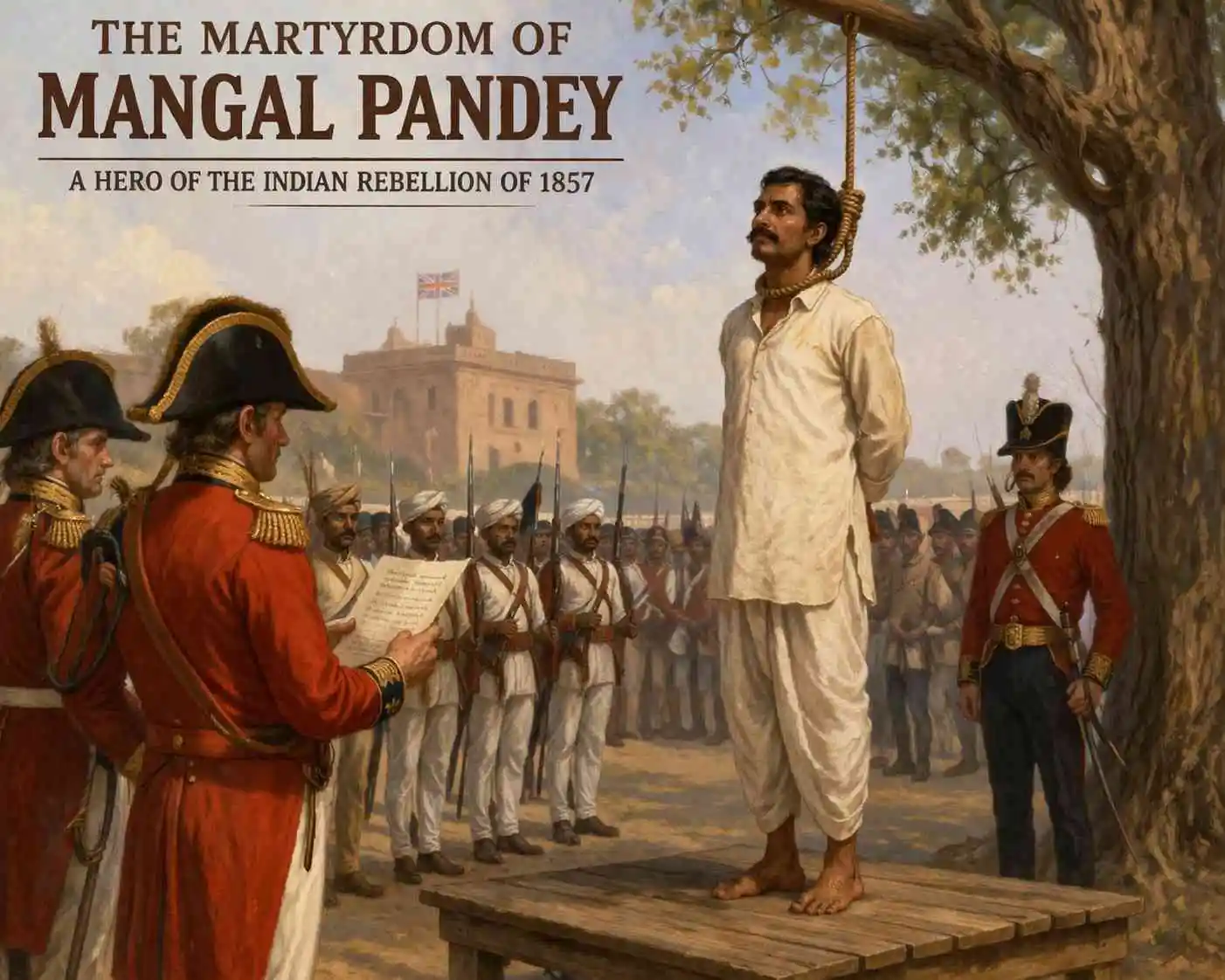
Mangal Pandey was hanged on April 8, 1857 — ten days ahead of the originally scheduled date. The British authorities moved the date forward, fearing that a delayed execution would give time for organized resistance to build around his case. The haste itself revealed their fear.
He went to the gallows without hesitation, without remorse, and without begging for mercy. His composure in the face of death elevated him from a rebel soldier to a martyr in the eyes of his countrymen. The hangman assigned to the execution reportedly refused to carry out the order initially, and outside hangmen had to be brought in — a detail that speaks volumes about how Mangal Pandey was perceived by ordinary people even at the moment of his death.
His regiment, the 34th Bengal Native Infantry, was disbanded as collective punishment for the sympathetic inaction of its members on March 29. This act of collective punishment only deepened the anger and sense of injustice among Indian soldiers across the country.
Key insights about Mangal Pandey's execution:
- Executed on April 8, 1857, ten days before the originally scheduled date
- British authorities rushed the execution fearing organized rescue or protest
- He faced death with complete composure, cementing his status as a martyr
- The assigned hangman initially refused, reflecting popular sympathy for Pandey
- His regiment was dissolved as collective punishment, intensifying soldier resentment
Impact on the Revolt of 1857
Spread of Rebellion
The martyrdom of Mangal Pandey did not suppress dissent — it ignited it. On May 10, 1857, just weeks after his execution, sepoys at Meerut openly mutinied, killed their British officers, and marched to Delhi where they proclaimed the aging Mughal emperor Bahadur Shah Zafar as the leader of a free India. The rebellion spread with astonishing speed across northern and central India.
Cities like Lucknow, Kanpur, Jhansi, and Bareilly erupted into armed conflict. The rebellion drew in not just soldiers but civilians, landlords, and rulers who had suffered under colonial policies. Although the British eventually suppressed the uprising through overwhelming military force by 1858, the Revolt of 1857 permanently altered the relationship between India and Britain.
Key insights about the spread of rebellion:
- The Meerut Mutiny on May 10, 1857 directly followed Mangal Pandey's execution
- Delhi, Lucknow, Kanpur, Jhansi, and Bareilly became major centers of resistance
- The uprising drew soldiers, civilians, and rulers into collective revolt
- The rebellion was suppressed by 1858 but fundamentally weakened British confidence
- The Revolt led directly to the abolition of the East India Company and direct Crown rule
Legacy in Modern India
Mangal Pandey is officially recognized by the Government of India as a freedom fighter and martyr. His birthday, July 19, is commemorated annually. A postage stamp was issued in his honor in 1984, and the government has named public institutions and roads after him across India, particularly in Uttar Pradesh.
Cultural Representations
His story has been adapted into various cultural forms. The 2005 Bollywood film Mangal Pandey: The Rising, starring Aamir Khan, brought his story to a global audience and reignited public interest in his life. Books, documentaries, and educational curricula across India continue to highlight his role as the man who fired the first shot of India's independence movement.
Key insights about Mangal Pandey's legacy:
- Officially recognized as a national martyr by the Government of India
- A commemorative postage stamp was issued in 1984
- Public institutions, roads, and parks bear his name, especially in Uttar Pradesh
- The 2005 Aamir Khan film introduced his story to younger generations globally
- He remains a symbol of individual courage against institutional injustice
FAQs
1. Why is Mangal Pandey considered a martyr?
Mangal Pandey is considered a martyr because he willingly sacrificed his life for the cause of Indian resistance against British colonial rule. He openly defied authority, attacked British officers at Barrackpore, and was executed for his actions on April 8, 1857. His refusal to submit, even in the face of certain death, and the inspiration his sacrifice provided to the wider 1857 rebellion make him a defining figure of Indian martyrdom.
2. What was the significance of the Barrackpore incident?
The Barrackpore incident of March 29, 1857 was the first open act of armed defiance against the British by an Indian soldier in the lead-up to the Revolt of 1857. Mangal Pandey's attack on British officers and his call to fellow sepoys to rebel signaled a breaking point in colonial relations. It demonstrated that Indian soldiers were willing to risk death rather than continue tolerating religious humiliation and political oppression.
3. How did the greased cartridge controversy lead to the 1857 revolt?
The Enfield rifle cartridges were rumored to be greased with beef fat and pork lard, which violated both Hindu and Islamic religious laws. Soldiers were required to bite these cartridges before loading. This caused widespread outrage among Hindu and Muslim sepoys who felt their religious identity was being deliberately attacked. The controversy became a flashpoint that united soldiers across religious lines in a shared cause of resistance against colonial authority.
4. Was Mangal Pandey acting alone or as part of an organized movement?
Mangal Pandey acted largely on his own initiative on March 29, 1857, without a pre-planned organizational structure behind him. However, his act reflected the collective grievances felt by thousands of Indian soldiers and civilians. His rebellion resonated precisely because it gave voice to feelings that were already widespread. The organized Revolt of 1857 that followed weeks later drew on that same reservoir of resentment.
5. How is Mangal Pandey remembered in India today?
Mangal Pandey is remembered as a national hero and freedom fighter in India. The government has honored him with postage stamps, memorials, and public institutions bearing his name. His story is taught in school curricula and has been depicted in films, including the notable 2005 Bollywood film starring Aamir Khan. He is widely regarded as the first soldier of India's independence struggle, the man whose courage in 1857 planted the seed of a free India.
Conclusion
The martyrdom of Mangal Pandey is far more than a historical episode. It is a story about the point at which human dignity refuses to be compromised any further. Mangal Pandey was not a politician, a philosopher, or a strategist. He was a soldier — a man of faith, duty, and honor — who reached a line he could not cross without surrendering his sense of self.
His act at Barrackpore on March 29, 1857 was born from years of accumulated injustice — economic exploitation, cultural humiliation, religious insult, and the growing awareness that the British East India Company regarded Indians not as people but as instruments of profit. When that awareness became unbearable, Mangal Pandey acted.
The fact that his rebellion was swiftly suppressed and that he was executed does not diminish its impact. In fact, the martyrdom itself became more powerful than any military victory could have been. His death transformed a solitary act of defiance into a national symbol. It told ordinary Indians — soldiers, farmers, princes, and merchants alike — that resistance was not only possible but necessary.
The Revolt of 1857 may not have immediately ended British rule. That would take another nine decades and countless more sacrifices. But it irreversibly changed the nature of colonial governance, forced the abolition of the East India Company, and planted the seeds of a national consciousness that would eventually bear fruit on August 15, 1947.
Mangal Pandey stood alone on a parade ground in Barrackpore and dared to say no. India took nearly a century to fully echo that answer — but when it did, it changed the world.
Click below to generate summary