Introduction: When the State Claimed Power Over Life Itself
Imagine waking up one morning to find that the government has the legal authority to detain you indefinitely — without giving you any reason, without allowing you to challenge your imprisonment in court, and without any judicial remedy available to you. That scenario is not a dystopian novel. It actually happened in India between 1975 and 1977, during one of the darkest chapters of the nation's democratic history: the Emergency period declared by Prime Minister Indira Gandhi.
At the center of this constitutional storm stood a landmark case — ADM Jabalpur v. Shivkant Shukla, decided by the Supreme Court of India in 1976. This case asked a deceptively simple but profoundly disturbing question: Can the State take away a citizen's right to life and personal liberty without any judicial oversight during a national emergency?
The majority of the Supreme Court answered yes. And that answer sent shockwaves through the legal fraternity, civil society, and every citizen who believed in the rule of law. One judge — Justice H.R. Khanna — said no, and in doing so, sacrificed his own career for the sake of constitutional conscience.
Historical Background: The Emergency of 1975
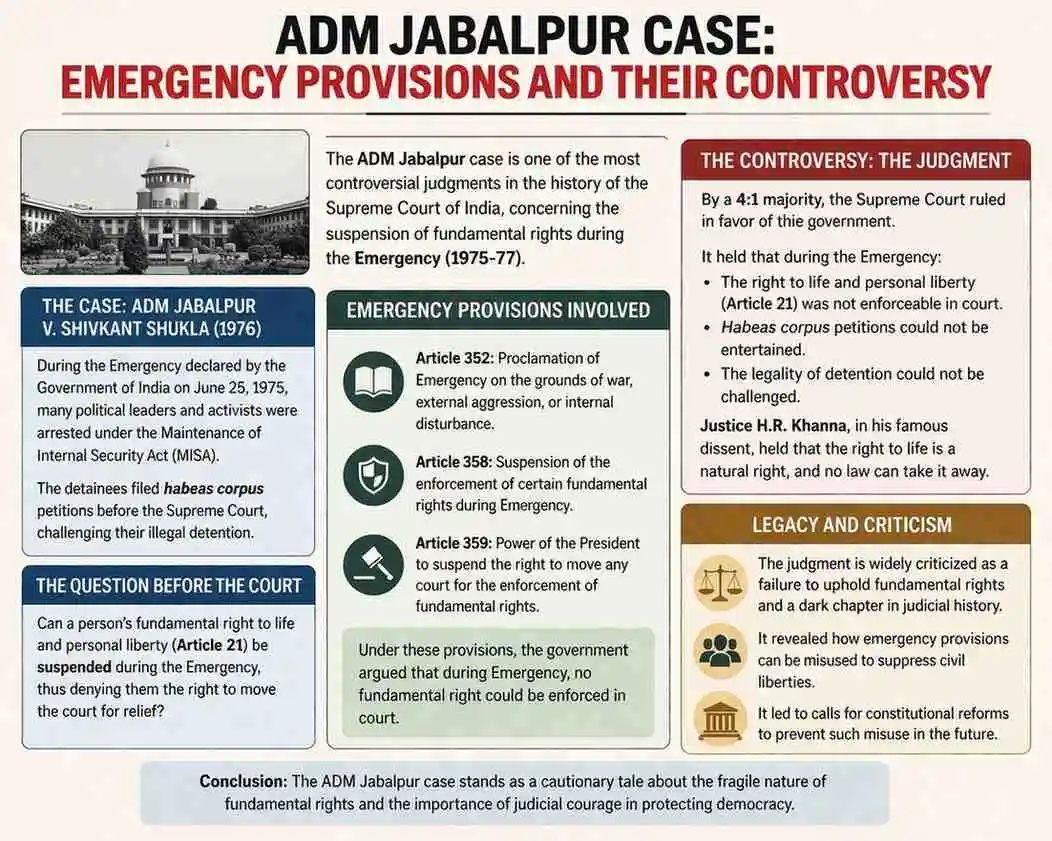
To understand the ADM Jabalpur case, you must first understand the context in which it emerged. On June 25, 1975, President Fakhruddin Ali Ahmed, acting on the advice of Prime Minister Indira Gandhi, declared a state of national emergency under Article 352 of the Indian Constitution. The official justification was "internal disturbance," a term that was vague enough to cover a wide range of political threats — real or imagined.
The political climate leading up to the Emergency was deeply charged. The Allahabad High Court had just ruled that Indira Gandhi had committed electoral malpractices and invalidated her election to Parliament. Opposition leaders like Jayaprakash Narayan were calling for mass civil disobedience. Faced with political pressure from all sides, Gandhi's government chose a drastic path: suspend constitutional freedoms and consolidate executive power.
Thousands of political opponents, journalists, lawyers, and activists were arrested and detained under the Maintenance of Internal Security Act (MISA) and the Defence of India Rules (DIR). Civil liberties were suspended. Press censorship was imposed. The government functioned more like an authoritarian regime than a constitutional democracy.
Key points to understand about this period:
- The Emergency lasted from June 25, 1975 to March 21, 1977.
- Thousands of citizens were detained without trial or formal charges.
- Habeas corpus petitions — the legal tool citizens use to challenge unlawful detention — were being filed across the country.
- The government argued that these petitions could not be entertained during an Emergency.
Constitutional Framework: Articles 352, 359, and 21
Three constitutional provisions formed the legal architecture of the ADM Jabalpur dispute.
Article 352 allows the President to proclaim a national emergency when the security of India is threatened by war, external aggression, or armed rebellion (and previously, "internal disturbance"). Once this proclamation is in place, the constitutional machinery shifts significantly.
Article 359 empowers the President, during an Emergency, to suspend the right of citizens to move any court to enforce the fundamental rights specified in the order. In 1975, the Presidential Order suspended the enforcement of Articles 14, 21, and 22, among others.
Article 21 is perhaps the most important provision in this entire debate. It reads: "No person shall be deprived of his life or personal liberty except according to procedure established by law." This article is considered the heart of the Indian Constitution — the ultimate protector of individual freedom. The central question in ADM Jabalpur was whether Article 21 could be completely suspended during an Emergency, leaving citizens with no legal recourse whatsoever.
Key constitutional takeaways:
- Article 352 is the source of Emergency power.
- Article 359 is the mechanism for suspending enforcement of rights.
- Article 21 is the fundamental right at stake — the right to life and liberty.
- The combination of these three provisions created a constitutional black hole during the Emergency.
Facts of the Case: Detention and Habeas Corpus
The ADM Jabalpur case did not arise from a single incident. It was a consolidation of multiple habeas corpus petitions filed by individuals who had been detained under MISA during the Emergency. These detainees challenged the legality of their imprisonment before various High Courts across India.
Several High Courts, including Allahabad, Bombay, Madhya Pradesh, and Rajasthan, ruled in favor of the detainees. They held that even during an Emergency, the courts had the authority to examine whether a detention was lawful, and that Article 21 could not be entirely suspended. These decisions gave hope to thousands of political prisoners.
The government, alarmed by these rulings, appealed to the Supreme Court of India. The case was titled Additional District Magistrate, Jabalpur v. Shivkant Shukla, and it was heard by a five-judge constitutional bench. The Shivkant Shukla mentioned in the title was one of many detainees whose habeas corpus petition had been upheld by the High Court.
The core factual dispute was straightforward:
- Citizens were detained without being told the reasons for their detention.
- They filed habeas corpus petitions to challenge their imprisonment.
- The government argued that no court could entertain these petitions during the Emergency.
- The High Courts disagreed; the Supreme Court had to settle the issue.
Legal Issues: Suspension of Fundamental Rights
The legal questions before the Supreme Court were of enormous constitutional magnitude. At their core, the issues can be summarized as follows:
Can the Presidential Order under Article 359 completely bar the courts from hearing habeas corpus petitions? If a detainee cannot invoke Article 21, does that mean the State can imprison any person for any reason without judicial scrutiny? Is the rule of law itself suspended during an Emergency?
The government's position was clear and aggressive: during an Emergency, the Presidential Order supersedes everything. No citizen can approach any court to enforce Article 21. The courts must step back entirely, and the executive must be trusted to exercise its powers responsibly.
The detainees' position was equally clear: the suspension of the right to enforce Article 21 does not mean that Article 21 itself ceases to exist. Courts must retain some residual power to ensure that detentions are not arbitrary or malicious. The rule of law cannot be completely abolished even during a national crisis.
Core legal issues in dispute:
- The scope and effect of the Presidential Order under Article 359.
- Whether courts retain any jurisdiction to review detentions during an Emergency.
- The relationship between the rule of law and emergency powers.
- Whether procedural rights can survive even when substantive rights are suspended.
Supreme Court Judgment: Majority and Dissent
On April 28, 1976, the Supreme Court delivered its judgment in a 4:1 majority. The case has since become one of the most debated and controversial decisions in Indian legal history.
Majority Opinion: The 4:1 Decision
The majority, comprising Chief Justice A.N. Ray, Justice M.H. Beg, Justice Y.V. Chandrachud, and Justice P.N. Bhagwati, ruled in favor of the government. Their decision held that during the Emergency, when the Presidential Order suspending the enforcement of Article 21 is in force, no person has the legal standing to approach a court to challenge their detention.
In simple terms, the majority said: the State can detain you, and you have no legal remedy. Even if your detention is malicious, wrongful, or entirely without cause, you cannot go to court. The Presidential Order effectively shields the executive from judicial accountability.
The majority justified their position on technical constitutional grounds, arguing that the Presidential Order was issued in accordance with the Constitution, and that the courts were bound to respect it. They took a formalist approach, prioritizing the letter of the law over its spirit.
Key aspects of the majority judgment:
- Habeas corpus petitions could not be entertained during the Emergency period.
- The Presidential Order under Article 359 had absolute effect.
- Courts lacked jurisdiction to question detentions under MISA during the Emergency.
- The decision effectively validated indefinite detention without judicial oversight.
Justice Khanna's Dissent: A Voice of Constitutional Conscience
Justice Hans Raj Khanna wrote a lone but luminous dissent that has since been celebrated as one of the finest moments in the history of Indian judiciary. He disagreed with every fundamental premise of the majority opinion.
Justice Khanna argued that the right to life and personal liberty is not merely a constitutional provision — it is a natural right that predates the Constitution itself. Even if Article 21 cannot be enforced during an Emergency, the courts cannot be completely shut out from reviewing whether a detention is lawful. The rule of law, he argued, is the foundational principle upon which the entire Constitution rests, and no executive order can erase it.
He drew upon international human rights principles, the history of common law, and the basic philosophy of democratic governance to support his position. His dissent was not just a legal argument — it was a moral statement about the limits of state power.
Justice Khanna paid a heavy price for his courage. Despite being the senior-most judge in line for the Chief Justice position, he was superseded — a junior judge was appointed as Chief Justice instead, in what was widely seen as an act of political retaliation by the Indira Gandhi government. He resigned rather than compromise his integrity.
Why It Became Controversial: Civil Liberty Concerns
The ADM Jabalpur judgment drew immediate and fierce criticism from legal scholars, human rights advocates, and constitutional experts. The controversy was not just about the outcome — it was about what the judgment revealed about institutional vulnerability.
The most damning criticism was that the judgment gave the executive unlimited power to imprison citizens without any accountability. It essentially told the government: during an Emergency, you are above the law. This was a frightening proposition in a country that had adopted a Constitution precisely to prevent the concentration of unchecked power.
Reasons why the case became deeply controversial:
- It legitimized arbitrary detention without judicial review.
- It revealed that emergency provisions could be weaponized for political purposes.
- It undermined public trust in the judiciary as an independent institution.
- It contradicted India's constitutional philosophy of limited government and fundamental rights.
- The majority judges later expressed regret for their decision, which added to the moral complexity.
Impact on Democracy: Institutional Consequences
The ADM Jabalpur judgment had consequences far beyond its immediate legal context. It damaged the credibility of the Supreme Court as a guardian of civil liberties. It demonstrated that even apex courts could capitulate to executive pressure during moments of political crisis.
The Emergency itself ended in 1977 when Indira Gandhi, confident of victory, called general elections — and was decisively defeated. The new Janata Party government that came to power was deeply committed to restoring constitutional freedoms and preventing any future misuse of emergency powers.
The 44th Constitutional Amendment: A Legislative Correction
In direct response to the abuses of the Emergency period, Parliament passed the 44th Constitutional Amendment in 1978. This amendment made several crucial changes to prevent a recurrence of what had happened.
Most significantly, the amendment removed "internal disturbance" as a ground for declaring an Emergency and replaced it with "armed rebellion" — a much higher and more specific threshold. It also provided that the right to move courts for the enforcement of Articles 20 and 21 cannot be suspended even during an Emergency.
Key changes introduced by the 44th Amendment:
- Stricter grounds for Emergency proclamation.
- Article 21 cannot be suspended even during an Emergency.
- Strengthened procedural safeguards for Emergency declarations.
- Greater parliamentary oversight over Emergency periods.
Later Judicial Reversal: The Privacy Judgment
The Supreme Court's landmark judgment in Justice K.S. Puttaswamy v. Union of India (2017) formally buried the legacy of ADM Jabalpur. A nine-judge bench unanimously declared that the right to privacy is a fundamental right under the Indian Constitution. In doing so, the court explicitly overruled ADM Jabalpur, calling it incorrectly decided and constitutionally unsound.
This reversal was a historic moment of judicial self-correction. It acknowledged that the 1976 judgment had failed the Constitution and failed the citizens of India.
Modern Relevance: Lessons for Today
The ADM Jabalpur case remains deeply relevant for anyone thinking about democracy, emergency powers, and judicial independence in the 21st century. It teaches us that constitutional provisions designed for exceptional circumstances can become tools of oppression when institutions fail to perform their oversight functions.
Modern lessons from the ADM Jabalpur case:
- Emergency powers must always be subject to judicial scrutiny.
- Judicial independence is the ultimate safeguard of democratic freedoms.
- Citizens must remain vigilant about the concentration of executive power.
- Legal frameworks must be continuously updated to close loopholes that authoritarianism can exploit.
- The courage of individuals like Justice Khanna proves that institutional integrity depends on personal integrity.
FAQs
What is the ADM Jabalpur case about?
The ADM Jabalpur case, decided in 1976, addressed whether citizens could approach courts to challenge their detention during the Emergency declared by Indira Gandhi's government. The Supreme Court's 4:1 majority ruled that the Presidential Order suspending Article 21 barred courts from entertaining habeas corpus petitions, effectively permitting indefinite detention without judicial review.
What did the Supreme Court decide in ADM Jabalpur?
The Supreme Court, by a 4:1 majority, ruled in favor of the government, holding that during an Emergency, citizens lose the right to move courts for enforcement of Article 21. This meant the executive could detain individuals without any judicial accountability for the duration of the Emergency.
Who was Justice H.R. Khanna and why is his dissent important?
Justice H.R. Khanna was the sole dissenting judge in the ADM Jabalpur case. He argued that the right to life and liberty transcends constitutional provisions and cannot be extinguished entirely. His dissent is celebrated as a landmark statement of judicial conscience and was later vindicated when the judgment was overruled in 2017.
How did the 44th Amendment respond to the Emergency?
The 44th Constitutional Amendment of 1978 strengthened safeguards against Emergency misuse. It raised the threshold for declaring an Emergency, explicitly protected Articles 20 and 21 from suspension even during Emergencies, and introduced greater parliamentary oversight to prevent future authoritarian abuses.
Is the ADM Jabalpur judgment still valid law in India?
No. The Supreme Court's nine-judge bench in Justice K.S. Puttaswamy v. Union of India (2017) explicitly overruled ADM Jabalpur, declaring it incorrectly decided. The court affirmed that the right to life, privacy, and personal liberty are inalienable fundamental rights that cannot be completely suspended under any circumstances.
What is the significance of Article 21 in the context of this case?
Article 21 guarantees the right to life and personal liberty. In ADM Jabalpur, the central dispute was whether this right could be entirely suspended during an Emergency. The majority said yes; Justice Khanna said no. The 44th Amendment and the 2017 privacy judgment ultimately confirmed that Article 21 cannot be suspended, vindicating Khanna's position.
Conclusion: The Price of Silence and the Value of Dissent
The ADM Jabalpur case is more than a constitutional law judgment. It is a cautionary tale about what happens when institutions prioritize political convenience over constitutional principle. When four of India's most senior judges told the government that it could imprison citizens without accountability, they did not just fail the detainees standing before them — they failed every citizen who depended on an independent judiciary for protection.
But the case also gives us Justice H.R. Khanna — a reminder that even in the darkest moments, individual courage can preserve the moral authority of institutions. His dissent cost him the Chief Justice's chair, but earned him an enduring place in the conscience of Indian constitutionalism.
Today, with the 44th Amendment and the Puttaswamy judgment firmly in place, the legal vulnerabilities exposed by ADM Jabalpur have been substantially addressed. But the deeper lesson — that democracy requires constant vigilance, independent institutions, and citizens willing to question the exercise of state power — remains as urgent as ever.
Understanding this case is not just an academic exercise. It is an act of democratic citizenship.
Click below to generate summary