Jallianwala Bagh Massacre: 10 Powerful Facts That Changed India Forever
Some events in history do not simply belong to the past. They live in the memory of nations, shaping the way people think, resist, and fight for their rights. The Jallianwala Bagh Massacre is one such event — a moment so brutal, so unjust, and so defining that it permanently altered the course of Indian history.
Imagine gathering peacefully on a festival day with your family, neighbors, and fellow citizens. You are unarmed. You are celebrating. And then, without warning, soldiers block the only exit and open fire into the crowd. This was the reality faced by thousands of Indians on April 13, 1919, in Amritsar, Punjab.
The tragedy did not just claim hundreds of lives. It shattered the illusion that British colonial rule could ever be just or fair. It radicalized leaders, poets, and ordinary citizens alike. It pushed the Indian freedom movement from polite negotiation to determined, uncompromising resistance.
Historical Background
To understand what happened on April 13, 1919, one must first understand the political atmosphere that made such an event possible. India in the early twentieth century was under full British colonial control. The British East India Company had long since handed power to the British Crown, and millions of Indians lived under laws they had no role in creating.
World War One had just ended. India had contributed over one million soldiers to the British war effort, with thousands losing their lives on foreign battlefields. Indians expected, in return, some form of political recognition or greater autonomy. Instead, the British government introduced the Rowlatt Act in March 1919.
The Rowlatt Act was a deeply oppressive piece of legislation. It allowed British authorities to imprison any Indian suspected of sedition without a trial and without evidence. There was no right to legal representation, no requirement for formal charges, and no system of appeal. Indians called it the Black Act, and the anger it generated across the country was immediate and intense.
Protests erupted in cities across India. In Amritsar, the situation became particularly tense. Two popular local leaders, Dr. Saifuddin Kitchlew and Dr. Satya Pal, were arrested by British authorities and deported from the city. Their arrest sparked widespread protests, and the city descended into civil unrest. The British administration responded by imposing martial law, banning public gatherings, and bringing in military forces under the command of Brigadier General Reginald Dyer.
Key historical factors that set the stage for the massacre:
- The Rowlatt Act stripped Indians of basic legal rights
- Veterans returning from World War One felt betrayed by British indifference
- The arrest of Kitchlew and Pal inflamed public anger in Amritsar
- Martial law restricted movement and created a pressure-cooker environment
- Rising nationalist sentiment made any act of repression more explosive in its consequences
What Happened on 13 April 1919
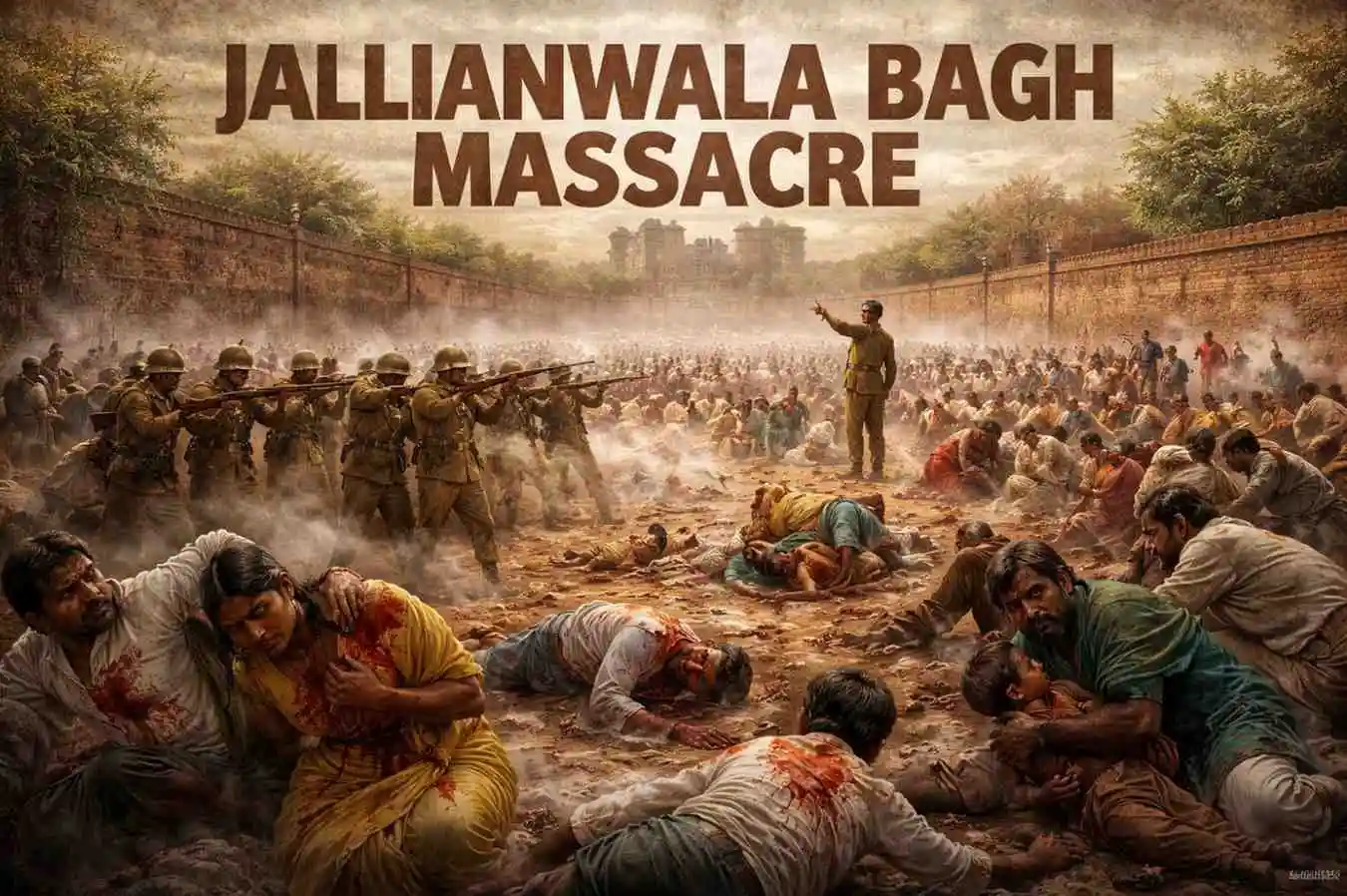
April 13, 1919 was Baisakhi — one of Punjab's most important harvest festivals and a sacred day in the Sikh calendar. Thousands of people had gathered at Jallianwala Bagh, an enclosed public garden in Amritsar, for a combination of festival celebration and political protest meeting.
The garden was surrounded on all sides by high walls, with only a few narrow passageways serving as entry and exit points. It was not a purpose-built arena — it was simply an open space that had organically become a gathering point for the community.
Role of General Dyer
Brigadier General Reginald Dyer arrived at Jallianwala Bagh with approximately ninety soldiers and two armored vehicles fitted with machine guns. The armored vehicles could not enter through the narrow passageways, so they were left outside. Dyer and his troops entered on foot.
Without any warning to the crowd, without any order to disperse, and without any attempt to communicate, General Dyer ordered his troops to open fire directly into the densest sections of the crowd. The soldiers continued firing for approximately ten minutes. They did not stop until their ammunition was nearly exhausted. By Dyer's own later admission, the firing was deliberate and intended to produce a moral effect — a message to all of India about the consequences of defiance.
Crowd and Baisakhi Gathering
The crowd that day was not exclusively a political gathering. It included families celebrating Baisakhi, farmers who had come to the city for the festival, and many people who were entirely unaware of the political ban on public meetings. Children were present. Elderly men and women were present. Pilgrims visiting the nearby Golden Temple had wandered into the Bagh out of curiosity.
When the firing began, panic erupted. People rushed toward the exits only to find them blocked or too narrow. Dozens jumped into a central well inside the garden to escape the bullets. Many drowned or were crushed. The death toll, as officially recorded by the British Hunter Commission, was 379. Indian National Congress estimates and independent historians have placed the number significantly higher, with some accounts citing over one thousand deaths.
Causes of the Jallianwala Bagh Massacre
The massacre was not a spontaneous reaction. It was the product of deliberate policy choices and deep structural injustice.
- The Rowlatt Act created widespread resentment across all sections of Indian society
- British authorities interpreted peaceful protest as sedition and a threat to empire
- The arrest of popular leaders escalated tensions unnecessarily
- General Dyer operated with the belief that a show of overwhelming force would restore order and deter future protests
- There was no functioning accountability mechanism to check military commanders in colonial India
- Racial attitudes within the British administration led many officers to discount the humanity and civil rights of Indian subjects
Immediate Aftermath
The immediate aftermath of the massacre was characterized by shock, silence enforced by martial law, and the slow spread of news across India. Dyer imposed a curfew and prohibited anyone from tending to the wounded. Survivors and relatives of the dead were forced to wait before they could retrieve bodies or seek medical help for the injured.
When news finally spread beyond Amritsar, the reaction was one of national horror. The British government initially supported Dyer. The Hunter Commission, set up to investigate the massacre, eventually censured Dyer and he was asked to resign from his command. However, he was not prosecuted, not imprisoned, and was celebrated by sections of the British public who raised a significant sum of money for him as a tribute.
For Indians watching these events unfold, the message was clear: the British empire did not consider Indian lives to be equal in value to British lives, and the system had no mechanism to deliver real justice.
Impact on Indian Freedom Movement
The Jallianwala Bagh Massacre did not break the spirit of Indian resistance. It ignited it. The event became a turning point in how Indians related to British rule and how leaders across the political spectrum framed their demands.
Gandhi's Response
Mohandas Karamchand Gandhi had until this point maintained a complex relationship with the British empire, even supporting the war effort in the hope that loyalty would be rewarded with political rights. After Jallianwala Bagh, his approach shifted fundamentally. Gandhi declared that cooperation with an unjust system was itself a moral failing. He began organizing the Non-Cooperation Movement, asking Indians across all sectors — from lawyers to students to government employees — to withdraw their participation from British institutions. This mass civil disobedience campaign marked a new chapter in the independence struggle.
Tagore's Protest
Rabindranath Tagore, India's most celebrated poet and the first Asian Nobel laureate, responded to the massacre with an act of remarkable moral courage. He renounced his British knighthood in protest, writing a letter to the Viceroy in which he argued that the honor of association with such a government was incompatible with his dignity as a human being. His gesture resonated deeply across the world and drew international attention to the atrocities of British colonial rule in India.
Casualties and Historical Debate
The exact death toll of the Jallianwala Bagh Massacre remains a subject of historical debate. Official British records from the Hunter Commission acknowledged 379 deaths and approximately 1,200 injuries. The Indian National Congress conducted its own investigation and estimated the deaths at over one thousand. Some historians, drawing on survivor testimonies and local records, have suggested figures even higher than this.
Part of the reason for the discrepancy lies in the suppression of information under martial law, the reluctance of British authorities to acknowledge the full scale of the tragedy, and the chaos that prevented accurate record-keeping in the hours after the firing. The well inside the garden, from which over one hundred bodies were reportedly recovered, stands as a silent witness to the panic and carnage of that afternoon.
Long-Term Legacy
The Jallianwala Bagh Massacre accelerated the timeline of Indian independence and permanently damaged the moral legitimacy of British colonial rule. It turned moderate nationalists into determined freedom fighters. It created a generation of young Indians — including Bhagat Singh, who visited the site as a boy and collected soil from the ground as a symbol of martyrdom — who were willing to sacrifice everything for independence.
The massacre also planted seeds of British accountability debates that would continue for decades. As late as 2019, on the centenary of the massacre, the British Prime Minister of the time described the event as deeply shameful, though a full formal apology has never been issued by the British government.
Memorial and Present-Day Significance
Today, Jallianwala Bagh is a national memorial maintained by the Government of India. The garden has been preserved as a heritage site, with the bullet marks on the walls left deliberately visible as a testament to what occurred. The well into which people jumped is enclosed and marked as a monument to those who perished.
The site attracts hundreds of thousands of visitors each year, including students, historians, and tourists from across the world. The flame of remembrance burns continuously at the memorial, ensuring that the event is not reduced to a footnote in colonial history but remains a living part of national consciousness.
Lessons from the Tragedy
The Jallianwala Bagh Massacre offers several enduring lessons that remain relevant far beyond the context of colonial India.
- Unchecked state power, without civilian oversight or accountability, can lead to atrocities
- Peaceful protest and the right to assembly are fundamental rights that must be legally protected
- Colonial and imperial systems are structurally incapable of delivering true justice to those they oppress
- Moral courage — whether expressed through Gandhi's civil disobedience or Tagore's renunciation — can shift the course of history
- Collective memory of injustice is a powerful force that must be preserved, not sanitized
- Historical wrongs demand honest acknowledgment, not diplomatic silence
FAQs
What was the Jallianwala Bagh Massacre?
The Jallianwala Bagh Massacre occurred on April 13, 1919, in Amritsar, Punjab, when British troops under General Dyer opened fire on thousands of unarmed Indian civilians gathered in an enclosed garden. The crowd had assembled for Baisakhi celebrations and a political protest meeting. With exits blocked and no warning given, hundreds were killed and many more injured in one of the darkest episodes of British colonial rule in India.
Why did General Dyer order the firing?
General Dyer ordered the firing because he believed the gathering violated a ban on public meetings imposed under martial law. He later stated in testimony that his intention was to produce a moral and military effect across Punjab — to send a message that defiance of British authority would be met with overwhelming force. His decision was not a panic response but a calculated act of colonial intimidation, which made it even more disturbing in the eyes of the world.
How many people died in the Jallianwala Bagh Massacre?
Official British records cited 379 deaths, while Indian National Congress investigations estimated over one thousand fatalities. The discrepancy is attributed to martial law suppression of information, unreliable record-keeping in the immediate chaos, and British reluctance to acknowledge the full scale of casualties. The well inside the garden, from which more than one hundred bodies were reportedly recovered, is considered powerful evidence that the official British count was a significant underestimate.
How did the massacre affect India's independence movement?
The massacre was a transformative moment for India's independence movement. Gandhi abandoned any remaining faith in British goodwill and launched the Non-Cooperation Movement. Tagore returned his knighthood. Across India, moderate political positions were replaced by more determined calls for full independence. Young activists like Bhagat Singh were radicalized by the event. The massacre demonstrated that colonial rule could never be reformed from within and must be actively resisted.
Has Britain formally apologized for the Jallianwala Bagh Massacre?
No formal apology has been issued by the British government. In 1997, Queen Elizabeth expressed deep regret during a state visit to India. In 2019, on the centenary of the massacre, Prime Minister Theresa May called it a deeply shameful event in British history. While these statements acknowledged the gravity of the tragedy, Indian leaders and historians have consistently called for a full, unambiguous formal apology that has not yet been delivered.
Conclusion
The Jallianwala Bagh Massacre is not merely a chapter in a history textbook. It is a moral reckoning — a reminder of what happens when power operates without conscience, when law is used as a weapon against the people it should protect, and when human lives are considered disposable in the service of empire.
Understanding the Jallianwala Bagh Massacre historical significance means recognizing how a single act of state violence can unite a nation, sharpen its resolve, and ultimately hasten the downfall of the very power that committed it. The British empire did not achieve order through that April afternoon. It sealed its own moral defeat.
As we walk through the preserved grounds of Jallianwala Bagh today, with bullet holes still visible in the worn stone walls, the silence speaks louder than any monument could. It asks us not just to remember, but to ensure that such a tragedy can never happen again — anywhere, to anyone.
The legacy of the hundreds who died there lives on in every democracy that protects the right to peaceful assembly, in every constitution that limits the power of the state over the individual, and in the enduring truth that justice, however long delayed, will always outlast oppression.
Click below to generate summary