The Code of Hammurabi: How Ancient Babylonian Laws Still Echo in Today's Legal World
Introduction to Ancient Legal Systems
Imagine living in a world where no written rules existed — where disputes were settled by whoever had more power, wealth, or social standing. Imagine a marketplace where a merchant could cheat you without consequence, or a landlord could evict you with no legal recourse. For much of early human history, that was the reality. Society functioned on informal customs, tribal authority, and the arbitrary decisions of rulers. Justice, if it existed at all, was inconsistent, unpredictable, and deeply unfair.
Then, nearly 4,000 years ago, something extraordinary happened in the ancient city of Babylon. A king named Hammurabi did something no ruler had done quite so systematically before — he wrote down the law. Not just a handful of rules, but a comprehensive legal code covering everything from property disputes and trade regulations to marriage, divorce, inheritance, and criminal punishment. This was the Code of Hammurabi, and it changed the world.
Who Was Hammurabi?
Hammurabi was the sixth king of the First Babylonian Dynasty, reigning from approximately 1792 to 1750 BCE. He rose to power during a period of intense political fragmentation in Mesopotamia — the region between the Tigris and Euphrates rivers in present-day Iraq. Through a combination of military strategy, diplomatic alliances, and administrative genius, Hammurabi unified the warring city-states of the region under a single Babylonian empire, making Babylon the dominant cultural and political force of its era.
What set Hammurabi apart from many rulers of his time was not just his military prowess, but his deep commitment to governance. He is frequently described in ancient texts as a "shepherd of his people," a leader who took personal responsibility for the welfare and order of his subjects. He built temples, maintained irrigation systems, and, most famously, codified the legal principles by which his empire would be governed.
Key facts about Hammurabi and his empire:
- He ruled for over 40 years, one of the longest reigns in ancient Mesopotamian history.
- His empire stretched from the Persian Gulf in the south to present-day Syria in the north.
- Babylon under Hammurabi became a major center of trade, religion, and intellectual activity.
- He believed his authority came directly from the gods, particularly the sun god Shamash, the deity of justice.
- His administrative letters, many of which survive today, reveal a ruler deeply involved in the day-to-day affairs of governance.
Hammurabi's legacy rests not on conquest alone, but on his vision of a society governed by consistent, written law — a vision that was truly revolutionary for its time.
The Discovery of the Code
For thousands of years, the Code of Hammurabi lay buried in the ruins of the ancient city of Susa (in modern-day Iran), where it had been taken as war plunder by the Elamite king Shutruk-Nahhunte around 1158 BCE. It was rediscovered in the winter of 1901-1902 by a French archaeological expedition led by Jacques de Morgan. The team unearthed the stele — a large, upright stone slab — in three pieces, which were later reassembled.
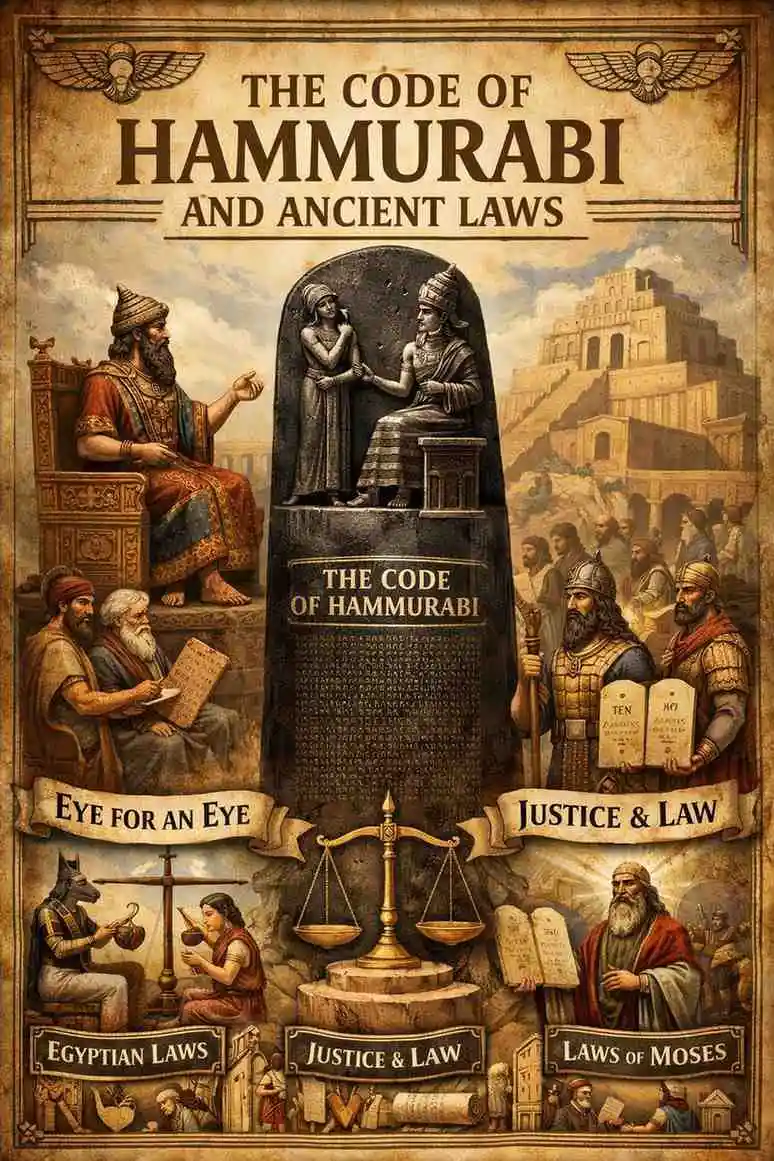
The stele stands nearly 2.25 meters (about 7.4 feet) tall and is carved from black diorite, one of the hardest and most durable stones known to ancient craftsmen. At the top of the stele is a bas-relief carving depicting Hammurabi receiving the laws from Shamash, the Babylonian god of justice. Below this divine scene, the laws are inscribed in cuneiform script — wedge-shaped characters pressed into clay and stone — across almost the entire surface of the monument.
Today, the stele is one of the most prized possessions of the Louvre Museum in Paris, where it remains on permanent display. Its discovery was a watershed moment in archaeology and legal history:
- It confirmed that ancient civilizations had sophisticated written legal systems.
- It provided historians with a detailed window into Babylonian society, economy, and values.
- It demonstrated the use of divine authority to legitimize civil law.
- It sparked a global conversation about the origins of legal thought and governance.
The physical durability of the stele itself — surviving nearly four millennia — is a testament to how seriously Hammurabi and his subjects regarded these laws.
Structure of the 282 Laws
The Code of Hammurabi consists of a prologue, 282 individual laws, and an epilogue. The prologue establishes Hammurabi's divine mandate to bring justice to the land. The epilogue calls blessings upon those who uphold the laws and curses upon those who violate or change them. The 282 laws in between cover an astonishing range of subjects for their time.
Civil Laws: Property and Contracts
Civil law in Hammurabi's code primarily governed the ownership and transfer of property, contractual obligations, and commercial transactions. These laws were designed to create a predictable, fair environment for economic activity across the empire. Merchants, landowners, farmers, and artisans all operated under clearly defined legal expectations.
Key civil law provisions included:
- Contracts for the sale of goods and land had to be witnessed and recorded to be legally binding.
- Lenders could charge interest on loans, but rates were regulated to prevent exploitation.
- A builder who constructed a house that collapsed and killed the owner could be put to death.
- Farmers who neglected their fields to the detriment of neighbors could be held financially liable.
- Theft was treated seriously, with punishments that often exceeded the value of the stolen goods.
These laws reflect an economy that was already quite complex — one involving credit, leasing, subcontracting, and long-distance trade. The fact that such detailed civil regulations existed nearly two millennia before the Roman legal system is remarkable.
Criminal Laws: Punishment and Justice
Criminal law under Hammurabi operated on a retributive model — the punishment was designed to mirror the offense. This is the origin of the famous "eye for an eye" principle, which we will explore in more depth shortly. Criminal laws covered assault, murder, theft, fraud, and false accusation.
Notable criminal law principles:
- Accusing someone of a capital crime without proof could result in the accuser's death.
- Judges who changed their verdicts after issuing them were fined and removed from the bench.
- Soldiers who hired substitutes to fight in their place faced the death penalty.
- Physicians who caused the death of a patient through negligence could have their hands cut off.
- A tavern keeper who failed to report criminals drinking at their establishment was executed.
Family Laws: Marriage and Inheritance
Family law comprised a significant portion of the code, addressing marriage contracts, divorce rights, inheritance distribution, adoption, and the obligations of parents and children.
Core family law provisions:
- Marriage required a formal contract; without one, the union was not legally recognized.
- A wife could seek divorce if her husband was absent, neglectful, or abusive.
- Inheritance was typically distributed among sons, but daughters could receive dowries.
- Adopted children had legal rights unless the birth parents reclaimed them before the adoption was finalized.
- A father who denied his son's inheritance had to prove just cause before a court.
The "Eye for an Eye" Principle
Perhaps the most cited aspect of the Code of Hammurabi is the principle of lex talionis — the law of retaliation — popularly summarized as "an eye for an eye, a tooth for a tooth." This principle holds that the punishment for a crime should be equivalent to the harm caused. While it may sound harsh by modern standards, it was actually a significant step forward in ancient legal thinking.
Before codified law, punishments were often wildly disproportionate. A minor slight could result in death; a serious injury might be settled with a small payment or ignored entirely. Lex talionis introduced the concept of proportional justice — the idea that punishment should fit the crime, no more and no less. This was a foundational concept in creating fairness within the legal system.
However, it is important to note that the "eye for an eye" principle in Hammurabi's code did not apply equally across all social classes. The severity of punishment often depended on whether the offender and victim were free citizens, freed slaves, or enslaved people. This reveals both the sophistication and the inherent inequality of the Babylonian legal system:
- If a man destroyed the eye of another free man, his eye was destroyed.
- If he destroyed the eye of a freed man, he paid a fine of one gold mina.
- If he destroyed the eye of a slave, he paid half the slave's value to the owner.
Social Class and Legal Inequality
The Code of Hammurabi explicitly recognized three social classes: the awilum (free citizens of higher status), the mushkenum (free citizens of lower or dependent status), and the wardum (slaves). Legal rights, penalties, and compensations were determined in large part by which class a person belonged to. This class-based legal structure meant that justice was not blind — it was deeply aware of social hierarchy.
Key aspects of social class in the code:
- Crimes against free citizens were punished more severely than those against slaves.
- Higher-class citizens sometimes received harsher punishments when they offended a peer.
- Slaves had limited legal rights but were protected from certain forms of abuse.
- The code attempted to prevent the most powerful from acting with total impunity.
Economic and Trade Regulations
Babylon was a thriving commercial hub, and Hammurabi's code reflects the complexity of its economy. Laws governing merchants, wage laborers, craftsmen, and farmers demonstrate an early understanding of economic regulation.
Important trade provisions:
- Merchants were required to provide receipts for transactions.
- Wage rates for laborers were set by law, preventing exploitation.
- Agricultural leases, boat rentals, and animal hire contracts were all regulated.
- Debt slavery — working off a debt through labor — was permitted but time-limited to three years.
Women, Family, and Marriage
Women in Babylonian society held more legal standing than in many later civilizations. Under Hammurabi's code, women could own property, engage in commerce, and seek divorce under specific conditions. However, their rights were still significantly constrained compared to men.
Highlights of women's legal status:
- A woman could take her dowry back if her husband divorced her without cause.
- A wife who neglected household duties or "belittled" her husband could be divorced without compensation.
- Widows retained certain property rights and custody over children.
- Women could act as witnesses and parties in legal contracts.
Slavery and Labor Laws
Slavery was a legally recognized institution in Babylonian society, and Hammurabi's code regulated the rights and obligations of both enslaved people and their owners. While slavery was accepted, the code placed certain protections around enslaved individuals.
Key slavery provisions:
- Helping a slave escape was a capital offense.
- A slave who publicly denied their master could have their ear cut off.
- Slaves who were harmed by third parties entitled their owners to compensation.
- Freed slaves had expanded legal rights under the code.
Religion and Divine Authority
The Code of Hammurabi was not presented as the invention of a human king but as a divine gift from the gods. The stele's iconic image of Hammurabi receiving laws from Shamash was a deliberate political and religious statement: these laws were sacred, not arbitrary. Disobeying them was not just a civil offense — it was a religious transgression.
This fusion of divine and civil authority served several purposes:
- It gave the laws a moral weight that pure political decree could not achieve.
- It discouraged resistance, as defying the law meant defying the gods.
- It established the king as an intermediary between the divine and earthly realms.
- It created a sense of shared moral community across the diverse Babylonian empire.
Comparison with Other Ancient Laws
Hammurabi's code was groundbreaking, but it was not the only ancient legal system. Comparing it to contemporaneous or nearby legal traditions reveals both its uniqueness and its shared themes.
- The Code of Ur-Nammu (circa 2100 BCE), written in Sumeria, predates Hammurabi's by about 300 years and is the oldest known law code. It favored fines over physical punishment.
- The Hittite Laws (circa 1650-1100 BCE) similarly preferred financial compensation over bodily harm.
- Mosaic Law in the Hebrew Bible shares the "eye for an eye" concept and several other legal parallels, suggesting either shared cultural heritage or mutual influence.
- Ancient Egyptian law, while not as formally codified, was guided by the concept of Ma'at — cosmic justice and truth — which parallels Hammurabi's invocation of divine sanction.
What distinguished Hammurabi's code was its sheer comprehensiveness, its public nature (inscribed on a large stone for all to see), and its explicit social hierarchy.
Influence on Modern Law
The reach of Hammurabi's legal thinking extends far beyond Babylon. Modern legal systems — particularly those rooted in civil law traditions — reflect many principles first articulated in this ancient code. The idea that laws should be written, public, and consistently enforced; that contracts require witnesses; that judges must be accountable; and that punishment should be proportional to harm — all of these concepts trace their intellectual lineage, in part, to Hammurabi.
Specific modern legal concepts with ancient parallels:
- Presumption of guilt and burden of proof are addressed in the code's false accusation laws.
- Consumer protection is reflected in laws governing merchants and craftsmen.
- Minimum wage concepts echo the code's fixed labor rates.
- Medical malpractice parallels the physician accountability laws.
- Family court principles around divorce, custody, and inheritance mirror Babylonian family law.
While modern law has evolved enormously in sophistication, scope, and values — particularly regarding equality and human rights — the foundational impulse behind Hammurabi's code remains alive in every courtroom in the world: the belief that a just society requires written, knowable, and enforceable rules.
Frequently Asked Questions
What is the Code of Hammurabi, and why is it important?
The Code of Hammurabi is one of the oldest known written legal codes in human history, created by the Babylonian king Hammurabi around 1754 BCE. It contains 282 laws covering civil, criminal, and family matters. Its importance lies in establishing the principle that laws should be written, public, and consistently enforced — a foundational idea for all modern legal systems worldwide.
Where is the Code of Hammurabi located today?
The original stele on which the Code of Hammurabi is inscribed is currently housed in the Louvre Museum in Paris, France. It was discovered by French archaeologists in 1901-1902 in the ruins of Susa (modern-day Iran). Standing nearly 2.25 meters tall and carved from black diorite, it remains one of the museum's most visited and historically significant artifacts.
What does "an eye for an eye" mean in the Code of Hammurabi?
The phrase "an eye for an eye" refers to the principle of lex talionis, or proportional retributive justice. In Hammurabi's code, it meant that punishments should be equivalent to the offense — if someone caused a specific harm, they should receive a comparable harm in return. This was actually a progressive concept in its time, as it limited disproportionate revenge and introduced consistency in sentencing.
How did the Code of Hammurabi treat women?
Women under Hammurabi's code had more legal standing than in many ancient societies. They could own property, engage in business, and seek divorce in certain circumstances. However, their rights were still substantially limited compared to men's. A wife who was divorced without cause could reclaim her dowry, while a wife deemed negligent could be divorced with no compensation. Widows retained some property rights.
How did the Code of Hammurabi influence modern law?
Hammurabi's code influenced modern law by establishing key principles still in use today — including written and publicly displayed laws, proportional punishment, contractual obligations, consumer protections, and judicial accountability. Many legal scholars trace early forms of presumption of evidence, labor rights, and family law directly to concepts first articulated in Hammurabi's 282 laws, particularly in civil law traditions.
Conclusion
The Code of Hammurabi is far more than a relic of the distant past. It is a living testament to humanity's enduring belief that order, justice, and fairness must be grounded in written, transparent, and consistently applied law. When Hammurabi inscribed those 282 laws in black diorite nearly four thousand years ago, he was doing something profoundly human — trying to create a world where people knew the rules, where the powerful were constrained, and where the vulnerable had at least some recourse.
Of course, the code was imperfect. Its class-based inequalities, its harsh physical punishments, and its acceptance of slavery are stark reminders of the moral limitations of ancient societies. But when we strip away those imperfections, we find a legal philosophy that still resonates: that law should be knowable, proportional, and divine in its commitment to justice.
From the courtrooms of New York to the family courts of Tokyo, from international trade agreements to neighborhood dispute resolution, the echoes of Hammurabi's vision can still be heard. The names have changed, the language has evolved, and the values have (thankfully) deepened — but the core project remains the same. The Code of Hammurabi reminds us that civilization is, above all else, a collective commitment to living by shared rules. And that is a project as ancient as it is urgent.
Click below to generate summary