Albert Einstein Passed Away: 7 Powerful Lessons That Still Shape Our World
There are very few names in human history that carry the weight of genius the way Albert Einstein's does. Even decades after Albert Einstein passed away, his ideas continue to ripple through physics classrooms, research laboratories, space agencies, and even philosophy discussions around the world. He was not merely a scientist — he was a cultural icon, a moral voice, and one of the most original thinkers humanity has ever produced.
But here is something worth asking: why do we still talk about him? Why does a man who died in 1955 remain relevant in the age of artificial intelligence, quantum computing, and deep space exploration? The answer lies not just in his equations, but in the way he thought — curiously, boldly, and without fear of being wrong.
Why Einstein Still Matters Today
Einstein matters today because the problems he wrestled with — understanding the universe, balancing science with ethics, questioning authority — are problems we are still wrestling with. His work forms the backbone of GPS technology, nuclear energy policy, gravitational wave research, and modern cosmology. His life story matters just as much as his science.
Early Life and Education
Childhood Curiosity
Albert Einstein was born on March 14, 1879, in Ulm, in the Kingdom of Württemberg in the German Empire. From a very young age, he displayed an unusual fascination with the invisible forces that governed the natural world. One of his most famous childhood memories involved a compass his father showed him at the age of five. He was mesmerized by the fact that the needle always pointed north, seemingly guided by something unseen. That mystery ignited a fire in him that would burn for the rest of his life.
He was not a prodigy in the traditional sense. He did not speak fluently until the age of three, and some early teachers found him slow or detached. But beneath the surface, his mind was constantly working, asking questions that most adults had long stopped asking. His curiosity was not just a personality trait — it was a cognitive engine.
Key insights from Einstein's childhood:
- Early curiosity about natural phenomena shaped his scientific thinking
- He asked questions that others had accepted as having no answers
- His imagination was always more powerful than his rote memorization skills
- Family support and access to books played a crucial role in his development
- He learned music early, which many researchers believe enhanced his abstract thinking
Academic Challenges
Contrary to popular belief, Einstein did not fail mathematics. That is a myth. However, he did struggle with the rigid, authoritarian structure of European schooling in the late 19th century. He clashed with teachers who demanded memorization over understanding. He eventually left his gymnasium in Munich and later failed his entrance exam to the Swiss Federal Polytechnic in Zurich on his first attempt — specifically in the language and botany sections, though he excelled in mathematics and physics.
He enrolled in a cantonal school in Aarau, Switzerland, where the teaching philosophy emphasized conceptual thinking over rote learning. This environment suited him perfectly, and he thrived. He eventually gained admission to the Polytechnic and graduated in 1900.
Breakthrough Discoveries
Theory of Relativity
Einstein's most celebrated contribution to science is undoubtedly the theory of relativity, which fundamentally changed the way we understand space, time, and gravity.
Special Relativity
In 1905 — often called his "miracle year" — Einstein published four groundbreaking papers. Among them was the special theory of relativity, which proposed that the laws of physics are the same for all non-accelerating observers and that the speed of light in a vacuum is constant regardless of the motion of the light source. This led to the famous equation E = mc², which revealed the equivalence of energy and mass and would later underpin nuclear science.
Special relativity shattered centuries-old assumptions about absolute time and space, showing instead that time can slow down and lengths can contract depending on relative motion. It was a revolution in thought, not just in physics.
General Relativity
A decade later, in 1915, Einstein extended his theory to include gravity. General relativity proposed that massive objects cause a curvature in space-time, and this curvature is what we perceive as gravity. This idea was confirmed in 1919 when observations during a solar eclipse showed that light bent around the sun exactly as Einstein had predicted. Overnight, he became an international celebrity.
Key insights from Einstein's discoveries:
- Special relativity challenged Newtonian physics and introduced time dilation
- E = mc² became the most recognized equation in scientific history
- General relativity redefined our understanding of gravity as geometry
- His 1919 confirmation transformed him into a global scientific icon
- These theories remain foundational to modern physics and cosmology
Nobel Prize Achievement
Interestingly, Einstein did not receive the Nobel Prize in Physics for his theory of relativity. Instead, he was awarded the 1921 Nobel Prize — received in 1922 — for his discovery of the photoelectric effect, which provided crucial evidence for quantum theory. This achievement showed that light could behave as both a wave and a particle, laying groundwork for quantum mechanics.
Albert Einstein Passed Away: Historical Context
The Day the World Lost a Genius
Albert Einstein passed away on April 18, 1955, at Princeton Hospital in New Jersey, USA. He was 76 years old. The cause of death was an abdominal aortic aneurysm — a rupture of the main blood vessel near the stomach. He had been aware of his condition for years and had previously declined surgery, reportedly saying he wanted to go when he wanted to go and felt that artificially prolonging life was undignified.
The night before he died, he was still working. Notes written in German — scribbled equations related to his unified field theory — were found on his bedside table. Even at the very end, Einstein was still reaching for answers to the deepest questions in physics. That image — a dying man writing equations by lamplight — says everything about who he was.
His brain was controversially preserved without his family's initial consent by pathologist Thomas Harvey, who hoped it would offer clues to his extraordinary intellect. His ashes were scattered at an undisclosed location, in keeping with his wishes to avoid any shrine or cult of personality.
Global Reaction
The world mourned deeply. Scientists, world leaders, artists, and ordinary people expressed grief and admiration. His death was front-page news globally. The New York Times declared him "the foremost scientist of his era." Tributes poured in from every continent. His passing marked not just the loss of a person, but the close of a particular chapter in the history of human thought.
7 Powerful Lessons from Einstein's Life
Lesson 1: Curiosity Drives Innovation
Einstein famously said that he had no special talents — only a passionate curiosity. That curiosity led him to question things most scientists took for granted. Curiosity is the starting point for every great discovery, and it is something every person can cultivate.
Lesson 2: Persistence Pays Off
Einstein spent over a decade developing general relativity and faced numerous rejections, failed attempts, and professional setbacks. He persisted because he believed in the problem. Persistence, not brilliance alone, is what separates achievement from potential.
Lesson 3: Imagination is Key
He once stated that imagination is more important than knowledge. His thought experiments — imagining riding a beam of light, or being inside a falling elevator — were not mathematical exercises. They were acts of pure imagination that later became rigorous science.
Lesson 4: Simplicity in Thinking
Einstein's guiding principle was to make things as simple as possible, but no simpler. He had a gift for stripping away complexity and identifying the elegant core of any problem. This approach is applicable in business, design, writing, and everyday decision-making.
Lesson 5: Value of Education
Despite his frustrations with formal schooling, Einstein deeply valued learning. He read voraciously, engaged with philosophy, music, and literature alongside science. He understood that education was not a stage of life but a lifelong commitment.
Lesson 6: Ethical Responsibility
Einstein used his platform to speak out against nationalism, militarism, and nuclear proliferation — even as his own equation made the atomic bomb theoretically possible. He believed scientists had a moral duty to consider the consequences of their work.
Lesson 7: Lifelong Learning
Einstein never stopped questioning, never stopped reading, never stopped trying to solve problems. On the day he died, he was still working. The lesson is clear: intellectual vitality does not have to diminish with age.
Key insights across these lessons:
- Curiosity and imagination often outperform raw intelligence
- Ethical responsibility is inseparable from scientific achievement
- Persistence through failure is a defining trait of great thinkers
- Simplicity is a form of genius, not laziness
- Learning is a lifelong discipline, not a phase
Einstein's Impact on Modern Science
Technology Influenced by His Work
Einstein's theories are not abstract ideas confined to textbooks. They are embedded in technologies we use every day. GPS satellites must account for time dilation effects predicted by both special and general relativity to provide accurate location data. Without Einstein's corrections, GPS systems would drift by several kilometers per day.
Laser technology, solar panels, and fiber optic communications all trace their theoretical roots to his work on the photoelectric effect and quantum theory. Nuclear power plants and medical imaging tools like PET scans also draw on principles he helped establish.
Role in Space Exploration
General relativity is essential to understanding black holes, gravitational waves, and the expanding universe. NASA and space agencies worldwide use Einsteinian physics for orbital calculations, deep space navigation, and interpreting data from telescopes like the James Webb Space Telescope. The 2015 detection of gravitational waves by LIGO was a direct confirmation of predictions Einstein made a century earlier.
Personal Life and Philosophy
Views on Humanity
Einstein was a committed humanist. He opposed racism publicly at a time when it was dangerous to do so, spoke at historically Black colleges in America, and called racism "America's worst disease." He was a pacifist who nonetheless signed a letter urging President Roosevelt to pursue nuclear research before Nazi Germany could — a decision he later described as the greatest regret of his life.
Spiritual Thoughts
Einstein did not believe in a personal God but expressed a deep sense of what he called "cosmic religious feeling" — an awe at the order and complexity of the universe. He saw science and spirituality as complementary rather than contradictory, and his reflections on this topic remain widely quoted in philosophical and interfaith discussions.
Misconceptions About Einstein
Myths vs Reality
Several myths surround Einstein's life. He did not fail mathematics — he excelled at it. He was not socially withdrawn — he was socially engaged and politically outspoken. His brain was not dramatically different in size, though certain regions associated with mathematical processing were slightly expanded.
Another common myth is that he worked entirely alone. In reality, he collaborated extensively, engaged passionately in scientific debates, and credited colleagues and predecessors generously.
Einstein's Legacy in Education and Culture
Influence in Schools
Einstein's life and work are taught in nearly every physics curriculum worldwide. Beyond equations, educators use his story to teach scientific thinking, resilience, and intellectual humility. Many schools and universities bear his name, and his thought experiments are used to introduce abstract physics concepts to beginners.
Presence in Popular Culture
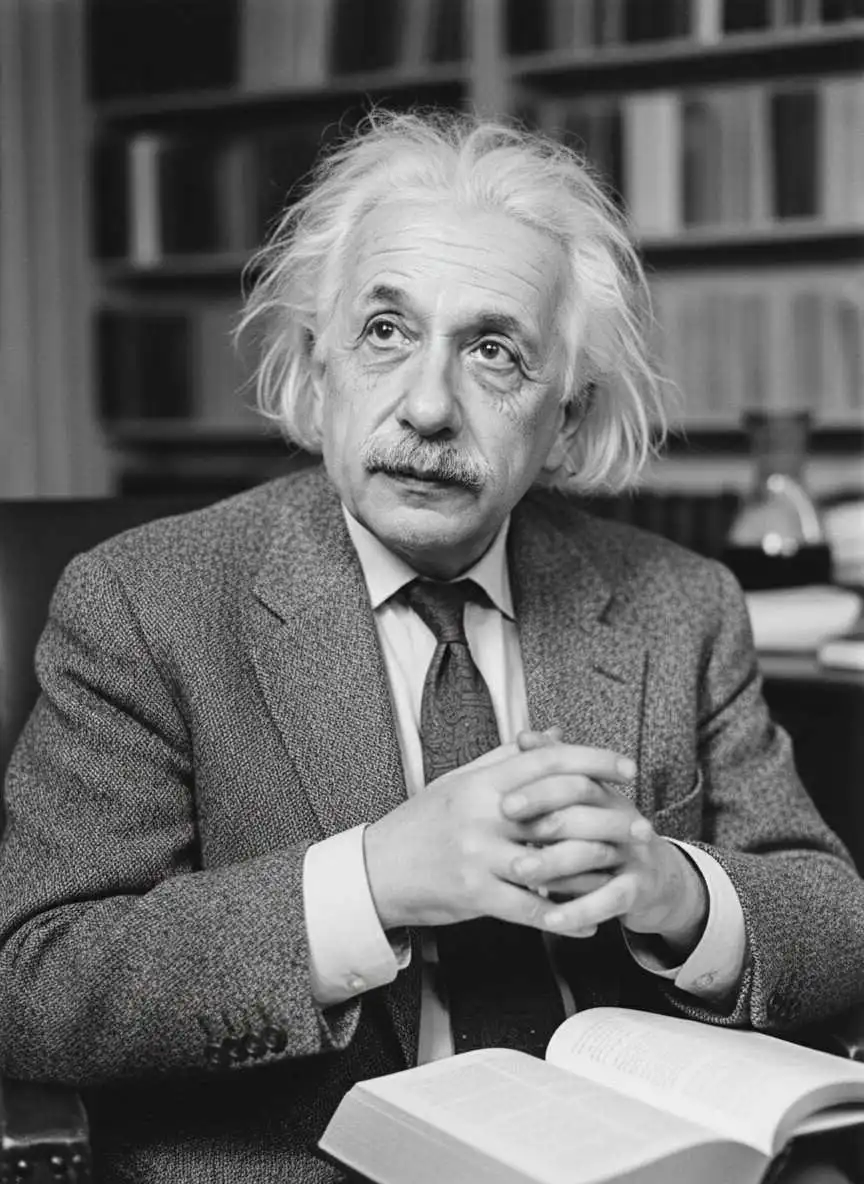
From TIME's Person of the Century designation to appearances in films, novels, memes, and marketing campaigns, Einstein occupies a unique place in popular culture. His image — wild hair, gentle eyes, rumpled clothes — is one of the most recognized in the world. He has become a symbol of genius itself, for better or worse, and his quotes circulate constantly on social media.
Frequently Asked Questions (FAQs)
1. When and how did Albert Einstein pass away?
Albert Einstein passed away on April 18, 1955, in Princeton, New Jersey, due to an abdominal aortic aneurysm. He was 76 years old. He had declined surgery, choosing to accept the natural course of his illness. Remarkably, he was still working on physics equations the night before his death, demonstrating his lifelong commitment to scientific inquiry.
2. What was Einstein's most important scientific contribution?
Einstein's most significant contribution was the general theory of relativity, published in 1915, which redefined our understanding of gravity as a curvature of space-time. His special theory of relativity and the equation E = mc² are equally transformative. He also made foundational contributions to quantum mechanics through his work on the photoelectric effect, for which he received the Nobel Prize.
3. Did Einstein actually fail in school?
No, this is a widespread myth. Einstein excelled in mathematics and physics throughout his education. He did fail the entrance exam to the Swiss Federal Polytechnic, but only in non-science subjects like language and botany. His academic challenges were more related to his dislike of rote memorization than any actual inability to learn complex material.
4. How does Einstein's work affect everyday life today?
Einstein's theories directly influence technologies we rely on daily. GPS systems must apply relativistic corrections to remain accurate. Laser technology, solar energy panels, and nuclear power all have theoretical foundations in his work. The photoelectric effect he explained is the basis for modern photovoltaic technology used in solar panels worldwide.
5. What can students learn from Albert Einstein's life?
Students can learn that curiosity, persistence, and imagination often matter more than conventional academic performance. Einstein faced rejection, institutional resistance, and personal hardships, yet persisted in his intellectual pursuits. His life demonstrates that great thinking comes from asking better questions, embracing failure as part of the process, and never losing the childlike wonder that drives discovery.
Conclusion
Albert Einstein passed away over seven decades ago, but the echoes of his life reverberate through every corner of modern civilization. From the satellites orbiting Earth to the philosophical conversations happening in universities, from the renewable energy powering homes to the telescopes peering into the depths of space — Einstein's fingerprints are everywhere.
His seven lessons — curiosity, persistence, imagination, simplicity, education, ethical responsibility, and lifelong learning — are not relics of a bygone era. They are active principles, urgently relevant in a world that increasingly rewards speed over depth and noise over substance.
What made Einstein truly extraordinary was not that he was beyond human — it was that he was fully, intensely human. He struggled, doubted, failed, loved, grieved, and kept going. He used his intellect not just to explain the universe, but to advocate for a more just and peaceful world within it.
If his life teaches us anything, it is this: the greatest thing you can do with your mind is keep it open, keep it moving, and never — not even on your last night on Earth — stop asking questions.
Click below to generate summary