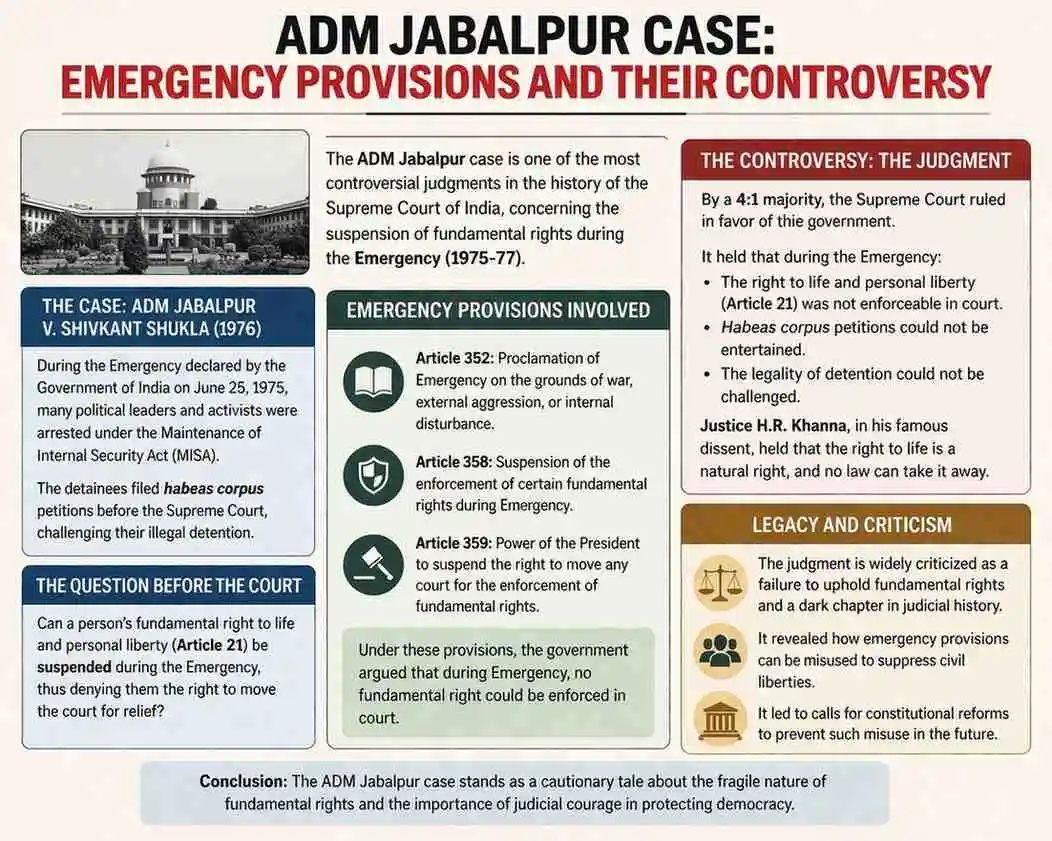
Why Emergency Provisions Exist in a Democratic Constitution
The Emergency Provisions in the Indian Constitution represent one of the most powerful and sensitive mechanisms built into the country’s constitutional framework. While India is founded on democratic principles, fundamental rights, and federalism, the framers of the Constitution recognized that extraordinary situations could arise where normal governance might fail to protect the nation. In such moments of grave crisis, the survival of the state, constitutional order, and national unity must take precedence over routine democratic processes.
Emergency provisions allow the Union Government to assume expanded authority and temporarily restrict certain freedoms to safeguard the country. These powers are not meant for ordinary circumstances but for rare and exceptional situations such as war, armed rebellion, breakdown of constitutional machinery in states, or severe financial instability. Carefully placed within Part XVIII of the Constitution, these provisions aim to balance national security with constitutional responsibility.
Why Emergency Provisions Are Important
-
Designed for extraordinary national crises
-
Enable swift and centralized decision-making
-
Protect sovereignty, unity, and integrity
-
Ensure constitutional continuity during instability
Constitutional Framework of Emergency Provisions
The Emergency Provisions are contained in Part XVIII of the Constitution of India, covering Articles 352 to 360. These articles collectively outline the circumstances under which emergencies may be declared, the procedure for their approval, and the consequences for governance and fundamental rights. The framers borrowed this concept from the Government of India Act, 1935, but incorporated stronger parliamentary controls and later safeguards through constitutional amendments.
These provisions form a legal framework that allows the Constitution to adapt during crises without collapsing. Rather than operating outside the Constitution, emergencies function within it, emphasizing that even extraordinary powers must follow constitutional discipline.
Articles Governing Emergency Provisions
-
Part XVIII of the Constitution
-
Articles 352 to 360
-
Covers national, state, and financial emergencies
-
Establishes legal procedures and limits
Purpose and Objectives of Emergency Provisions
The framers of the Constitution understood that democratic governance alone may not be sufficient during severe crises. Emergencies such as war or economic collapse demand rapid and unified action, which decentralized governance structures may not effectively provide. Emergency provisions exist to bridge this gap between normal governance and extraordinary necessity.
Their purpose is not to weaken democracy permanently but to preserve it during moments of extreme danger. By temporarily centralizing power, the Constitution ensures that governance does not collapse when the nation faces existential threats.
Main Objectives
-
Protect national sovereignty and integrity
-
Maintain constitutional governance
-
Address internal and external threats
-
Ensure financial and administrative stability
Types of Emergencies in the Indian Constitution
The Constitution of India provides for three distinct types of emergencies, each designed to address a specific category of crisis. These emergencies differ in scope, grounds, duration, and effects on governance. Together, they form a comprehensive crisis-management system within the constitutional structure.
Each type of emergency reflects a different dimension of national vulnerability—security, governance, and financial stability.
Three Constitutional Emergencies
-
National Emergency
-
State Emergency (President’s Rule)
-
Financial Emergency
National Emergency Under Article 352
A National Emergency is the most serious form of constitutional emergency. It can be proclaimed when the security of India or any part of its territory is threatened by war, external aggression, or armed rebellion. Originally, the term “internal disturbance” was used, but this was replaced by “armed rebellion” through the 44th Constitutional Amendment Act, 1978, to prevent misuse.
This provision empowers the Union Government to take sweeping measures to defend the nation. However, it also contains procedural safeguards to prevent arbitrary use.
Threats That Can Trigger National Emergency
-
War
-
External aggression
-
Armed rebellion
Grounds for Proclamation of National Emergency
The proclamation of a National Emergency depends on the existence of a serious threat to national security. These grounds are clearly defined to ensure that emergency powers are not invoked lightly or for political convenience.
The replacement of “internal disturbance” with “armed rebellion” strengthened democratic safeguards by narrowing the scope of this provision.
Recognized Grounds
-
Declared or undeclared war
-
Attack by a foreign power
-
Violent internal uprising
Procedure for Declaring a National Emergency
The process of declaring a National Emergency involves both the executive and the legislature, ensuring democratic oversight. The President issues the proclamation, but only on the written advice of the Union Cabinet. This requirement was introduced to ensure collective responsibility and prevent unilateral action.
Parliamentary approval acts as a further safeguard by subjecting the proclamation to legislative scrutiny.
Proclamation Process
-
Issued by the President of India
-
Based on written advice of Union Cabinet
-
Parliamentary approval within one month
-
Requires special majority
Duration and Extension of National Emergency
A National Emergency is initially valid for six months. However, it can be extended indefinitely as long as Parliament approves its continuation every six months. This ensures periodic review and prevents permanent concentration of power.
The requirement of repeated approval reflects the principle that emergency powers must remain temporary and accountable.
Duration Rules
-
Valid for six months initially
-
Can be extended every six months
-
Parliamentary approval mandatory
Effects of National Emergency on Centre-State Relations
One of the most significant effects of a National Emergency is the transformation of India’s federal structure into a unitary system. During this period, the Centre gains extensive control over state administration and legislative matters.
This shift is intended to ensure coordinated national action during crises that affect the entire country.
Impact on Federal Structure
-
Centre assumes greater authority
-
States operate under central direction
-
Federal system becomes unitary
Impact of National Emergency on Fundamental Rights
During a National Emergency, the operation of certain fundamental rights is affected. Article 19 is automatically suspended, while other rights can be suspended under Article 359. However, the 44th Constitutional Amendment ensured that Articles 20 and 21 remain protected even during emergencies.
This balance reflects lessons learned from past misuse and reinforces the importance of basic human rights.
Effect on Rights
-
Article 19 automatically suspended
-
Other rights may be restricted
-
Articles 20 and 21 remain protected
Effect on Parliament and Legislative Powers
A National Emergency significantly enhances the legislative authority of Parliament. It can legislate on subjects normally reserved for states. Additionally, the term of the Lok Sabha may be extended by one year at a time.
These provisions ensure continuity of governance during national crises.
Parliamentary Changes
-
Parliament legislates on state subjects
-
Lok Sabha term extendable
-
Strengthened central law-making power
National Emergencies Declared in India
India has experienced National Emergencies on three occasions. Each proclamation was based on different grounds and had a profound impact on governance and civil liberties.
The Emergency of 1975, in particular, deeply influenced constitutional reforms and safeguards.
Declared National Emergencies
-
1962 – China War
-
1971 – Indo-Pak War
-
1975 – Internal Emergency
State Emergency or President’s Rule Under Article 356
A State Emergency, commonly known as President’s Rule, is imposed when a state government cannot function according to constitutional provisions. This situation arises when constitutional machinery breaks down in a state.
Article 356 allows the Union to intervene to restore constitutional governance, though its misuse has been widely criticized.
Meaning of President’s Rule
-
Failure of constitutional governance
-
State administration taken over by Centre
-
Temporary suspension of state autonomy
Grounds for Imposition of President’s Rule
President’s Rule may be imposed under several circumstances, including loss of majority in the state assembly or inability to form a government. These conditions reflect administrative paralysis rather than security threats.
Judicial oversight has strengthened safeguards against arbitrary use.
Common Grounds
-
Breakdown of constitutional machinery
-
Loss of legislative majority
-
Failure to form government
Procedure and Duration of State Emergency
The proclamation of President’s Rule must be approved by Parliament within two months. Initially valid for six months, it can be extended up to a maximum of three years under specific conditions.
This structure balances central intervention with democratic accountability.
Duration Framework
-
Parliamentary approval within two months
-
Initially valid for six months
-
Maximum duration of three years
Effects of President’s Rule on State Governance
When President’s Rule is imposed, the state executive authority shifts to the President, who acts through the Governor. The state legislative assembly may be dissolved or suspended, and Parliament assumes legislative powers for the state.
These measures aim to restore stable governance.
Administrative Effects
-
President controls state executive
-
Governor acts on behalf of President
-
Assembly dissolved or suspended
-
Parliament legislates for state
Use and Misuse of Article 356
Article 356 has been used more than 100 times since independence, often drawing criticism for political misuse. The Supreme Court’s judgment in the S.R. Bommai case significantly restricted arbitrary application.
Judicial review now acts as a strong deterrent against misuse.
Key Developments
-
Frequent use since independence
-
Criticism for political misuse
-
S.R. Bommai case guidelines
-
Judicial review permitted
Financial Emergency Under Article 360
A Financial Emergency may be declared when the financial stability or credit of India is threatened. This provision addresses economic crises rather than political or security threats.
Unlike other emergencies, a Financial Emergency has never been declared in India.
Nature of Financial Emergency
-
Addresses economic instability
-
Protects national financial credit
-
Preventive constitutional mechanism
Grounds and Procedure for Financial Emergency
Severe economic crisis or collapse of public finance may justify a Financial Emergency. The President proclaims it, subject to parliamentary approval within two months.
Once approved, it continues until revoked.
Procedural Aspects
-
Proclaimed by President
-
Parliamentary approval required
-
Continues until revoked
Effects of Financial Emergency
A Financial Emergency significantly centralizes financial control. The Centre may reduce salaries of government employees and judges and issue financial directions to states.
This ensures uniform fiscal discipline across the country.
Major Consequences
-
Salary reduction of officials
-
Centre controls state finances
-
Money bills reserved for President
Role of the President During Emergencies
During emergencies, the President becomes the focal constitutional authority. However, all actions are taken on the advice of the Union Cabinet, reinforcing the parliamentary system.
The President acts as a constitutional guardian rather than an independent decision-maker.
Presidential Role
-
Central constitutional authority
-
Acts on cabinet advice
-
Ensures constitutional continuity
Safeguards Against Misuse of Emergency Powers
The 44th Constitutional Amendment Act, 1978 introduced crucial safeguards to prevent abuse of emergency provisions. These changes were informed by the experience of the 1975 Emergency.
They strengthened democracy while retaining crisis-management capacity.
Key Safeguards
-
Written cabinet advice mandatory
-
Parliamentary approval strengthened
-
Articles 20 and 21 protected
-
Judicial review allowed
Criticism of Emergency Provisions
Emergency provisions have faced criticism for enabling excessive centralization of power and suspension of civil liberties. The experience of the 1975 Emergency highlighted the dangers of misuse.
However, criticism has also led to reforms and stronger safeguards.
Major Criticisms
-
Threat to democracy
-
Concentration of power
-
Potential political misuse
-
Restriction of civil liberties
Importance of Emergency Provisions in a Federal Democracy
Despite criticism, emergency provisions remain essential for national survival. They act as a constitutional safety valve, enabling the state to respond effectively to extraordinary threats.
Without such provisions, constitutional governance itself could be endangered during crises.
Why They Matter
-
Ensure national security
-
Maintain constitutional order
-
Enable crisis management
-
Protect sovereignty
Comparison of Emergency Types
The three types of emergencies differ in scope and purpose. Understanding these differences highlights the comprehensive nature of India’s constitutional design.
Quick Comparison
-
National Emergency – Article 352, whole or part of India
-
State Emergency – Article 356, specific state
-
Financial Emergency – Article 360, entire country
Conclusion
Emergency Provisions in the Indian Constitution reflect the wisdom of balancing democratic ideals with national survival. While they grant extraordinary powers, they are embedded within a framework of accountability, safeguards, and judicial oversight. The lessons of history have strengthened these provisions, ensuring that liberty and security coexist rather than conflict.
In a diverse and complex nation like India, emergencies may arise from multiple fronts. The Constitution’s ability to adapt without breaking is what makes these provisions indispensable. Used responsibly, they protect democracy; misused, they threaten it. Ultimately, their value lies in restraint, vigilance, and constitutional morality.
Final Takeaway
-
Extraordinary powers for extraordinary situations
-
Designed to protect, not replace democracy
-
Safeguards ensure accountability
-
A vital constitutional mechanism
Click below to generate summary