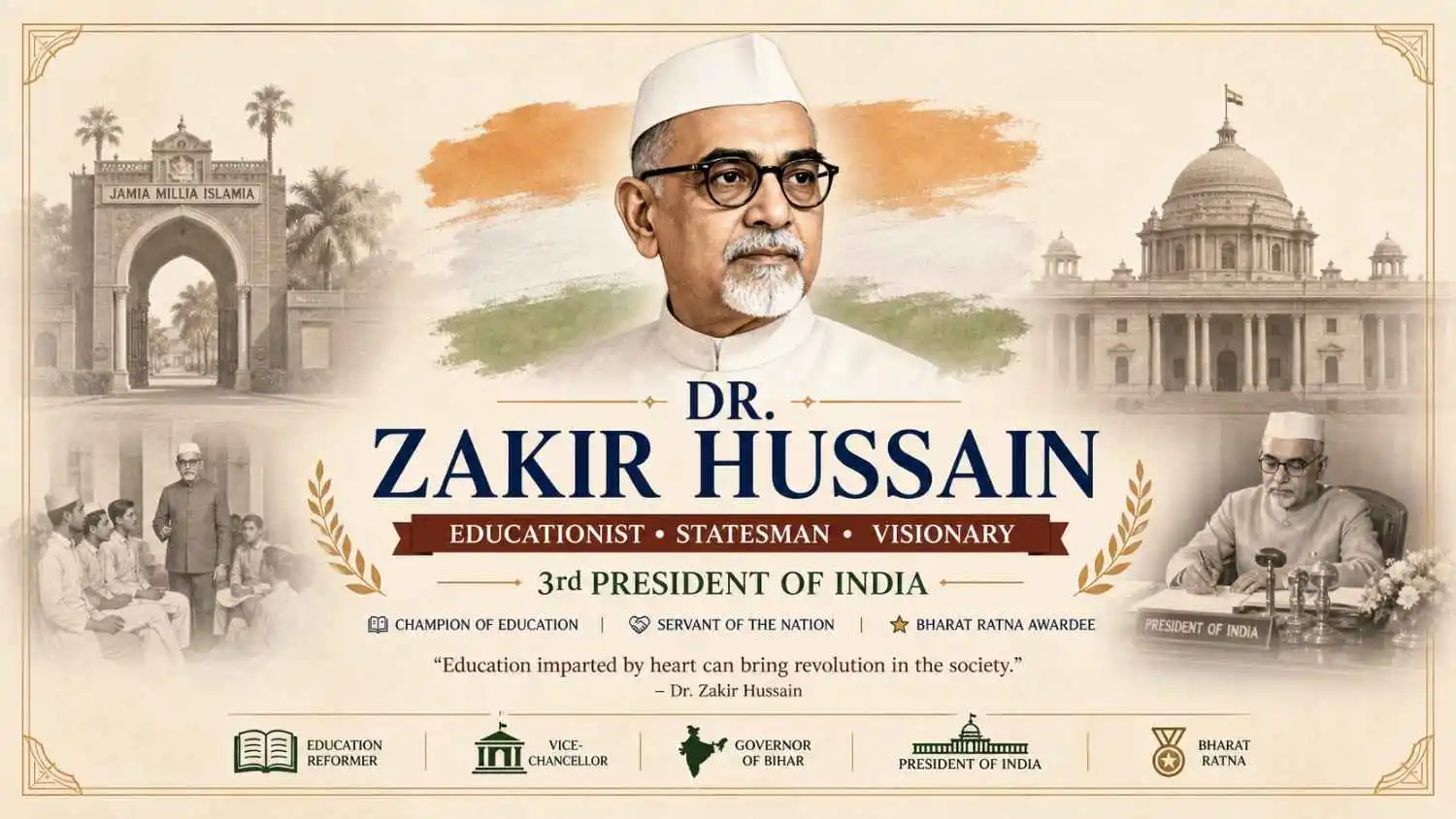
What does it take for a man raised in the fading shadow of colonial India to become the conscience of a new republic? Dr. Zakir Hussain's life answers that question not with declarations, but with decades of quiet, relentless work — as a teacher, a builder of institutions, a governor, a vice president, and finally, the third President of India. His story is not just biographical trivia for competitive exams. It is a blueprint for how intellectual conviction, moral integrity, and an unshakeable belief in education can shape the destiny of a nation.
Dr. Zakir Hussain Biography: An Overview
Key Facts and Timeline of His Life
Dr. Zakir Hussain was born on February 8, 1897, in Hyderabad (then in the Nizam's dominions). He passed away on May 3, 1969, becoming the first President of India to die in office. Across those 72 years, he wore many hats — student, economist, educationist, Vice-Chancellor, Governor of Bihar, Vice President, and ultimately, President of India.
Here is a quick-reference timeline for students and exam aspirants:
- 1897 — Born in Hyderabad
- 1920 — Joined the Non-Cooperation Movement; left Aligarh Muslim University in solidarity
- 1920 — Co-founded Jamia Millia Islamia in Aligarh (later moved to Delhi)
- 1926–35 — Pursued doctoral studies in economics at the University of Berlin
- 1926–48 — Served as Vice Chancellor of Jamia Millia Islamia
- 1952–57 — Member of Rajya Sabha
- 1956 — Awarded Padma Vibhushan
- 1957–62 — Governor of Bihar
- 1962–67 — Vice President of India
- 1963 — Awarded Bharat Ratna
- 1967–69 — President of India
- 1969 — Died in office on May 3, at Rashtrapati Bhavan
Why He Is Remembered in Indian History
Dr. Zakir Hussain is remembered not merely as a constitutional figurehead but as a transformative force in Indian education and democratic values. He was the first Muslim President of India and the first president to die while in office. More significantly, he represents the idea that scholarship and statecraft are not opposing callings — they can, in the right hands, be deeply complementary.
Dr. Zakir Hussain Early Life and Background
Birth, Family, and Childhood Influences
Dr. Zakir Hussain was born into a family of modest means but considerable intellectual inheritance. His father, Fida Hussain Khan, was a lawyer by profession, and his mother, Nazneen Begum, was known for her deep piety and warmth. He was the seventh child in a large family. The early death of his father, when Zakir Hussain was just ten years old, brought financial hardship to the household — a challenge that, rather than dampening his spirit, sharpened his resolve.
The family relocated to Etawa in Uttar Pradesh, and it was in this environment of limited resources but rich cultural exposure that young Zakir Hussain's character was forged. He displayed an early love for reading, a curiosity that his teachers noted with admiration.
- Place of birth: Hyderabad, Andhra Pradesh (then under Nizam's rule)
- Father: Fida Hussain Khan (lawyer)
- Early influence: Loss of father at age 10 instilled self-reliance and intellectual seriousness
- Cultural milieu: Exposed to both Urdu literary traditions and broader Indian philosophical values
Early Education and Intellectual Development
Zakir Hussain completed his early schooling with distinction and eventually enrolled at the Muhammadan Anglo-Oriental College in Aligarh — the institution that would later become the Aligarh Muslim University (AMU). It was here that the seeds of his national consciousness were planted. The college was a crucible of intellectual debate, where Muslim scholars wrestled with questions of modernity, identity, and India's future.
His exposure to thinkers like Sir Syed Ahmad Khan's legacy, combined with the rising wave of the Indian independence movement, gave him a dual awareness — of community identity and of broader national belonging. He was not merely a student; he was already becoming a thinker.
Educational Journey and Academic Excellence
Studies in India and Abroad
After joining the Non-Cooperation Movement of 1920 alongside fellow students, Dr. Zakir Hussain took the bold decision to leave AMU in protest against the colonial education system. This was not impulsive idealism — it was a principled stand that directly led to the founding of Jamia Millia Islamia.
Later, in 1926, he travelled to Germany to pursue doctoral studies in economics at the University of Berlin. His doctoral thesis, focused on economic thought and national development, was completed in 1926 (some sources cite 1935 as the period of his deep engagement with Berlin scholarship; records vary slightly). His time in Germany exposed him to European educational philosophy — particularly the progressive ideas of thinkers like John Dewey and the Humboldtian model of education.
- Institutions attended: MAO College Aligarh (precursor to AMU), University of Berlin
- Subject of doctoral work: Economics
- International exposure: Germany (Weimar Republic era — a period of intense intellectual ferment)
Influence of Global Education Systems on His Vision
Germany's emphasis on academic freedom, research-driven learning, and the university as a space for critical inquiry left a lasting imprint on Dr. Zakir Hussain. He returned to India not just with a doctorate, but with a reconceptualised vision of what Indian education should look like — rooted in Indian values, yet open to global intellectual currents.
He believed that education must be connected to productive life. Abstract knowledge divorced from lived experience was, for him, incomplete. This philosophy would directly shape Jamia Millia Islamia and his later contributions to national education policy.
Zakir Hussain Education Contributions
Role in Jamia Millia Islamia and Educational Reforms
If one single achievement were to define Dr. Zakir Hussain's legacy, it would be the rescue and rejuvenation of Jamia Millia Islamia. Founded in 1920 by a group of nationalist Muslim scholars including him, the institution faced severe financial crisis in its early years. When Dr. Zakir Hussain took over as Vice Chancellor, the institution was on the verge of collapse.
He did something remarkable: he refused government funding and chose to sustain the institution through community support, public donations, and sheer institutional will. Under his leadership (1926–1948), Jamia became a model of:
- Nationalist education — aligned with the freedom struggle
- Inclusive pedagogy — welcoming students regardless of religious or economic background
- Craft-based and vocational training — long before "skill development" became policy jargon
- Child-centred learning — inspired by Gandhian and global progressive education models
He implemented what is now known as the Basic Education Model, closely linked to Mahatma Gandhi's Nai Talim (New Education) framework. The approach emphasised learning through productive work, rejecting rote memorisation in favour of experiential understanding.
Philosophy of Education and Nation Building
For Dr. Zakir Hussain, education was not merely instruction — it was nation building. He argued that true education must develop the whole person: intellectual faculties, moral sensibility, physical capability, and social consciousness. He saw the teacher not as an authority figure dispensing information, but as a guide nurturing the innate capacities of the learner.
Key pillars of his educational philosophy:
- Education must be in the mother tongue to be genuinely accessible
- Vocational training must be integrated into general education
- Schools must reflect democratic and secular values
- Education is the most powerful tool for social equality
These ideas were radical in colonial India and remain relevant today in conversations about NEP 2020 and educational reform.
What Is Dr. Zakir Hussain Famous For?
Contributions as an Educationist and Thinker
Dr. Zakir Hussain is famous, first and foremost, as an educationist of rare depth and dedication. His contributions span four interconnected domains:
- Institution building: Transformed Jamia Millia Islamia from a struggling college into a prestigious national institution
- Curriculum reform: Advocated for mother-tongue medium instruction and activity-based learning
- Educational committees: Chaired the Zakir Hussain Committee (1937), which laid the groundwork for the Wardha Scheme of Basic Education — a landmark in Indian education policy
- Academic leadership: His writings on education, economics, and national development remain studied in academic and policy circles
Role in Shaping Modern Indian Education
The Wardha Scheme, developed under his committee's recommendations, proposed a system of free and compulsory basic education for children between 7 and 14 years, taught through a craft or productive activity as its pedagogical core. This was visionary thinking that presaged modern competency-based education frameworks.
When you read about the Right to Education Act (2009) or competency-based learning under NEP 2020, the intellectual ancestry traces, at least partially, back to the ideas championed by Dr. Zakir Hussain in the 1930s.
Political Journey: From Educationist to Statesman
Entry into Public Service and National Politics
Dr. Zakir Hussain's transition into formal politics was gradual and organic. He had always been politically conscious — his participation in the Non-Cooperation Movement of 1920 is evidence of that. But his primary identity remained that of an educationist for decades.
His formal entry into national politics came when he was elected to the Rajya Sabha in 1952, where he contributed to debates on education, culture, and minority affairs. His interventions were characterised by erudition, restraint, and a consistent focus on constitutional values.
Key Roles Before Presidency
Before becoming President, Dr. Zakir Hussain held two significant constitutional positions:
- Governor of Bihar (1957–62): His first executive constitutional role
- Vice President of India (1962–67): Serving under President Sarvepalli Radhakrishnan
Both roles demonstrated his capacity to navigate political institutions with dignity and purpose, while remaining above partisan fray.
Zakir Hussain as Governor of Bihar
Appointment and Responsibilities
Dr. Zakir Hussain was appointed Governor of Bihar in 1957, a role he held until 1962. Bihar at the time was grappling with significant developmental challenges — agrarian distress, low literacy rates, and complex caste dynamics.
As Governor, his responsibilities included:
- Acting as the constitutional head of the state
- Providing assent to legislative bills
- Advising the state government in matters of public importance
- Representing the Union Government's interests at the state level
Key Contributions and Governance Style
Dr. Zakir Hussain brought to Bihar's Raj Bhavan the same intellectual seriousness and moral clarity that had characterised his work at Jamia. He was known for:
- Active engagement with education policy at the state level
- Encouraging dialogue between political parties and civil society
- A non-partisan, constitutional approach to governance that earned bipartisan respect
- His commitment to the upliftment of Bihar's rural and educationally backward communities
His tenure as Governor was a period of bridge-building — between constitutional formalism and genuine public service.
How Did Zakir Hussain Become President of India?
Political Context and Election Process
The year 1967 was a pivotal one in Indian democracy. The Indian National Congress, while still dominant, had seen its majorities shrink in the general elections. Choosing the right presidential candidate was both a constitutional and political exercise.
Dr. Zakir Hussain was nominated by the ruling Congress party and contested the presidential election of 1967. He won against his opponent, K. Subba Rao (the former Chief Justice of India), securing the votes of the majority of the Electoral College — comprising elected members of both Houses of Parliament and the State Legislative Assemblies.
He was sworn in as the third President of India on May 13, 1967.
- Electoral victory: Won comfortably in a contested election
- Nominated by: Indian National Congress
- Opponent: K. Subba Rao (supported by opposition parties)
- Sworn in: May 13, 1967
Historic Significance of His Presidency
The historic significance of Dr. Zakir Hussain becoming President of India cannot be overstated. He was:
- The first Muslim to hold the office of President of India
- A symbol of India's constitutional secularism — not merely as an abstract principle, but as lived political reality
- A President who brought academic prestige and moral authority to the constitutional office
His election was a powerful statement by Indian democracy that merit, integrity, and national contribution — not religious identity — would determine the highest office.
Dr. Zakir Hussain as President of India
Major Initiatives and Leadership Approach
As President, Dr. Zakir Hussain was deeply conscious of the ceremonial yet influential nature of his office. He used the platform to:
- Promote educational development through his presidential addresses
- Champion the cause of religious harmony and national integration
- Emphasise the role of youth in nation building
- Support institutions of higher learning and cultural preservation
He maintained a dignified yet accessible presidential style — hosting academics, writers, and thinkers at Rashtrapati Bhavan alongside heads of state. Rashtrapati Bhavan, under him, became an intellectual space as much as a political one.
Impact on Indian Democracy and Education Policy
The impact of Dr. Zakir Hussain's presidency on Indian democracy was largely symbolic but profoundly significant. In a country as diverse as India — where religion, caste, language, and region create constant centrifugal pressures — the election of a Muslim scholar-statesman to the nation's highest office reinforced the foundational premise of the Constitution: that India belongs to all its citizens equally.
His presidency also coincided with a period of policy focus on education, and his voice — both formal and informal — consistently pushed for greater investment in human capital development.
Zakir Hussain Speech and Ideology
Themes in His Famous Speeches
Dr. Zakir Hussain's speeches were not political rhetoric. They were philosophical treatises delivered in the language of moral conviction. The recurring themes across his famous speeches include:
- Education as liberation: Knowledge, he believed, was the most potent instrument of human freedom
- Composite culture: India's strength lies in its diversity — its music, poetry, languages, and traditions are not competing claims but complementary threads
- Youth and national character: He consistently urged young Indians to develop inner discipline, moral clarity, and a spirit of service
- Religious humanism: He rejected dogmatism in all forms, advocating for a faith rooted in compassion and reason
Influence of His Words on Society and Youth
His speeches influenced generations of students, particularly those associated with Jamia Millia Islamia and institutions that carried forward the spirit of basic education. For UPSC aspirants and students of political science, his addresses provide valuable insights into India's early post-independence philosophy of governance.
His ideology can be summarised in one principle: a person who is educated but lacks moral character has only half an education.
Why Did Zakir Hussain Get Bharat Ratna?
Contributions That Led to the Award
Dr. Zakir Hussain was awarded the Bharat Ratna in 1963 — India's highest civilian honour — while he was serving as Vice President. The award recognised a lifetime of contributions that were, by that point, already legendary:
- Decades of institution-building at Jamia Millia Islamia
- Pivotal role in shaping Basic Education policy through the Wardha Scheme
- His work as Governor of Bihar in strengthening democratic governance
- His intellectual contributions to educational philosophy and economic thought
- His role as a symbol of national unity and secular democracy
Significance of the Bharat Ratna in His Legacy
The Bharat Ratna awarded to Dr. Zakir Hussain had special significance: it was conferred on an educationist, not a politician in the conventional sense. It signalled that India's republic valued those who built the foundations of a literate, thinking citizenry — not just those who won elections or commanded armies.
For students preparing for competitive exams, note that Dr. Zakir Hussain received the Padma Vibhushan in 1956 and the Bharat Ratna in 1963 — both before becoming President, a sequence that underscores how thoroughly his contributions were recognised even before he occupied the nation's highest office.
Dr. Zakir Hussain Death and National Mourning
Circumstances of His Death
On May 3, 1969, Dr. Zakir Hussain passed away at Rashtrapati Bhavan in New Delhi. He had been in failing health for some time, battling cardiac ailments. His death came unexpectedly during the course of his presidential tenure — making him the first President of India to die in office.
He was 72 years old at the time of his passing. The nation was stunned. V.V. Giri, who was serving as Vice President, was sworn in as Acting President, and subsequently won the presidential election that followed.
National and International Reactions
The national mourning that followed Dr. Zakir Hussain's death was genuine and widespread. Political leaders across party lines paid tribute. Flags were flown at half-mast. Schools, colleges, and universities observed silence.
International condolences poured in from governments across the world — a reflection of the stature he had built not just as a head of state, but as an educationist and humanist of international repute.
He was buried at the Jamia Millia Islamia campus in New Delhi, the institution he had devoted the best years of his life to — a fitting resting place for a man who had made education his life's work.
Legacy and Lasting Impact
Influence on Education and Policy Today
Dr. Zakir Hussain's legacy lives in several visible and invisible ways:
- Jamia Millia Islamia, now a Central University, stands as the most tangible monument to his life's work
- The Basic Education framework he championed continues to influence discussions on activity-based and experiential learning
- His writings are studied in schools of education and political science across India
- The Zakir Hussain Delhi College, one of Delhi University's oldest colleges, is named in his honour
In policy terms, his emphasis on mother-tongue instruction, vocational integration, and child-centred pedagogy presaged several key provisions of India's National Education Policy 2020.
Conclusion
Dr. Zakir Hussain's life is a rare convergence of intellectual brilliance, institutional commitment, and moral leadership. He did not stumble into greatness — he built it, brick by brick, through decades of work at Jamia Millia Islamia, through his foundational contributions to India's education policy, through his dignified service as Governor and Vice President, and finally, through his historic presidency.
FAQs
1. Who was Dr. Zakir Hussain and why is he important?
Dr. Zakir Hussain was the third President of India (1967–1969), the first Muslim to hold that office, and one of India's most eminent educationists. He co-founded Jamia Millia Islamia, chaired the influential Zakir Hussain Committee on Basic Education, and received both the Padma Vibhushan and Bharat Ratna for his contributions to education and national life.
2. How did Dr. Zakir Hussain become President of India?
He was nominated by the Indian National Congress and won the Presidential Election of 1967 against K. Subba Rao. He secured the majority of votes in the Electoral College comprising elected members of Parliament and State Legislative Assemblies, and was sworn in on May 13, 1967.
3. What were Dr. Zakir Hussain's major contributions to education?
He co-founded and served as Vice Chancellor of Jamia Millia Islamia, chaired the Zakir Hussain Committee (1937) that produced the Wardha Scheme of Basic Education, and championed mother-tongue medium instruction, activity-based learning, and vocational integration in schooling — ideas that continue to influence Indian education policy.
4. Why did Dr. Zakir Hussain receive the Bharat Ratna?
He was awarded the Bharat Ratna in 1963 in recognition of his extraordinary contributions to education, institution-building, and national integration. The award acknowledged decades of work at Jamia Millia Islamia, his role in shaping Basic Education policy, and his distinguished service as Governor of Bihar and Vice President of India.
5. How did Dr. Zakir Hussain die, and what was the national response?
Dr. Zakir Hussain died of cardiac failure on May 3, 1969, at Rashtrapati Bhavan — becoming the first Indian President to die while in office. The nation observed widespread mourning, with political leaders across party lines paying tribute. He was buried at the Jamia Millia Islamia campus in New Delhi, the institution he had built and loved.