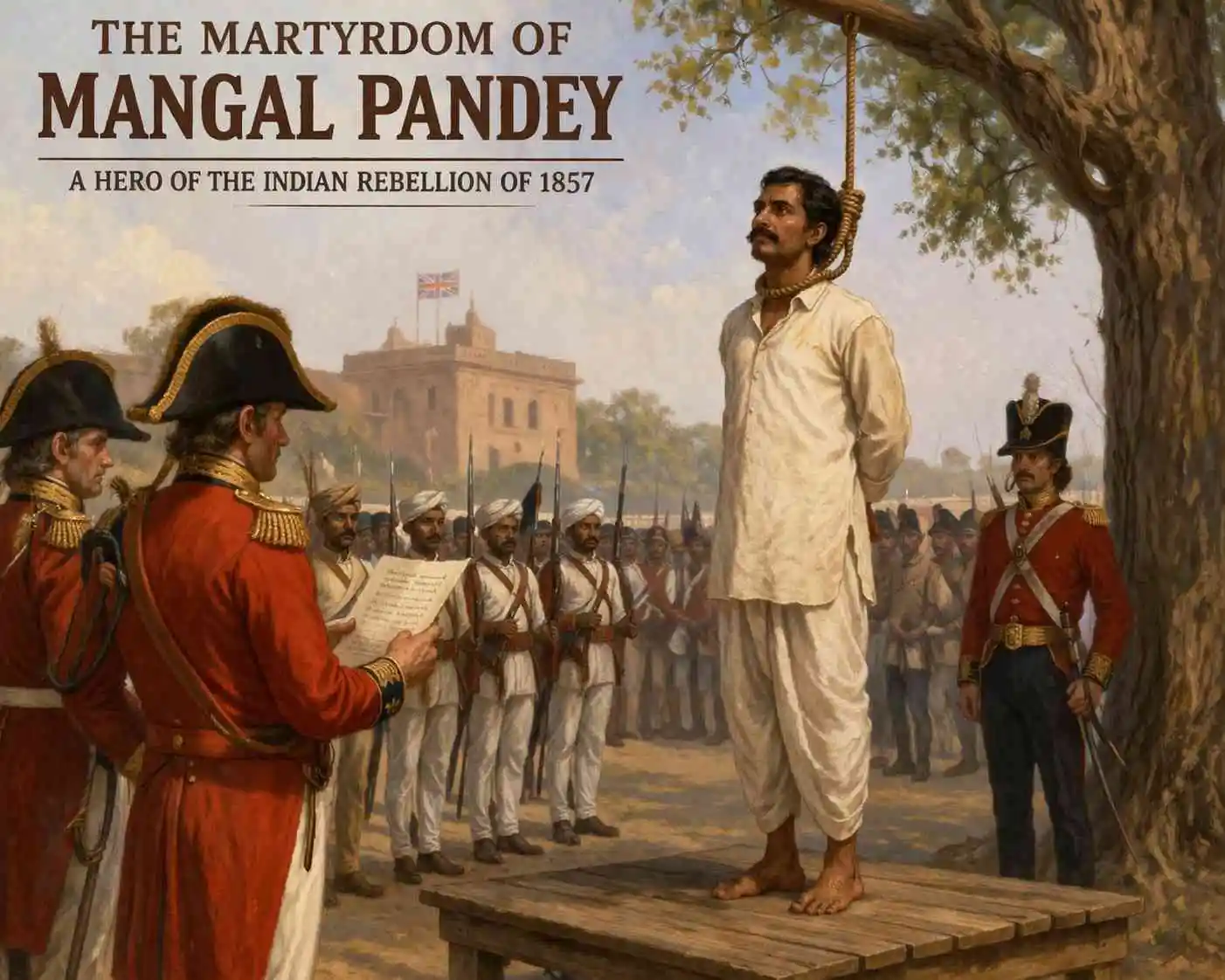
Mangal Pandey is a legendary figure in Indian history, recognized as one of the earliest symbols of resistance against British rule. His courageous actions in 1857 are often seen as the spark that led to the Revolt of 1857, also called India’s First War of Independence. Though his rebellion was brief, its effects were huge, stirring a sense of nationalism and unity among Indians from various regions and communities.
During a time when the British East India Company had unchecked control over India's political, economic, and military life, Mangal Pandey stood against injustice and foreign rule. His actions not only challenged the authority of the colonial rulers but also the fear that silenced many Indians. Today, he is remembered not just as a soldier but as a revolutionary whose bravery laid the groundwork for India’s long fight for freedom.
Early Life of Mangal Pandey
Birth and Family Background
Mangal Pandey was born on 19 July 1827 in a small village called Nagwa in what is now Ballia district, Uttar Pradesh. He came from a Brahmin family that traditionally emphasized education, discipline, and religious beliefs. His upbringing significantly shaped his strong sense of morality and cultural identity.
Growing up in rural India, Mangal Pandey saw firsthand the struggles common people faced under British economic policies. Heavy taxes, exploitation of farmers, and neglect of Indian customs created widespread resentment.
Education and Early Influences
While details about his formal education are scarce, it is believed Mangal Pandey received basic traditional schooling. He was deeply influenced by Hindu values and held strong beliefs regarding purity, faith, and honor. These beliefs later fueled his opposition to British military practices that disrespected Indian religious traditions.
Mangal Pandey's Entry into the British Army
Joining the East India Company’s Army
In 1849, Mangal Pandey joined the British East India Company’s army as a sepoy (infantry soldier). He became part of the 34th Bengal Native Infantry, one of the main regiments mainly made up of Indian soldiers led by British officers.
For many Indians, serving in the military offered stable pay and social respect. However, even with their vital role in upholding British control, Indian soldiers were treated as inferior to their British peers.
Discrimination and Growing Discontent
Indian sepoys dealt with racial discrimination, unequal pay, limited chances for promotion, and harsh discipline. British officers often showed little respect for Indian traditions and religious practices. Over time, these injustices led to deep dissatisfaction within the native army.
Mangal Pandey, like many others, became increasingly aware of the exploitative nature of British rule and the humiliation faced by Indian soldiers.
Causes Behind Mangal Pandey’s Revolt
The Greased Cartridge Controversy
The immediate cause of Mangal Pandey’s rebellion was the introduction of the Enfield rifle in the British army. The cartridges for this rifle were rumored to be greased with fat from cows and pigs.
For Hindus, the cow is sacred.
For Muslims, the pig is forbidden.
To use the rifle, soldiers had to bite off the cartridge, which violated their religious beliefs. This act was seen as not just insensitive but as a deliberate attempt to undermine Indian religions and convert soldiers to Christianity.
Loss of Trust in British Intentions
Although British officials denied using animal fat, their insincere response to concerns increased suspicion. This incident became symbolic of the general disregard colonial rulers showed toward Indian culture.
Mangal Pandey viewed this as an attack on faith and identity. His anger echoed the collective frustration of thousands of sepoys.
The Historic Act of Defiance in 1857
Events at Barrackpore
On 29 March 1857, at the Barrackpore cantonment near Calcutta, Mangal Pandey revolted against British authority. He attacked British officers and urged his fellow soldiers to rise up against colonial rule.
This act was unprecedented for that time. An open rebellion by a sepoy directly challenged the East India Company’s authority and inspired others to question their loyalty to British rulers.
Reaction of Fellow Soldiers
Though many soldiers felt sympathy for Mangal Pandey, fear and uncertainty hindered immediate large-scale support. Still, his bravery sent a strong message across military units and civilian populations.
His defiance marked a key moment, showing that resistance was possible.
Arrest, Trial, and Execution
Capture and Court Martial
After the incident, Mangal Pandey was arrested by British authorities. He faced a swift court-martial on charges of mutiny and violence against British officers.
The trial was quick and intended to make an example. British officials feared that delaying the punishment might spark further rebellion in the army.
Execution and Martyrdom
Mangal Pandey was executed by hanging on 8 April 1857. He faced death with remarkable courage, refusing to apologize or show regret for his actions.
His execution turned him from a rebel sepoy into a martyr for the freedom cause. News of his sacrifice spread quickly, igniting revolts across northern and central India.
Role of Mangal Pandey in the Revolt of 1857
Catalyst for a Nationwide Uprising
Although the Revolt of 1857 had various causes and leaders, Mangal Pandey’s actions sparked widespread resistance. Within months of his execution, revolts broke out in Meerut, Delhi, Kanpur, Jhansi, and other areas.
Indian soldiers, landlords, peasants, and rulers joined the uprising, challenging British dominance on an unprecedented scale.
Symbol of Unity and Resistance
Mangal Pandey became a symbol of unity across religious and regional lines. His protest against religious disrespect resonated with both Hindu and Muslim groups, strengthening collective resistance.
British Perspective on Mangal Pandey
Colonial Interpretation
Initially, British historians depicted Mangal Pandey as a misguided soldier swayed by rumors and fanaticism. This narrative aimed to minimize the political significance of his actions.
By labeling him as an isolated rebel, colonial authorities sought to deny the widespread dissatisfaction with British rule.
Reassessment by Modern Historians
Today, scholars view Mangal Pandey as a conscious and brave resistor. His actions are now seen as part of a greater resistance rooted in economic exploitation, cultural disrespect, and political oppression.
Mangal Pandey in Indian National Consciousness
Recognition After Independence
After India gained independence in 1947, Mangal Pandey received recognition as one of the earliest freedom fighters. History textbooks, monuments, and academic research began to honor his contribution to the freedom struggle.
He is now remembered as a pioneer who challenged colonial rule before organized nationalism fully emerged.
Representation in Literature and Cinema
Mangal Pandey’s life has inspired books, plays, and films. These portrayals have helped share his story with younger generations and reinforced his status as a national hero.
Popular culture has played an essential role in transforming him from a historical figure into a symbol of patriotism and sacrifice.
Values and Ideals Represented by Mangal Pandey
Courage and Moral Conviction
Mangal Pandey’s greatest legacy lies in his moral courage. He chose to stand for his beliefs despite knowing the possible consequences. His actions show the power of individual resistance against injustice.
Nationalism Before Its Time
Long before political parties or mass movements emerged, Mangal Pandey displayed a sense of nationalism rooted in dignity, faith, and self-respect.
His revolt laid the emotional and ideological groundwork for later freedom movements led by prominent leaders.
Comparison with Other Freedom Fighters
While later freedom fighters embraced mass movements, non-violence, or political negotiation, Mangal Pandey’s resistance was direct and military-focused.
Despite differences in methods, all freedom fighters shared a common goal: liberation from colonial rule. Mangal Pandey’s sacrifice represents the earlier phase of this long and complex struggle.
Historical Importance of Mangal Pandey
Mangal Pandey’s contribution to Indian history goes beyond the events of 1857. He symbolizes the awakening of political consciousness among Indians and the realization that colonial rule could be challenged.
His legacy serves as a reminder that the freedom struggle was not the result of a single movement but a continuous process shaped by countless sacrifices.
Conclusion
Mangal Pandey remains one of the strongest symbols of India’s early resistance against British colonialism. His fearless act of defiance in 1857 transformed him into a martyr whose sacrifice sparked a nationwide uprising and changed the course of Indian history.
Though his life was short, his impact was enduring. Mangal Pandey’s courage, conviction, and willingness to sacrifice for dignity and faith continue to inspire generations. He shows that the fight for freedom often starts with one voice refusing to stay silent.
Understanding Mangal Pandey's story is essential to grasp the roots of India’s freedom struggle and the lasting spirit of resistance that ultimately led to independence.
Click below to generate summary